
Red horse and red-clad crowned soldier make Le Breton and Jarrault’s 1863 Berith a nearly monochrome counterpart to the separate sign at Ars Goetia 28.
- 1863 headword
- Berith
- Ars Goetia
- No. 28 · Duke
- Legions
- Dictionnaire 26 · Goetia 26
What Collin de Plancy’s Berith entry says
Berith appears as a terrible duke known by several names, including Béal, Bérith, and Bolfri. He is a young soldier dressed entirely in red, mounted on a red horse, and crowned. He answers about time but is frequently deceitful, changes metals to gold, grants dignities, refines a singer’s voice, and commands twenty-six legions. Collin de Plancy then adds ancient identifications and a long Petit Albert story about an invisible household helper tending a clock and horses.
The article expands in concentric circles. A compact Weyer-like spirit record leads to religious name comparison, then to a domestic folktale, then to rival explanations of the helper as mandrake or sylph. The effect is analytical: one headword gathers entities that may share a name without proving they are one being.
Reading Louis Le Breton’s 1863 portrait
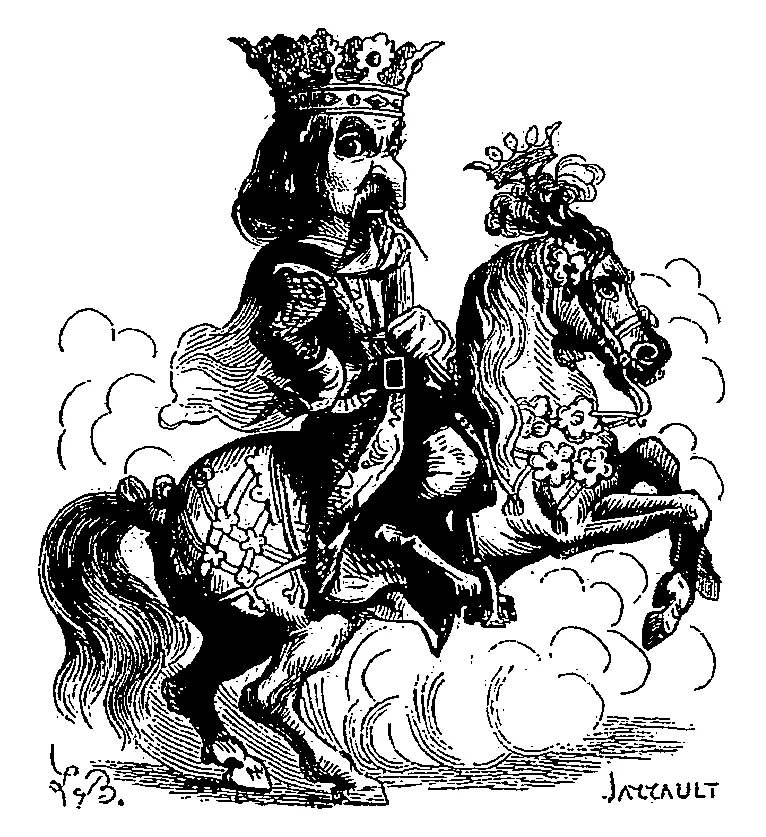
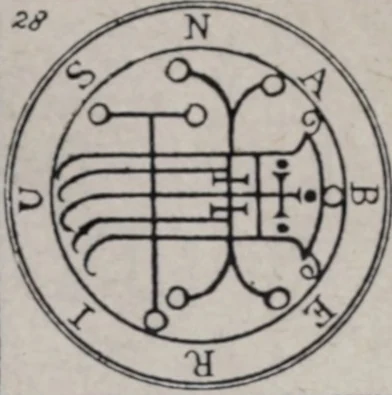
Le Breton makes color legible in monochrome through tone and costume. A crowned soldier sits rigidly on a richly shaded horse, with armor, cloak, and military bearing distinguishing him from civilian riders elsewhere in the series. The red-on-red description cannot survive literally in black ink, so pattern and contrast carry the rank.
The portrait chooses the catalogue soldier and ignores the later invisible household helper. Berith’s Goetia seal is another selection from the same broad reception: an abstract sign beside entry 28. Neither image encompasses the dictionary’s argument about names and folklore.
Berith and Ars Goetia spirit 28
The Goetia retains the red soldier, red horse, gold crown, time knowledge, alchemy, dignities, deceptive speech, variant names, and twenty-six legions. The shared core is unusually detailed and gives the engraving a precise verbal base.
The Dictionnaire adds a clear singing voice, ancient cult identifications, and the Petit Albert anecdote. The Goetia says the answers are true when the spirit is properly constrained and lists later name variants with different spellings. The French article is a reception dossier; the Goetia remains a catalogue operation.
Worked comparison: one name, two kinds of figure
Divide the Dictionnaire entry at the point where the Petit Albert story begins. Before it stands a visible crowned soldier with rank, offices, and legions. After it comes an unseen helper operating tools in a stable and clock room. Le Breton illustrates the first figure only. Treating the anecdote as another pose of the soldier would erase the article’s uncertainty about whether the entities are the same.
The worked split shows how an alphabetical dictionary can preserve association without identity. The Goetia seal and the 1863 portrait both point back to the catalogue Berith, while the domestic story documents how the name traveled into another genre.