
Grimorium Verum, the “True Grimoire,” survives as a short French printed book with a dramatic Solomonic title, a Memphis imprint dated 1517, and a named spirit hierarchy. The surviving book and related manuscripts frame this account instead of a verified origin story taken from the title page.
Explore the reading room
The evidence at a glance
A 69-page British Library copy can be read through the Google Books scan. Its title attributes the work to Solomonic keys, calls Plaingière its translator from Hebrew, names Alibeck the Egyptian, and gives Memphis, 1517. Each assertion belongs to the printed title. Peterson’s edition quotes a British Library description that retains the 1517 imprint and supplies [1817] in brackets. The two numbers must not be silently substituted for one another: one belongs to the print’s presentation, while the other is a later cataloguing judgment reported through an editor.
| Witness | What is documented | What it cannot prove alone |
|---|---|---|
| Alibeck print, BL 8632.aa.5 | Printed Memphis, 1517 claim; 69-page copy | Actual publication in Memphis in 1517 |
| British Library description quoted by Peterson | Supplied date shown as [1817] | An exact first composition date |
| Wellcome MS.983 | Related French pseudo-Solomonic manuscript, c. 1709 | Identity with the later Alibeck print |
| Wellcome MS.4667 | French Solomonic manuscript milieu, mid-eighteenth century | A direct Verum copy or ancestor |
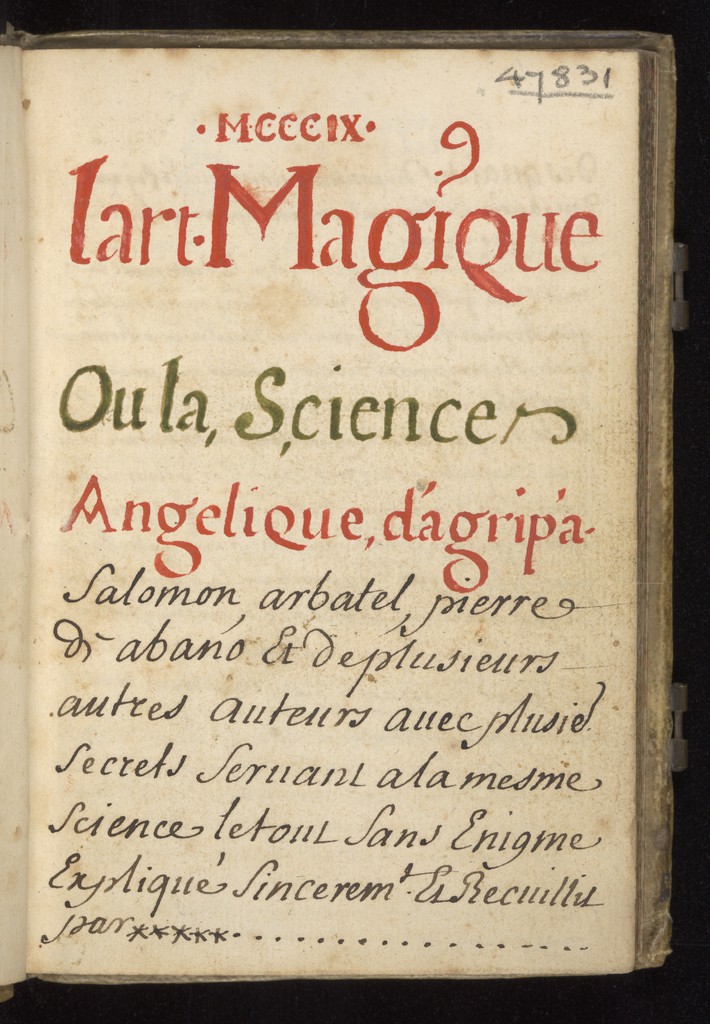
Wellcome’s L’art Magique MS.983 is catalogued to about 1709 and contains a related pseudo-Solomonic grimoire along with other tracts. It preserves an earlier French manuscript setting in a distinct physical object. Wellcome MS.4667 records more French Solomonic material from the mid-eighteenth century. Neither catalogue calls its item an Alibeck printing. The image below gives this older manuscript family a material presence while preserving that distinction.
Three views of the surviving tradition
The edition-history article separates the claimed 1517 imprint from the supplied later date. The structure guide traces the book’s three-part promise, major spirit names, Syrach group, and restored seals. The comparison guide sets Grimorium Verum beside the Ars Goetia without combining their lists. Modern edited translations and redrawn figures add later editorial layers.
A printed assertion, an institutional manuscript description, and a modern comparative edition preserve different kinds of evidence. Seals and spirit names can change between witnesses, and an online image may derive from a different version than its surrounding text. The lists look definitive only until the surviving witnesses are set beside one another.
Source records
- Google Books record and scan of the 69-page British Library copy ↗
- Joseph H. Peterson, Grimorium Verum edition and British Library shelfmark transcription ↗
- Wellcome Collection, L’art Magique, MS.983 (c. 1709) ↗
- Wellcome Collection, Pseudo-Solomon, MS.4667 (mid-eighteenth century) ↗
- Wellcome Collection catalogue record for Aaman Lamba’s 2024 study of MS.983 ↗
Historical and bibliographic commentary. Described ritual results are claims in the sources, not verified effects.