
Grimorium Verum is more than a demon-name list. Its introduction presents three parts, and its spirit hierarchy needs to be read with the material arrangements and variant figures that surround it.
- Format
- 69-page French print
- Superior names
- Lucifer, Béelzébuth, Astaroth
- Syrach group
- Eighteen named spirits
A book arranged for several kinds of material
The opening of the British Library print describes a first part concerned with spirit characters and forms of address, a second with purported natural and supernatural secrets, and a third with what it calls the key to the work. The language of the title is Latin while much of the book is French. Its structure matters because a visitor who searches only for the “Grimorium Verum demons” will miss pages of preparation, signs, prayers, and miscellaneous short experiments. The historical text makes claims about what those actions would accomplish; a catalogue of claims is not evidence that they work.
Book divisions also tell us something about the marketing of compact grimoires. A short print can promise an entire system by joining a prestigious Solomonic attribution, a named hierarchy, instruments, and practical secrets. None of those features proves an actual Solomonic author or a single unchanged ancient source. The three-part program is best read as the publisher’s presentation of a particular compilation.
Three superiors and the Syrach sequence
The printed spirit material gives prominence to Lucifer, Béelzébuth, and Astaroth, and then proceeds through subordinate names. Duke Syrach is connected with a set of eighteen spirits beginning with Claunech and Musisin. Spellings vary in manuscript and print: the same place in an ordered sequence can carry a slightly different form. This is one reason an online list that modernizes names without naming its witness is difficult to use as historical evidence.
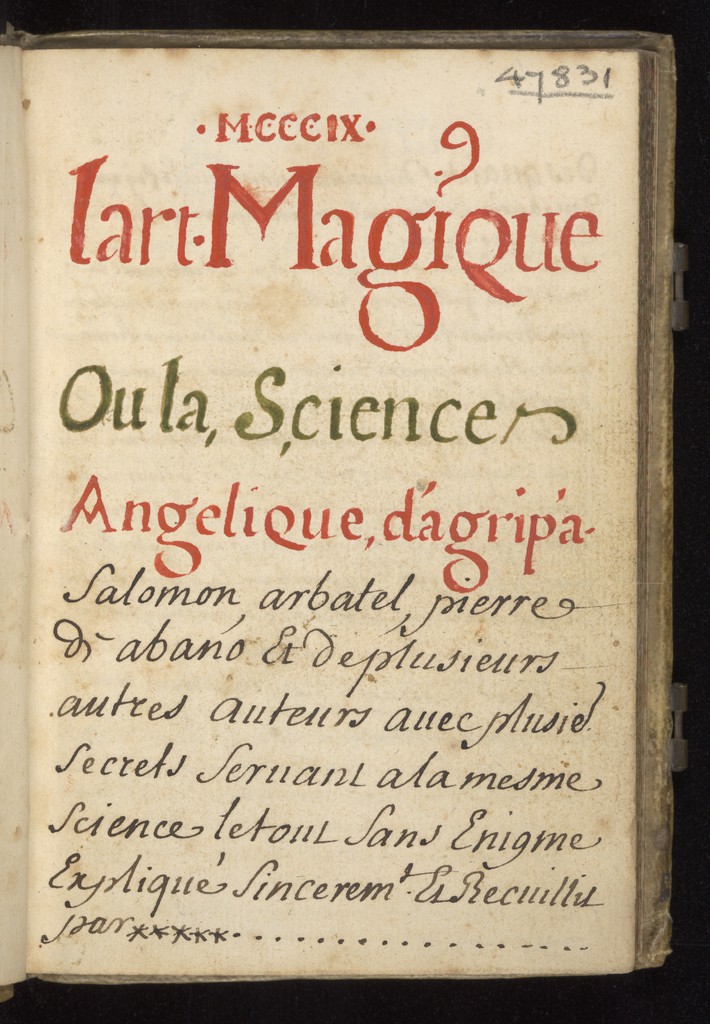
A reader can compare the printed source with Wellcome MS.983’s related pseudo-Solomonic tract. Both organize a hierarchy and include drawn characters, but that shared architecture does not make the surviving artifacts identical. MS.983 is a hand-copied volume with coloured figures; the Alibeck item is a small printed book. One can ask which names, ranks, and figures correspond, which move, and which disappear. The answers depend on exactly which leaf or print impression is being examined.
How seal variants reveal different witnesses
Peterson’s edited presentation warns that figures missing from the Alibeck copy have sometimes been supplied from other grimoires or earlier related manuscripts. A clear modern drawing beside a name may therefore document an editorial reconstruction rather than a line actually present in that print. The figures in Wellcome MS.983 and the British Library Alibeck printing belong to different objects. Neither can stand as a universal Grimorium Verum seal sheet.
The coloured MS.983 title leaf shown here is evidence of a related manuscript’s visual character, not a plate of all eighteen Syrach spirits. The external scans preserve different material objects, while modern translations and restored figures reflect later editorial work. A name or sign can therefore have several dated forms without any one redrawing functioning as a timeless original.
Worked reading: hierarchy becomes a ritual sequence
Read the hierarchy as a routing system rather than a list. The text first names Lucifer, Béelzébuth, and Astaroth as three superior powers, assigns two immediate subordinates to each, and then places eighteen purpose-specific spirits under Syrach. Claunech, first in that eighteen-name sequence, is associated with wealth; Bechaud with winds and storms; Surgat with opening locks. Rank and office do different jobs. The superior names organize command, while the Syrach group routes a narrowly described request to a named subordinate.
The later ritual pages convert that map into sequence. They move through preparation of implements and writing materials, purification by water and fumigation, an invocation to the intermediary Scirlin, separate conjurations of the three superiors, conjuration of lower spirits, and dismissal. The promise of “secrets” comes only after this machinery has been established. Reading the book this way explains why a detached seal sheet is incomplete: the characters identify positions inside a chain of preparation, address, constraint, and release, and several links in that chain vary or disappear between the Alibeck print and related manuscripts.
The Memphis 1517 date and Solomonic attribution are printed claims. The supplied [1817] date and manuscript dates are later catalogue judgments about different objects.
Source records and editions
- Google Books record and scan of the 69-page British Library copy ↗
- Joseph H. Peterson, Grimorium Verum edition and British Library shelfmark transcription ↗
- Joseph H. Peterson, French-text witness notes and variant figures ↗
- Wellcome Collection, L’art Magique, MS.983 (c. 1709) ↗
- Wellcome Collection catalogue record for Aaman Lamba’s 2024 study of MS.983 ↗
Continue reading
← Grimorium Verum overview · Short occult-library guide · Ars Goetia directory