
“Enochian” is a later umbrella name for material that John Dee and Edward Kelley recorded during their claimed angelic conversations in the 1580s. The surviving evidence is more varied than a single alphabet or set of tablets. It includes dated conference notes, grids of letters, forty-eight Angelical Keys, books of names, objects, a seventeenth-century printed selection, and later occult adaptations. This guide begins with the identifiable record behind each claim.
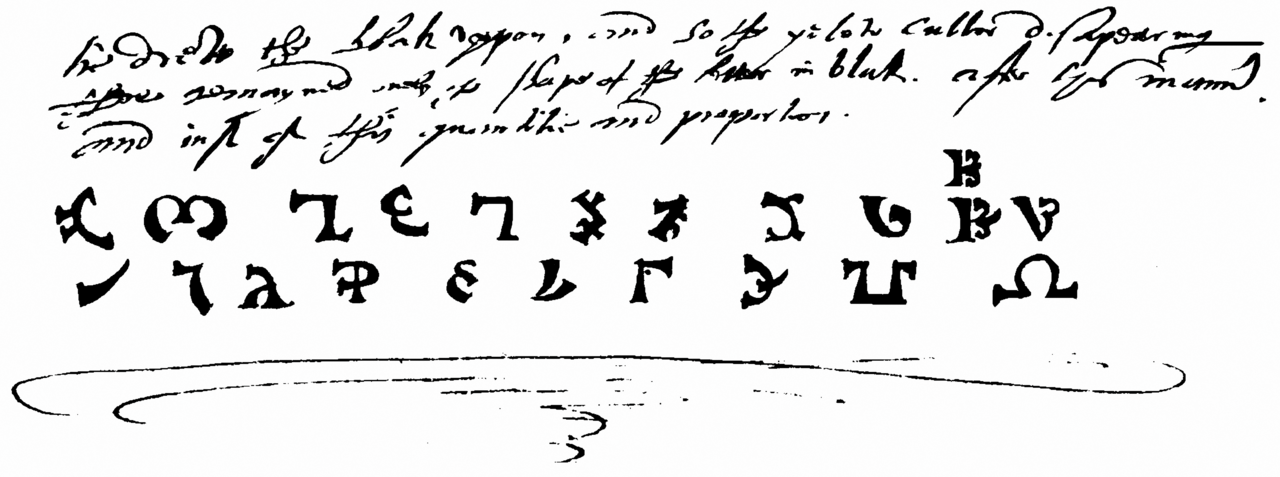
What does “Enochian” mean?
Dee’s notes refer to an Angelical language and to a “Book of Enoch.” Modern readers often use “Enochian” for both the language and a broad family of associated practices. That modern convenience can conceal differences within the record. A letter drawn in an early diary, a square in Liber Logaeth, a Key copied into Dee’s ceremonial book, and a colored watchtower in a later order paper belong to different dates and stages of the tradition.
Dee was an Elizabethan scholar concerned with mathematics, astronomy, religion, and natural philosophy. Kelley acted as a scryer in many of the recorded sessions. Their reports describe communication with angels; a dated manuscript establishes that a report was written and transmitted, while the claimed origin remains a claim in the text. For a first orientation, read the language and naming guide alongside the Dee and Kelley biography.
The surviving books and the 1659 print
The British Library catalogues three central Sloane volumes separately. Sloane MS 3188 preserves early conferences dated 1581–83; MS 3189 is associated with Liber Logaeth and its letter grids; MS 3191 contains Dee’s Angelical Keys, Liber Scientiae, and Heptarchia Mystica in distinct folio ranges. The works occupy different folios and preserve different phases of Dee’s project.
Early conference records and the dated alphabet detail. Read the manuscript guide →
Liber Logaeth, a separate book with large letter grids. Explore Liber Logaeth →
Keys, earthly knowledge, and seven-planet notes in different sections. Find the Keys →
A selected and framed printed witness, not a facsimile of all Dee’s books. Compare the edition →
Explore the Enochian collection
Choose a route by the question you want to answer. The manuscript archive deals with particular witnesses and editions; the reference guides explain terms and counts; the questions section compares frequent claims. The Aethyr index is a focused path through one named sequence, while the named-figures guide follows Nalvage, Madimi, and a reported circular table to dated passages.
A short chronology of the evidence
- 1580s · Recorded conferences. Dee and Kelley described messages, names, letters, and instructions over a series of sessions. The notebooks are a developing record, not a finished handbook written in one sitting.
- 1583–85 · Books and tables. Liber Logaeth, the Angelical Keys, Liber Scientiae, and the materials later discussed as the Great Table belong to related but distinguishable documentary groups. See the Great Table source comparison.
- 1659 · A printed selection. Meric Casaubon’s A True & Faithful Relation brought parts of the conversations into print with his own editorial preface and purpose. A printed plate may document how a design circulated without being an image of the original object.
- Late nineteenth and early twentieth centuries · Adaptation. Golden Dawn papers reorganized Dee material for an elemental curriculum. Crowley’s Liber Chanokh is another later presentation. Read the Golden Dawn reception guide and Crowley edition guide as reception history.
Letters, Calls, Aethyrs, and ritual objects
The Angelical alphabet is visually striking, but the surviving folio is not a pronunciation key. Modern transliterations and spoken conventions require a stated edition or method. The language tools provide a source-bounded phrase concordance, a transparent letter-name transliterator, and a worked grammar analysis. The pronunciation guide identifies where later speaking habits enter the picture.
The forty-eight Keys and nineteen Calls guide unpacks two counts that are often presented as a contradiction. The Aethyrs and earthly parts guide keeps those named sequences distinct. The thirty Aethyrs index provides a compact route through the Aethyr names. None of those counts by itself establishes a ritual result.
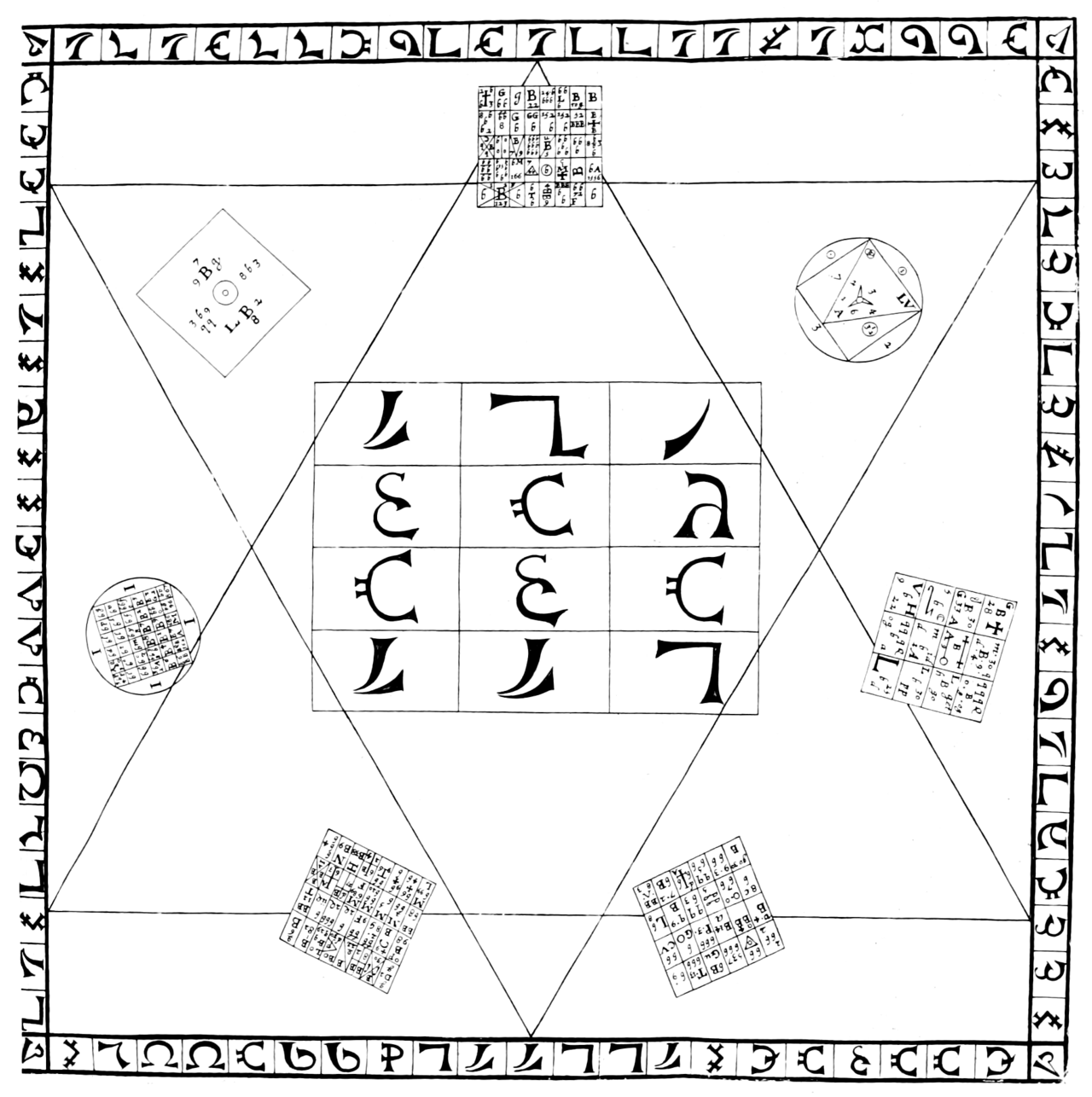
The table, wax discs, and scrying objects have their own histories. The Sigillum Dei Aemeth and wax discs page starts with surviving material and catalogues. The obsidian mirror page addresses the object’s later ownership and study. These objects should not be merged into one reconstructed “Enochian ritual” without stating which source gives each detail.
Three questions readers often ask
Is Enochian the language of the ancient Book of Enoch?
The shared name is not a shared textual identity. Dee’s sixteenth-century Book of Enoch or Liber Logaeth is a different object from the ancient Enochic writings preserved in Aramaic fragments and an Ethiopic tradition. The Book of Enoch comparison traces the naming issue.
Are the Heptarchia and Watchtowers the same system?
No single surviving folio turns those labels into interchangeable terms. MS 3191 includes Dee’s seven-planet Heptarchia Mystica; the later Watchtower curriculum has a different arrangement and reception history. The Heptarchia and tablets guide sets out the relationship with the manuscript divisions visible.
Can a modern chart be called Dee’s original?
A redrawing may follow a 1580s record, Casaubon’s engraving, an Ashmole copy, or a Golden Dawn paper. The diagram variants guide compares those layers directly. Visual similarity alone does not establish date or authorship.