
- Earliest episode
- June 1584, in Dee’s conference record
- Later revision
- 1587, usually called Tabula Recensa
- Printed reception
- Casaubon 1659; The Equinox 1912
What is the Great Table?
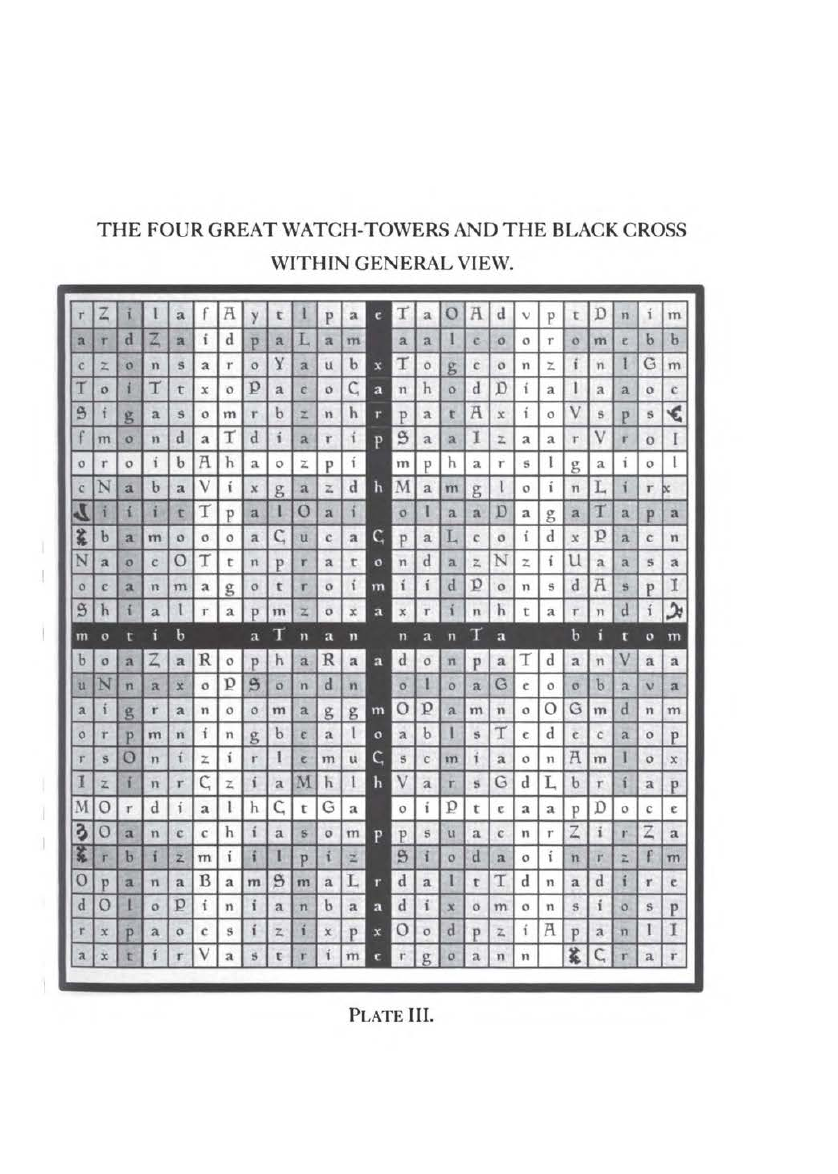
The phrase names a composite grid of Angelical letters. The four component tables are often called Watchtowers. In accounts of the 1584 delivery, each component has twelve columns and thirteen rows. A cross of letters joins the four at their inner edges. Colors, directions, elements, and ritual instructions in modern renderings belong to additional historical layers rather than to the grid alone.
The British Library catalogues the relevant 1583–1587 conference diaries as Cotton MS Appendix XLVI. It separately catalogues Sloane MS 3191, a manuscript in Dee’s hand containing the Keys and Liber Scientiae. These records overlap in subject but are not a single book. A diary statement, a working-manuscript diagram, and a later published plate are three distinct forms of evidence preserved in different witnesses and periods.
Why are there different Great Tables?
Dee’s 1584 arrangement and a revision reported in 1587 are not identical. The later form is usually labeled Tabula Recensa, or Reformed Table. A site that silently combines cells from both is not displaying a historical page as it stood. Casaubon’s 1659 Relation printed parts of Dee’s conferences after Dee’s death and adds another stage of selection, layout, and possible transcription or printing error.
Crowley’s 1912 Equinox issue reproduced general and individual Watch-Tower plates. Those plates document early twentieth-century occult reception rather than Dee’s original manuscript, and they cannot settle an uncertain sixteenth-century letter.
The table across four dated witnesses
The 1584 Watchtower account establishes the four-part structure and its central cross. The 1587 reform changes parts of the letter arrangement. Casaubon’s 1659 Relation presents Dee’s record in print, and the 1912 Equinox plates show a later directional and ceremonial setting. These witnesses preserve related material without offering one unchanged diagram.
Plate III makes the 1912 editorial argument visible: four Watch-Towers form one field because a dark cross binds their inner edges. The issue later prints the cross again as a detached Table of Union. That pair of views teaches both an integrated whole and a separately usable central tablet. It preserves the broad four-plus-center relationship while adding a polished visual hierarchy absent from a catalogue description of Dee’s manuscript.
The historical documents report conversations with beings described as angels. The manuscripts and editions preserve those reports; their account of spiritual origin remains a claim within the records. The changes in the table’s arrangement can be traced through the dated copies and printed versions.
Worked reading: MPH ARSL GAIOL turns a quadrant into a reading system
A close case begins with the three groups printed in The Equinox I:7 for the central line of the later Water tablet: MPH, ARSL, GAIOL. The groups have three, four, and five letters. On the page they are not decorative captions placed beside a grid. The text says that the line gives three holy names and then uses the tablet’s other cross-lines to derive six seven-letter senior names. A reader moves through a prescribed line, divides its letters into unequal groups, and then reads further paths outward from the center. The table is operating as a spatial text.
That reading rule explains why the central cross matters to the composite. Four 12-by-13 quadrants alone would be four blocks of letters. The named lines and joining structure tell a later interpreter where a sequence begins, how it is divided, and which other lines intersect it. In The Equinox presentation, GAIOL therefore identifies more than one five-letter word. It anchors the Water tablet’s central spine within an early twentieth-century ceremonial explanation that also names a king, seniors, and lesser crosses.
The exact spelling also reveals the cost of choosing an edition. Burns and Moore report that Sloane MS 3191 preserves OL and CH alternatives at the end of this name, so the same passage can be read as GAIOL or GAICH. Their modern rectification favors GAICH because C and H continue the governor name VIROCHI through the crossing. The Equinox prints GAIOL. Neither choice can be inferred merely from the table’s fourfold shape; the letter sequence depends on which witness and editorial rule controls the square.
This example distinguishes three historical layers. The Great Table’s joined quadrants supply the underlying field. Sloane MS 3191 preserves Dee’s working arrangement and its unresolved letter alternatives. The 1912 prose supplies a later, explicit route through that field and selects one spelling. The close reading does not prove the supernatural claims attached to the names. It shows how the table converts geometry into ordered language, and why a diagram without its reading rules is only part of the evidence.
Sources
- British Library, Cotton MS Appendix XLVI catalogue ↗The surviving conference record, dated 1583–1587, containing the 1584 and 1587 episodes.
- British Library, Sloane MS 3191 catalogue ↗Dee’s handwritten Keys and Liber Scientiae; a separate object from the conference diary.
- Wellcome Collection, Casaubon, A True and Faithful Relation (1659) ↗Digitised public-domain printed edition; a seventeenth-century edited witness, not the autograph.
- The Equinox I:7 (1912), original issue scan ↗Printed Plates III–VIII: a general view, four directional Watch-Towers, and the detached Black Cross or Table of Union, all listed facing printed page 234.
- Burns and Moore, John Dee and Edward Kelley’s Great Table ↗Modern comparative analysis of the 1584 delivery and 1587 changes; used to frame, not replace, primary witnesses.
- Burns and Moore, Great Table, Part II ↗Discussion of the Black Cross, textual variants, and later attributions.