
The familiar seventy-two names are an address system for a later Goetia catalogue. Earlier printed witnesses preserve many of the same names in a different order. This selective crosswalk makes ten changes visible without pretending that a name, number, spelling, and seal have one timeless form.
Selected name crosswalk
| Weyer · 1577 | Scot · 1584 inventory | Goetia · later list | What changes |
|---|---|---|---|
| 1 · Baël | Baell | 1 · Bael | Opening king in all three catalogues. |
| 2 · Agares | Agares | 2 · Agares | The second position remains stable. |
| 3 · Marbas | Marbas | 5 · Marbas | The later Goetia places him after Vassago and Samigina. |
| 4 · Pruflas | No entry | No entry | The visible omission; no Goetia seal is assigned to this Weyer entry. |
| No entry | No entry | 3 · Vassago | Present in the later Goetia, not in these two earlier printed lists. |
| 22 · Paymon | Paimon | 9 · Paimon | A large move in sequence despite a recognizable name. |
| 23 · Belial | Beliall | 68 · Belial | The position shift shows why a number needs its edition label. |
| No entry | No entry | 70 · Seere | One of the three names closing the Goetia list. |
| No entry | No entry | 71 · Dantalion | One of the three names closing the Goetia list. |
| No entry | No entry | 72 · Andromalius | Final entry of the Goetia catalogue. |
Scroll the table sideways to see all four columns.
Bael and Agares keep their first two positions. Marbas shifts from Weyer’s third to the Goetia’s fifth after Vassago and Samigina enter the later opening run. Paimon moves from Weyer’s twenty-second to the Goetia’s ninth; Belial moves from twenty-third to sixty-eighth. These are bibliographic facts about list positions. They cannot establish that one manuscript copied another directly, and they should not be used to infer a ritual sequence.
Pruflas is the opposite sort of diagnostic. Weyer lists him fourth, after Marbas, while Scot’s inventory moves directly onward without an entry and the later Goetia also lacks one. Vassago and the three spirits placed at the Goetia’s end are absent as entries from Weyer and Scot. The familiar count comparison; 69 in Weyer, 68 in Nicholson’s count of Scot’s inventory, and 72 in the later Goetia; follows from these list differences, but does not explain every wording or order change.
Read the witness studies
What the list differences show
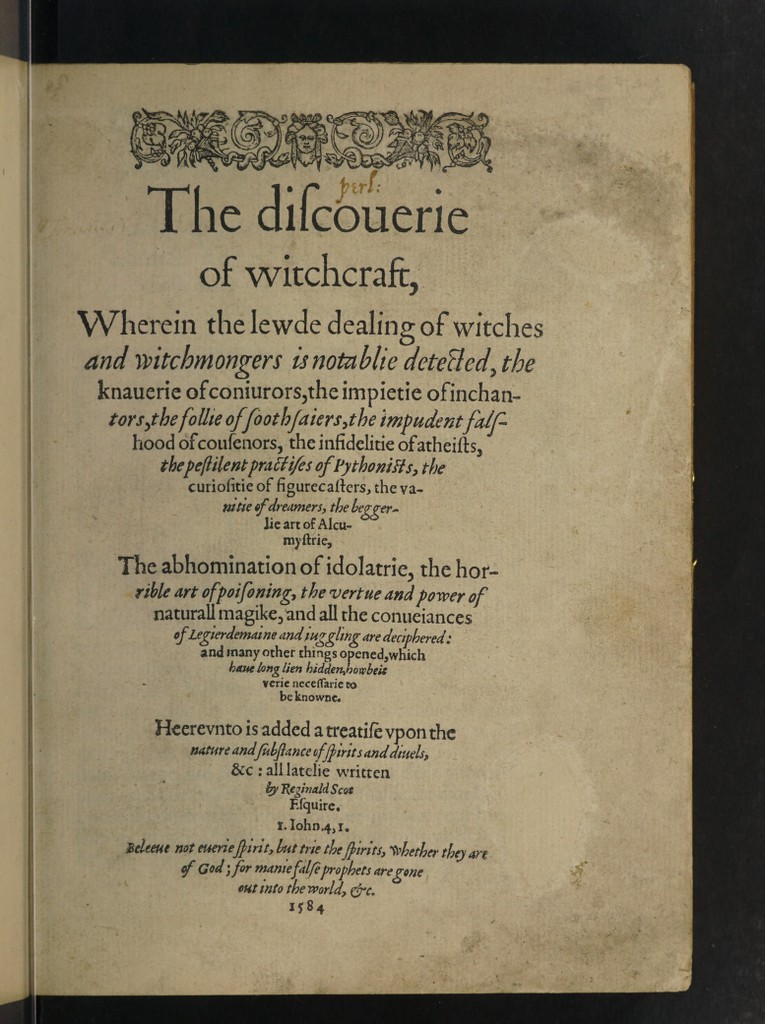
Weyer’s 1577 appendix, Scot’s 1584 inventory, and the later Goetia are related lists, not three printings of an unchanged table. Weyer has 69 entries; Nicholson counted 68 names in Scot’s following inventory; the later Goetia has 72 numbered spirits. The gap reflects additions, omissions, and rearrangements, while wording and seals can vary within a name as well.
The crosswalk shows ten examples of those changes. It cannot establish a single direct copying path between every witness. The Goetia profiles elsewhere on the site follow the 1904 printed order, with seal images from a separate 1916 plate; the illustrated and textual forms represent different printings of the later catalogue.
Source records
- Indiana University, catalogue record for the 1577 fifth edition ↗
- Weyer, De praestigiis daemonum, fifth edition (1577), digitized volume ↗
- Scot, The Discoverie of Witchcraft (1584), 1886 annotated reprint, Book XV, chapters 1–2 ↗
- Wellcome Collection, 1584 Scot copy and Public Domain Mark ↗
- Mathers/Crowley, The Book of the Goetia of Solomon the King (1904), numbered catalogue ↗
- The Lesser Key of Solomon, 1916 edition, Project Gutenberg ebook 72679 ↗
- Joseph H. Peterson, modern Weyer/Scot/Goetia comparison (copyrighted edition; link only) ↗