
Sigil of Vassago
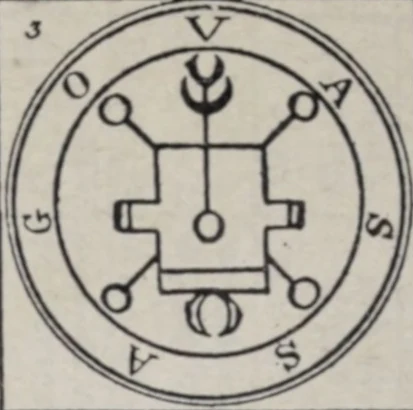
At a glance
- Entry
- 3 of 72
- Rank
- Prince
- Legions
- 26 in the text
Description in the text
Vassago is characterized as having a good nature and being akin to Agares. The text assigns him knowledge of past and future events and the discovery of concealed or lost things.
Read entry 3 on page 22 of the 1916 edition
Appearance
The passage gives no detailed visible form.
Topics attributed to this entry
- Past and future
- Lost things
Reading this entry
Vassago’s short entry identifies him as a prince of the same nature as Agares and, unusually for this catalogue, calls him good in nature. He is credited with declaring past and future things and locating what is hidden or lost. Unlike many neighboring entries, the passage does not supply a visual form, voice, clothing, or mount. A depiction of Vassago with specific animal features would therefore need another source, not this numbered description.
The link to Agares is left unexplained; it need not mean that their appearances or every attributed office are identical. The text moves directly from that comparison to Vassago’s knowledge and then to his 26 legions and seal. That brevity is informative in its own right: the Goetia does not give every spirit the same amount or kind of detail.
Read entry 3 on page 22 of the 1916 edition or compare the 1904 transcription.
A closer reading of entry 3
What the numbered text says
“Good Nature” is an assessment made by this particular passage, not a moral classification for the whole catalogue. Vassago’s entry is also unusually selective: it names past and future knowledge and the recovery of hidden or lost things, but says nothing about present events. Nor does it supply an appearance. Both omissions matter when comparing modern descriptions with the numbered source.
About the printed seal
Seal 3 survives on the same 1916 plate as its neighboring entries even though the text offers no bodily image. A visible emblem is therefore evidence that the edition assigns Vassago a sign, not evidence for an animal shape or costume.
Compare another entry
Compare entry 11: Gusion. Gusion’s entry explicitly adds the present to past and future and says that he resolves the meaning of questions. Vassago’s much shorter office includes finding things concealed or lost. This prince and duke should not be flattened into a generic divination category.