
Sigil of Gusion
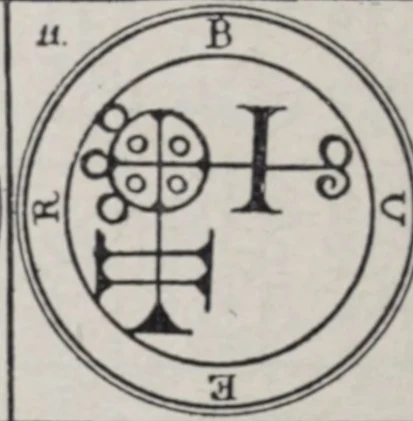
At a glance
- Entry
- 11 of 72
- Rank
- Duke
- Legions
- 40 in the text
Description in the text
Gusion is credited with answering questions about the past, present, and future and clarifying difficult questions. He is also said to reconcile friendships and confer honor or dignity.
Read entry 11 on page 25 of the 1916 edition
Appearance
A form called a “Xenopilus” in the source, without a clear explanation of the term.
Topics attributed to this entry
- Divination
- Reconciliation
- Honor
Reading this entry
Gusion is described as appearing like a “Xenopilus,” a term the passage does not explain. The word should be retained as an uncertainty rather than silently converted into a specific animal, costume, or supernatural species. He is a strong duke whose attributed knowledge spans past, present, and future. More unusually, the text says he resolves the meaning of questions, suggesting an interpretive office as well as simple prediction.
Gusion is also credited with reconciling friendships and conferring honor or dignity. These social outcomes sit alongside the intellectual work of making questions clear. The source does not tell us how these tasks relate, and the unexplained appearance term reminds us how much can be lost between manuscript, printed edition, and modern retelling. His 40 legions and seal are clear enough in the cited passage.
Read entry 11 on page 25 of the 1916 edition or compare the 1904 transcription.
A closer reading of entry 11
What the numbered text says
The source’s “Xenopilus” is an unexplained comparison, so it is more responsible to preserve the word than to turn it into a species or costume. Gusion’s knowledge covers past, present, and future, but the passage goes further: it promises the meaning and resolution of questions. That interpretive task sits beside reconciliation and the granting of honor, with no stated mechanism joining them.
About the printed seal
The 1916 numbered plate supplies seal 11. The drawing does not resolve “Xenopilus”; an uncertain word in the prose remains uncertain after an emblem is reproduced. This distinction is useful wherever an image seems to offer more precision than its accompanying text.
Compare another entry
Compare entry 3: Vassago. Vassago’s entry mentions past and future, then hidden or lost things. Gusion adds the present and question interpretation, plus social standing and friendship. These differences are visible in the primary catalogue even though both can appear under a broad “knowledge” heading.