
Sigil of Vual
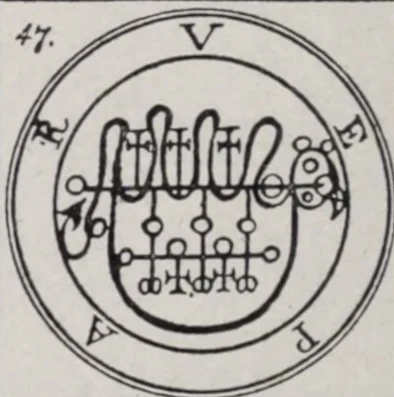
At a glance
- Entry
- 47 of 72
- Rank
- Duke
- Legions
- 37 in the text
- Also written
- Uvall, Voval
Description in the text
Vual is credited with procuring love and reporting past, present, and future events. His entry also assigns him the creation of friendship between friends and enemies.
Read entry 47 on page 37 of the 1916 edition
Appearance
A dromedary that changes into a human figure speaking imperfect Egyptian.
Topics attributed to this entry
- Love
- Divination
- Friendship
Reading this entry
Vual is also printed as Uvall or Voval. He begins as a dromedary, then takes human shape and speaks what the source calls imperfect Egyptian. The passage does not identify a dialect or explain the linguistic judgment, so a modern profile should not invent one. This duke is credited with love, knowledge of past, present, and future, and friendship between friends and foes.
The entry says Vual formerly belonged to the Order of Powers and governs 37 legions. The camel form connects visually with Paimon’s mount, but the texts give them different ranks, entrances, and offices. Vual’s imperfect speech is especially distinctive because language is usually listed as a spirit’s teaching subject; here it characterizes the figure. The seal completes the record in the cited edition.
Read entry 47 on page 37 of the 1916 edition or compare the 1904 transcription.
A closer reading of entry 47
What the numbered text says
The dromedary-to-human change is followed by an imperfect use of Egyptian, a linguistic detail the passage does not translate or explain. Love, knowledge of past and future as well as the present, and friendship across hostile groups form the attributed office. The text also assigns Vual to the order called Potestates or Powers. These name variants and rank terms are part of the source’s vocabulary, not evidence for separate beings.
About the printed seal
Seal 47 appears on frontispiece 5. The printed heading offers Uvall, Vual, and Voval while assigning one number; the plate should therefore be linked to all three spellings. Its lines do not encode the Egyptian speech or dromedary form in the written record.
Compare another entry
Compare entry 33: Gaap. Gaap’s entry also combines a broad time-knowledge claim with love and hatred, but frames him as a guide before four kings and adds rapid travel. Vual instead begins as a dromedary and ends with friendship, leaving the two as separate catalogue portraits.