
Sigil of Gremory
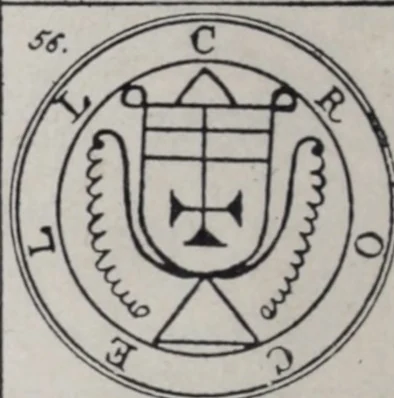
At a glance
- Entry
- 56 of 72
- Rank
- Duke
- Legions
- 26 in the text
- Also written
- Gamori
Description in the text
Gremory is said to tell of past, present, and future events and the location of hidden treasure. The passage also associates her with procuring the love of women.
Read entry 56 on page 40 of the 1916 edition
Appearance
A beautiful woman wearing a duchess’s crown at her waist and riding a camel.
Topics attributed to this entry
- Divination
- Hidden treasure
- Love
Reading this entry
Gremory, or Gamori, appears as a beautiful woman riding a large camel, with a duchess’s crown tied around her waist rather than worn on her head. The duke is credited with speaking about past, present, and future, identifying hidden treasures and their location, and producing love in women of different ages. The crown placement and camel are unusual visual particulars worth preserving in a historical description.
The passage gives no other form or explanation for why a figure titled duke has a duchess’s crown. That tension should be reported rather than harmonized away. Gremory governs 26 legions and has a seal. The attributed influence over another person’s affection is part of the source’s coercive magical framework, and this page records it without treating it as a relationship practice.
Read entry 56 on page 40 of the 1916 edition or compare the 1904 transcription.
A closer reading of entry 56
What the numbered text says
The crown in Gremory’s portrait is tied at the waist, an easily lost detail when the beautiful rider on a camel is redrawn. The entry combines reports about time with treasure whose container or hiding place may be described. It then attributes the procurement of women’s love, naming younger and older women as objects of that power. This is a coercive claim in a historical grimoire, not a model of consent. The text provides no corresponding claim about men’s love or about the rider’s own identity beyond the form it describes.
About the printed seal
Gremory’s seal is numbered 56 on the fifth frontispiece. The camel and waist-worn crown belong to the written appearance, while the seal is an edition-specific sign. The passage explains no visual correspondence between those separate elements.
Compare another entry
Compare entry 71: Dantalion. Dantalion also has a love office, but its passage centers changing thoughts and producing visions of a distant person. Gremory’s treasure and time claims are absent there. Grouping both under love obscures the very different accompanying offices.