
Sigil of Agares
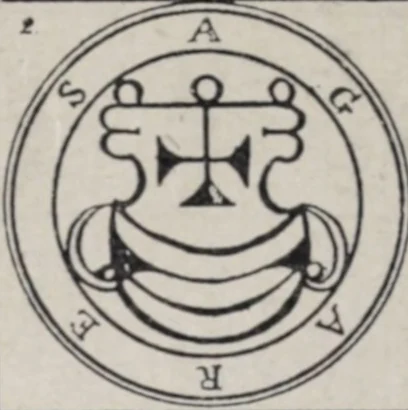
At a glance
- Entry
- 2 of 72
- Rank
- Duke
- Legions
- 31 in the text
- Also written
- Agreas
Description in the text
Agares is said to teach languages, return people who have run away, and set the stationary in motion. The text also credits him with shaking the earth and undoing spiritual or secular dignities.
Read entry 2 on page 22 of the 1916 edition
Appearance
An elderly man riding a crocodile and carrying a goshawk.
Topics attributed to this entry
- Languages
- Travel and return
- Earthquakes
Reading this entry
Agares is a duke under the power of the east, pictured as a mild-looking older man riding a crocodile with a goshawk on his fist. Gentle bearing and improbable mount give the entry its contrast. Its name is given both as Agreas and Agares in the cited edition. The offices range widely: teaching languages, returning runaways, putting stationary people in motion, earthquakes, and the removal of spiritual or temporal dignity.
Those offices do not form a single modern category. The phrasing repeatedly turns on movement and reversal: people leave and return, stillness becomes motion, and established rank is overturned. The passage also says he belonged to the Order of Virtues, a reference to an angelic hierarchy within the grimoire’s own cosmology. His 31 legions and seal finish an unusually detailed early entry.
Read entry 2 on page 22 of the 1916 edition or compare the 1904 transcription.
A closer reading of entry 2
What the numbered text says
Entry 2 prints the two names together: Agreas is an alternate form of Agares in this witness, not a second numbered spirit. The description calls the older rider mild even as it gives him a crocodile and goshawk. His attributed offices move from language learning and returning absentees to earthquakes and the loss of spiritual or temporal standing; the source lists these without giving them a shared cause.
About the printed seal
Agares is numbered 2 on the 1916 plate. His passage uses both “seal” and “character” for the emblem. Neither term puts the crocodile, hawk, or eastern association into the printed strokes; those details belong to the written description.
Compare another entry
Compare entry 3: Vassago. The next entry explicitly calls Vassago of the same nature as Agares, but narrows the recorded office to knowledge of time and recovery of hidden things. It does not repeat Agares’s mount, language teaching, or earthquakes. The stated relationship stops short of a merged profile.