
Sigil of Samigina
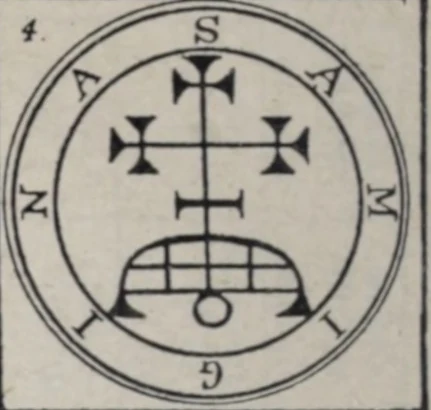
At a glance
- Entry
- 4 of 72
- Rank
- Marquis
- Legions
- 30 in the text
- Also written
- Gamigin
Description in the text
Samigina is credited with teaching the liberal sciences. The entry also says that he can give an account of the dead, especially souls described in the text as having died in sin.
Read entry 4 on page 22 of the 1916 edition
Appearance
A small horse or donkey that may take human form; he speaks hoarsely.
Topics attributed to this entry
- Liberal sciences
- The dead
Reading this entry
Samigina, also named Gamigin in the passage, first appears as a small horse or donkey. At the operator’s request the figure becomes human, but the hoarse voice remains part of the description. The title is marquis, and the office includes teaching the liberal sciences. This is one of several Goetia entries that place learning beside an animal-to-human transformation rather than presenting a scholar-like figure from the outset.
The other attributed task is giving an account of dead souls, especially those the text describes as having died in sin. The entry does not explain what such an account contains or establish it as a record of actual people. Its wording reflects the religious categories of the grimoire. The passage closes with 30 legions and a seal worn by the operator, another instance of the catalogue’s repeated documentary formula.
Read entry 4 on page 22 of the 1916 edition or compare the 1904 transcription.
A closer reading of entry 4
What the numbered text says
This entry divides its portrait into an initial small horse or ass and a subsequent human form. It then places liberal sciences beside an account of souls said to have died in sin. That second office is bounded by the text’s religious language; it does not identify people, offer historical testimony, or describe a method of inquiry. The voice remains a separate descriptive detail rather than proof of any identity.
The Gutenberg 1916 transcription prints “GAMIGIN”; the Wikisource 1904 transcription currently displays “GAMIGM” in its heading. The local profile follows the Gutenberg spelling.
About the printed seal
Seal 4 on the 1916 plate is attached to the numbered entry under both printed names. The design should be catalogued under one entry number; the alternate heading does not imply a second emblem in this edition.
Compare another entry
Compare entry 5: Marbas. Marbas also changes from an animal to human form and is credited with knowledge, but his offices concern hidden matters, illness, mechanical arts, and bodily transformation. Samigina’s liberal sciences and dead-soul account are a different combination despite the shared two-stage appearance.