
- Autograph diary
- Cotton MS Appendix XLVI
- Edited print
- Casaubon, 1659
- Later plates
- The Equinox I:7, 1912
Dee’s conference diary and his separate book
Cotton MS Appendix XLVI is catalogued as John Dee’s conferences, with material dated 1583–1587 and a later 1607 entry. It contains the reported June 1584 Watchtower communication and the subsequent reform. The catalogue establishes the volume’s identity and scope, while individual leaves preserve the specific letters.
Sloane MS 3191 is another British Library item, described as the only book of ceremonial magic extant in Dee’s hand. It includes the Angelical Keys and Liber Scientiae, written and collected in the mid-1580s. It is not a synonym for Cotton Appendix XLVI. Names drawn from Liber Scientiae and placed across the Great Table combine material from both documents.
What Ashmole can and cannot establish
Elias Ashmole copied and preserved Dee material in the seventeenth century. The British Library catalogues Sloane MS 3677 as an Ashmole copy related to the earlier conferences and Sloane MS 3678 as a copy of Sloane MS 3191. These are important witnesses to transmission and sometimes to lost or damaged readings. A difference in either copy is evidence of its own stage of transmission rather than automatically a feature of Dee’s autograph.
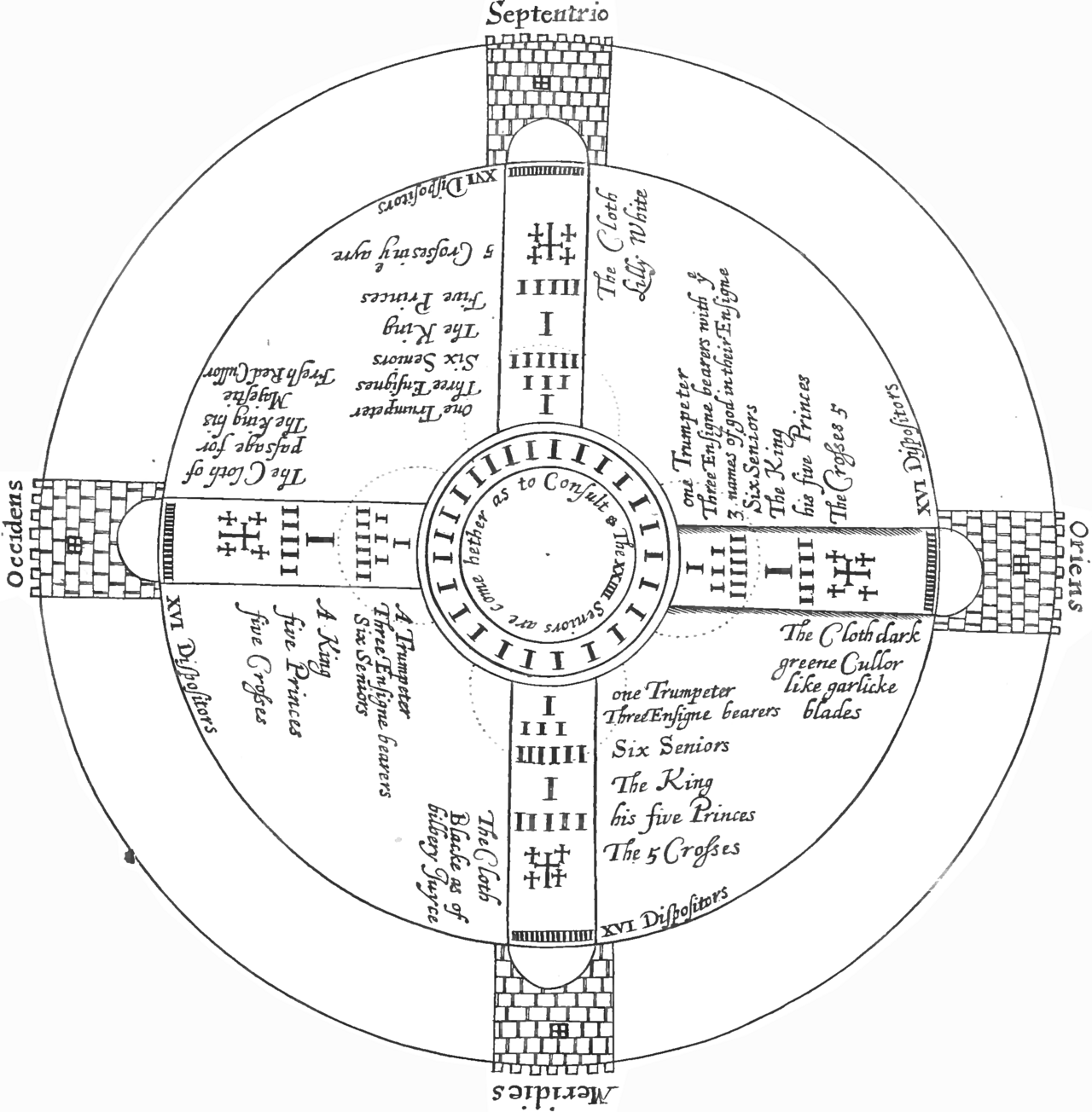
A diagram from Casaubon’s 1659 Relation uses a circular layout and cross to visualize related material. It is distinct from the four lettered quadrants of the Great Table and shows how a printed witness could present the tradition differently.
Casaubon’s 1659 book
Meric Casaubon issued A True and Faithful Relation decades after Dee’s death. Wellcome Collection dates its copy to 1659, marks the digitisation public domain, and provides online access. Cornell’s Digital Witchcraft Collection independently catalogues the edition. Casaubon’s print is a primary source for seventeenth-century circulation of Dee’s record and a useful guide to passages now difficult to read in manuscript.
It remains an edited print, with its own typography, page arrangement, and potential errors of transcription. A small table attributed only to “Dee” can therefore conceal whether it came from Casaubon, a later reprint, or a manuscript page.
The twentieth-century plate tradition
The Equinox I:7 (1912) lists a general Watch-Tower view and four directional plates. Those plates show a later occult teaching arrangement. The fact that they were printed before many modern websites makes them historically important; their age does not erase the three-century distance from the 1584 action.
Casaubon’s 1659 diagram belongs to a printed account, while the four quadrants of the Great Table belong to the earlier manuscript record. The 1912 Equinox plates represent a still later arrangement. Their dates and forms matter when comparing what each image actually shows.
Worked comparison: one changing cell across Cotton, Casaubon, and The Equinox
A responsible three-witness comparison begins by admitting what the accessible records do not show. The British Library catalogue establishes that Cotton MS Appendix XLVI contains Dee’s 1583–1587 conference record, including the period of the Great Table actions. It does not expose a legible image or diplomatic transcription of one numbered Water-table cell. Casaubon’s 1659 Relation is an edited typographic presentation of the conference material, not a facsimile. An exact Cotton-to-Casaubon letter change therefore cannot be certified from catalogue metadata alone.
The verifiable later choice is clearer. The Equinox I:7 prints the Water central names as MPH, ARSL, GAIOL. At the penultimate position of the last name it has O, followed by L. An adjacent manuscript witness, Sloane MS 3191, is reported by Burns and Moore to preserve the alternatives OL and CH at that ending. Their rectified chart selects GAICH because C and H continue VIROCHI. That evidence proves a real editorial fork between manuscript alternatives, the 1912 printed selection, and a modern rule-based reconstruction.
Cotton and Casaubon still matter to the comparison, but at the level their evidence supports. Cotton locates the 1584 delivery and its corrections in a dated diary. Casaubon shows how that diary entered print through rearranged type and editorial selection. The Equinox shows a later occult publisher stating one clean central name and surrounding it with a developed Water-table apparatus. The chain documents increasing visual and textual regularization even where the exact same cell cannot be read securely in all three public witnesses.
The worked result is thus bounded rather than evasive. O in GAIOL is certain for the 1912 prose; O/C with its linked L/H alternative is supported for Sloane MS 3191 by a named collation; Cotton’s corresponding mark and Casaubon’s exact setting require page-level inspection beyond their catalogue descriptions. A chart that claims one uninterrupted cell across all stages would overstate the record. The uncertainty itself explains why later diagrams diverge and why a clean printed table must be treated as an editorial state.
Sources
- British Library, Cotton MS Appendix XLVI catalogue ↗The surviving conference record, dated 1583–1587, containing the 1584 and 1587 episodes.
- British Library, Sloane MS 3191 catalogue ↗Dee’s handwritten Keys and Liber Scientiae; a separate object from the conference diary.
- Wellcome Collection, Casaubon, A True and Faithful Relation (1659) ↗Digitised public-domain printed edition; a seventeenth-century edited witness, not the autograph.
- Cornell Digital Witchcraft Collection, 1659 Relation ↗Second institutional record for the 1659 book and its diagrams.
- The Equinox I:7 (1912), original issue scan ↗Printed Plates III–VIII: a general view, four directional Watch-Towers, and the detached Black Cross or Table of Union, all listed facing printed page 234.
- 100th Monkey Press, bibliography of The Equinox I:7 plates ↗Identifies Plates III–VIII and lists the general view, four directional Watch-Towers, and Black Cross as facing page 234 in the March 1912 first edition.
- Wikimedia Commons, 1659 Dee diagram file record ↗Public-domain status and provenance of the printed diagram displayed on the witness guide.
- Burns and Moore, Great Table, Part II ↗Discussion of the Black Cross, textual variants, and later attributions.