
The Greek Magical Papyri are often introduced as a single book of ancient spells. The label Papyri Graecae Magicae, abbreviated PGM, is a modern edition label for a dispersed group of papyri. Each physical roll or codex has its own shelfmark, writing, condition, date estimate, and custody. A modern numbered passage is useful for finding a text, but it cannot tell you by itself where the surviving object is held or how its words were transmitted.
Start with an object, not a legend
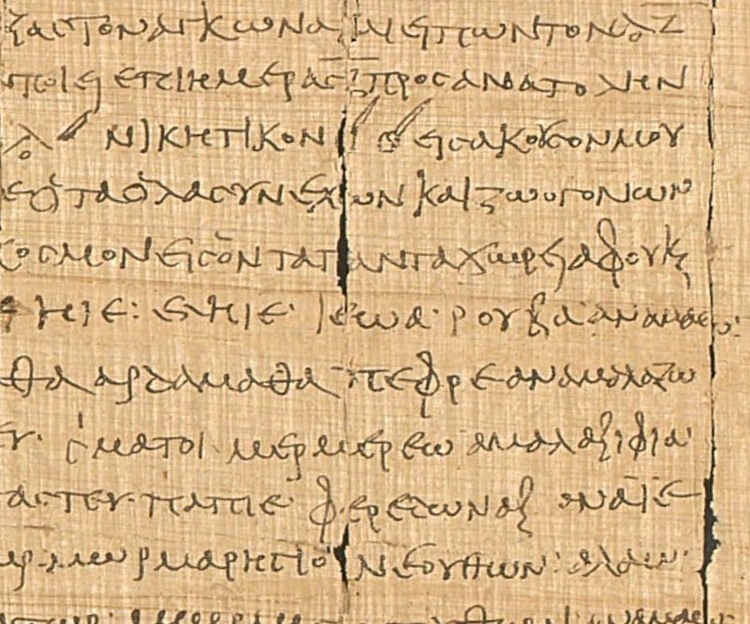
The Papyrus 121 study follows a British Library roll catalogued as PGM VII. The catalogue describes 19 columns on one side and 13 on the other, with additional writing in a different hand. That physical description matters. A collection of dream-oracle requests, protective amulets, medical prescriptions, victory charms, and coercive attraction texts was copied and later handled as material, not issued as a uniform modern “grimoire.” The British Library dates the manuscript to the fourth century CE. A familiar image of one detail circulates with an older third-century caption; our image caption identifies the difference rather than silently choosing the older label.
Other PGM labels point to different holdings. The Berlin Papyrus Database catalogues P. 5025 A+B as PGM I, a Greek roll with five recto columns and a fourth-to-fifth-century date; its parts are listed in Warsaw and the Berlin papyrus depot. P. 5026 is PGM II, another fourth-century roll. PGM IV refers to a much larger Paris codex known as the Great Magical Papyrus of Paris. A University of Würzburg research account describes its 72 pages, 66 of them inscribed, and bilingual Greek and Old Coptic recipes. They are distinct witnesses, not four chapters of one ancient volume.
Why these texts attract readers
The manuscripts preserve a broad range of ancient ritual writing: requests for dreams and direct visions, appeals to named gods and other figures, amulets, protective and healing aims, as well as attempts to influence other people. Some passages combine Greek instructions with Egyptian-language invocations. Others use signs or strings of syllables that modern editors discuss under names such as charaktēres and voces magicae. These details are valuable evidence for language contact, scribal work, and religious life in Roman Egypt. They are not evidence that any claimed magical outcome occurred.
It is also possible to read them without treating every instruction as a practice to repeat. Several attraction and binding recipes explicitly imagine control over another person. The ritual-language guide explains those categories as historical sources and keeps the wishes of a text separate from an ethical recommendation today. The ancient love-spell papyri guide adds context for the coercive examples, while the protective-magic collection follows material evidence from other places and periods.
What the PGM numbers connect
PGM VII identifies a sequence in a modern edition, while Papyrus 121 names the surviving London roll. Berlin P. 5025 and P. 5026 correspond to PGM I and II; the large Paris codex is PGM IV. Their writing surfaces, hands, and histories differ. An English translation adds another modern layer to each ancient object.
This archive is a historical reference within a wider occult library. Its pages do not claim that ancient Egyptian-Greek papyri directly supplied every later European grimoire, Enochian diagram, or Goetia seal. Comparisons can be illuminating when a named text, date, and transmission path support them. Begin with the objects and keep later adaptations in their own sources.
Sources and further reading
- British Library, Papyrus 121 ↗ — physical catalogue for PGM VII
- Berlin Papyrus Database, P. 5025 ↗ — physical catalogue for PGM I
- Berlin Papyrus Database, P. 5026 ↗ — physical catalogue for PGM II
- University of Würzburg, PGM IV ↗ — research account of the Paris codex
- Wikimedia Commons, Papyrus 121 detail ↗ — public-domain image record