
British Library Papyrus 121 is the physical object behind the editorial label PGM VII. The library calls it a magical handbook and dates it to the fourth century CE. The surviving roll is fragmentary and written on both sides; its catalogue counts 19 columns on the recto and 13 on the verso, with some additions in another hand. A reference such as “PGM VII” helps find passages in a modern edition, while “Papyrus 121” directs a reader to the holding institution and the material witness.
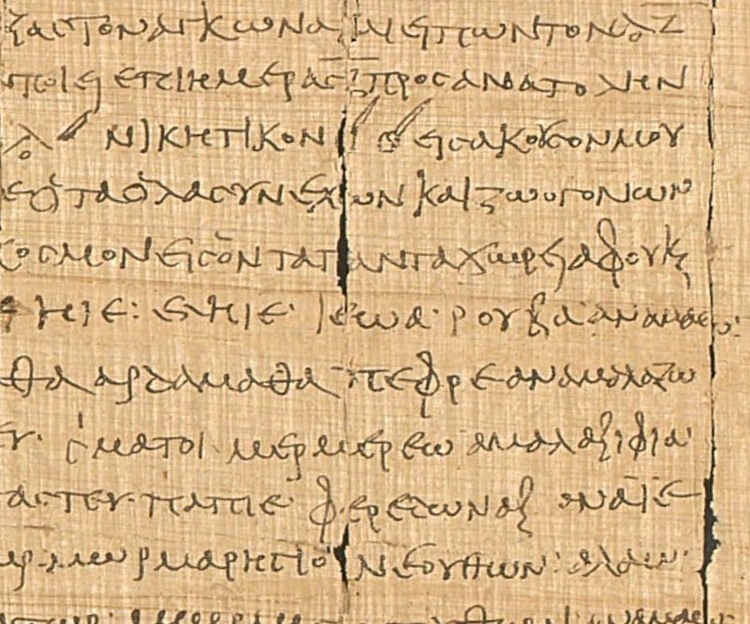
What survives of the roll?
The catalogue describes fragments of a roll folded from right to left, damaged at the beginning. The British Library’s curator Federica Micucci describes it as originally over two metres long. Neither measure means that all sections were copied at once or by one person. The catalogue explicitly notices additional hands on the verso, a reminder that a ritual collection could grow or be reused. The list of contents is a modern finding aid arranged by column and line, and it should be distinguished from a single ancient table of contents.
That list is unusually varied. It includes requests for dream oracles, direct vision and lamp divination; an amulet against fever; charms involving household pests and wild animals; victory and favour texts; and several attraction, binding, or silencing recipes. A page labelled “spell” therefore does not name one purpose or one theology. A reader can use the catalogue’s column labels to find a specific item without imagining that every line belongs to a coherent system.
Dreams, amulets, and coercion
A dream-oracle request seeks an answer during sleep; an amulet asks for protection or success; a binding recipe voices an attempt to constrain someone. Those are different aims even when copied on the same roll. The library’s inventory places dream material at several points on both sides. An ancient author’s promise that a procedure would work is part of the document’s rhetoric, not a verified outcome. Read the result sought by the text as a historical claim, then ask what the manuscript shows about the writer’s available language and cultural world.
Some attraction passages are coercive. The British Library’s article makes their intended control over another person explicit. That should not be softened into generic “romance.” We discuss their wording as evidence of ancient social assumptions and textual conventions, without reproducing instructions or treating another person’s consent as a problem to solve with ritual. For broader context, see ancient love-spell papyri and ritual language and spells.
Worked reading: a missing picture still governs the recipe
One Papyrus 121 attraction text tells its reader to use a sea shell and refers to a figure of Typhon that should appear “below,” yet the drawing is no longer preserved. The surviving directions still assign that lost figure a material, an ink, and a position: it belongs on the shell, is drawn with myrrh ink, and is surrounded by names written in a circle. The shell is then placed into the heat of a bath while the perimeter words are repeated. The missing image was therefore one part of a larger working object. Replacing it with a modern drawing based only on the name “Typhon” would invent the very evidence the fragment has lost.
A nearby lamp recipe creates urgency by another route. Seven divine names are written on seven wicks, the lamp carries wormwood seeds, and the promised arrival is tied to the seventh wick’s flicker. The shell text repeats demands for speed; the lamp text turns seven physical parts into a countdown. Both write coercion as an engineered schedule, but their surviving evidence differs. The lamp instructions retain the numerical mechanism, while the shell recipe preserves the place where an absent figure once controlled the object’s design.
This comparison shows why a fragment cannot be reduced to a list of ingredients. Shape, placement, repeated speech, and timing divide the work among the object’s parts. It also exposes the rhetoric of the desired result: sleeplessness, compulsion, and immediate movement are presented as measures of success. The papyrus verifies that such a sequence was written and copied; it does not verify the promised effect or make the coercive aim acceptable.
Why the image needs two dates
The accompanying 750-pixel detail comes from a Wikimedia Commons file attributed to an older British Library viewer and marked as a public-domain reproduction. Its Commons description labels the object third-century. The current British Library catalogue assigns Papyrus 121 to the fourth century. Dating ancient handwriting involves scholarly judgment and can change; this page follows the present institutional catalogue while preserving the image-record discrepancy. The detail is a small crop and does not show the full two-sided roll, its folds, or all the later additions. Do not use its appearance alone to identify an exact column or a spell.
A roll behind a modern number
British Library Papyrus 121 is the physical manuscript behind PGM VII. The library catalogue describes its writing on both sides and identifies sections by column and side; modern editions use PGM line ranges. The catalogue currently marks its digitized image link unavailable. The London, Berlin, and Paris witnesses retain distinct material histories even when collected under one editorial title.
Sources and further reading
- British Library, Papyrus 121 ↗ — current shelfmark, description, date, and column inventory
- British Library, Love spells in the Greek Magical Papyri ↗ — curatorial context for the roll and ritual categories
- Wikimedia Commons, Papyrus 121 detail ↗ — image provenance and Public Domain Mark