
- Earlier term
- Black Cross or Cross of Union
- Later display
- Five-by-four extracted tablet
- Source caution
- Arrangement varies by edition
A joining structure inside the Great Table
The central cross gives the four lettered quadrants a common frame. The 1584 material discusses letters associated with this joining structure. In the historical record, its position within the composite table matters: a name copied into a small detached rectangle loses the surrounding Watchtowers and may obscure the relationship the larger drawing was meant to express.
The term Black Cross points to how this area was visually distinguished, not to a fifth elemental quarter equivalent to one of the four larger grids. Burns and Moore show why it matters to compare the manuscript’s marginal arrangement with Casaubon’s typographic presentation: a printer’s placement can make a note seem like a finished tablet that the handwritten page did not present in exactly that way.
Where the Tablet of Union enters a reader’s view
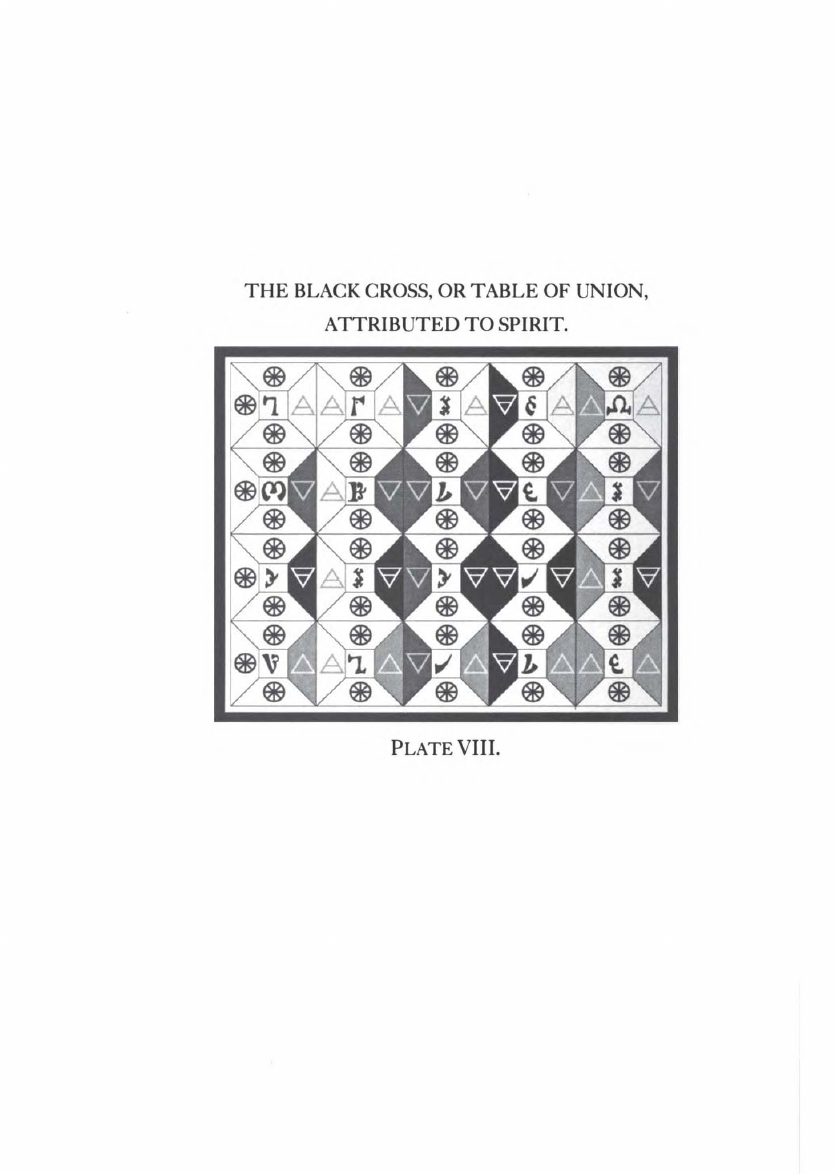
Later occult instruction extracts the center into a compact grid commonly called the Tablet of Union. The rows are often associated with names derived from the cross, and Golden Dawn teaching gives the extract a distinct role alongside four elemental tablets. The 1912 Equinox plates are a dated printed witness to that later diagrammatic setting. They are valuable for studying the setting, rather than a photographic record of what Dee saw in 1584.
Plate VIII states the later move in its own title: the Black Cross is also a Table of Union and is attributed to Spirit. Its five columns and four rows now fill an independent frame, with every letter square subdivided into attributed faces. Beside Plate III’s general view, the change is material rather than merely verbal: a connector embedded among four quadrants becomes a fifth teaching object that can be printed and studied by itself.
The twenty-letter extract can differ according to whether its letters come from the 1584 table, the 1587 reform, or a later reconstruction. That variation helps explain why printed Tablets of Union do not always agree cell by cell.
Not the Holy Table
The Black Cross should also not be confused with Dee’s Holy Table, the physical table used in his practice and represented in a different 1659 engraving. Both are square or cross-shaped in popular images, but the Great Table is a lettered composite, while the Holy Table is a separate object with its own design, dimensions, and manuscript history. The Holy Table page in the Dee archive describes that artifact.
Later ritual uses depend on who assigned the letters, where they were written, and when the extraction was made. Those historical facts describe a documented tradition without verifying an occult effect.
Worked reading: E enters the first square of the Black Cross
The 26 June 1584 material supplies a concrete starting point for the Black Cross: Dee is instructed to place E in its first square. That small direction matters because it treats the cross as a sequence with an entry point, not simply as empty bands between four quadrants. In the same action, the names Lexarph, Comanan, and Tabitom are connected with letters set down in groups of five after the first L of Lexarph is omitted. The resulting groups begin with EXARP and continue across the material later extracted as four five-letter rows.
The manuscript layout complicates the familiar picture. Burns and Moore describe the grouped letters as a marginal note in Cotton MS Appendix XLVI, linked by a line to the three governor names. Casaubon’s 1659 typography moves and centers the material so that it resembles a self-contained table. Layout therefore changes the apparent force of the words. In a margin they can be Dee working out an instruction; in print, centered groups beneath speech can look like a finished diagram delivered all at once.
Placing E first helps test those two presentations. The instruction continues into the cross that joins the Watchtowers, and the later Sloane MS 3191 arrangement keeps the letter groups in that joining structure. E opens the joining cross, and its relation to the surrounding quadrants gives it meaning before the letters are extracted into a separate tablet. Extracting the twenty letters into a five-by-four Tablet of Union is a useful later operation, but it changes the viewer’s first object from a connector to an independent tablet.
The close reading also exposes a real textual uncertainty. Casaubon’s second five-letter group is printed with a reading that specialists flag as problematic, and the timing of Dee’s marginal addition is not certain. The article therefore does not claim that one clean modern rectangle reproduces every stroke of the 1584 page. What can be followed securely is the logic: omit the initial L, arrange the remaining material by fives, begin the Black Cross with E, and understand later detached Tablets of Union as editorial extractions from that earlier joining structure.
Sources
- British Library, Cotton MS Appendix XLVI catalogue ↗The surviving conference record, dated 1583–1587, containing the 1584 and 1587 episodes.
- Wellcome Collection, Casaubon, A True and Faithful Relation (1659) ↗Digitised public-domain printed edition; a seventeenth-century edited witness, not the autograph.
- The Equinox I:7 (1912), original issue scan ↗Printed Plates III–VIII: a general view, four directional Watch-Towers, and the detached Black Cross or Table of Union, all listed facing printed page 234.
- Burns and Moore, Great Table, Part II ↗Discussion of the Black Cross, textual variants, and later attributions.