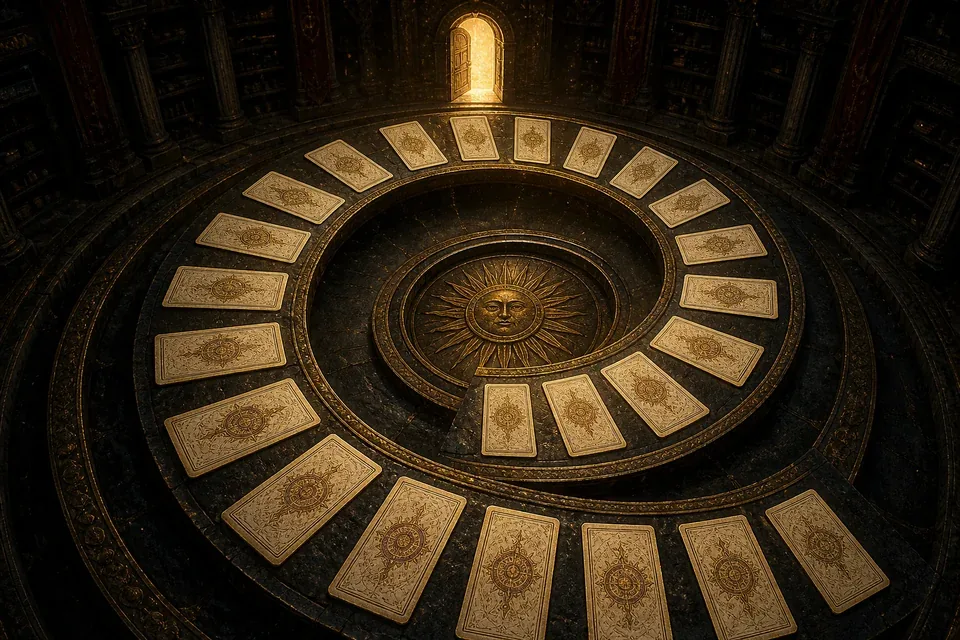
A tarot reading can help turn a large question into smaller observations. Choose one card for a focused prompt, three cards for a short sequence, or ten for a Celtic Cross.
What happens in a free reading?
The complete Rider–Waite–Smith deck is shuffled locally. In the one- and three-card tools, you choose from twelve face-down cards and assign positions in the order selected. The Celtic Cross lays ten unique cards into named places and lets you reveal them in any order. A card cannot appear twice in one deal. Every result shows an original card summary and a link to a longer guide with image details, upright context, reversed context, and reflection questions.
An optional question can help you decide which part of a card feels relevant. The page keeps that text in the current tab only; it does not send it to a server or save it in browser storage. If you want a different set, use Reshuffle. The draw is an interpretive exercise rather than a way to confirm hidden facts about a person or guarantee an event.
Begin with the artwork
The cards reproduce Pamela Colman Smith’s artwork for the early twentieth-century Rider–Waite–Smith deck. First describe a visible detail: a gesture, object, direction of movement, or relationship between figures. Then compare it with the card’s customary themes and with the question you actually asked. A striking image can suggest several readings; the surrounding facts still matter.
For a first attempt, try a question you can act on: “What should I pay attention to in this conversation?” or “Which part of this decision needs more information?” The spread guide explains what each position means, while the beginner guide shows how to read images and neighboring cards without treating them as commands.
Explore beyond the draw
The card library covers all 22 Major Arcana and all 56 Minor Arcana cards. Its pages distinguish image observations from upright and reversed interpretations. Read the full entry for a card that interests you, then return to the spread and ask whether the position changes your emphasis. A card in the “future” position can suggest a possibility to examine, not a prediction you must accept.