You can read your first tarot card without memorizing all 78 meanings. Start with a question, look closely at the artwork, then use a card guide to test a possible interpretation against your real situation. A reading is most useful when it leaves you with a clearer question or a practical next step.
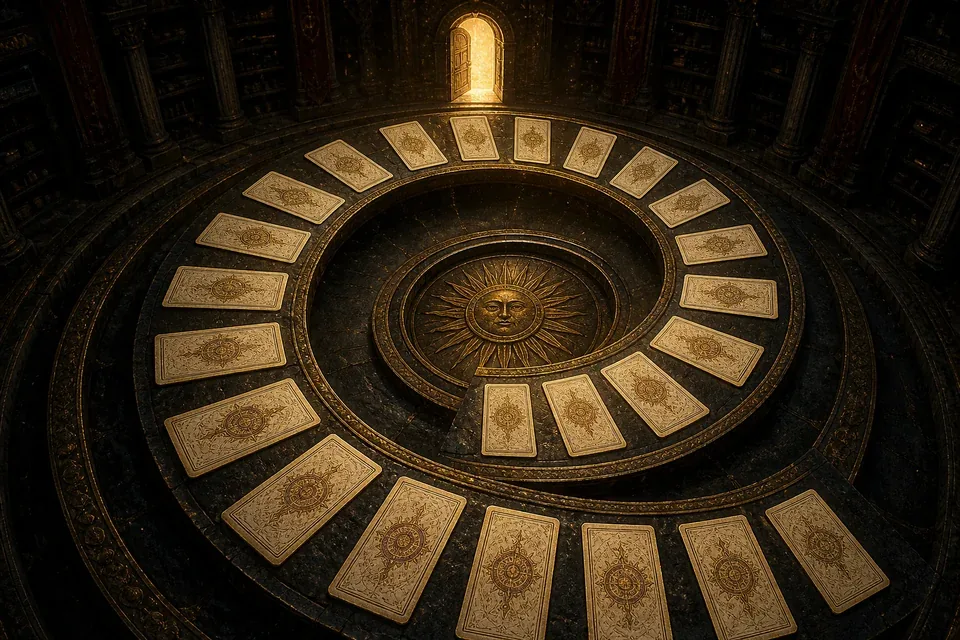
How do you read a tarot card?
Write an open question such as “What should I check before I begin?” Shuffle and draw one card. Name two or three things you can actually see: a person, object, gesture, setting, or direction of movement. Only then read the card’s customary themes. Ask which details fit your question and which do not. Write down one interpretation in your own words; do not treat a keyword as an instruction.
For a first attempt, use the illustrated Rider–Waite–Smith deck. Pamela Colman Smith’s scenes give you something specific to observe on every card, including the numbered Minor Arcana. The 78-card meaning library is there when you want context, not as a vocabulary test before you start.
One-card example: The Fool
Suppose you ask, “What should I check before starting a course?” You draw The Fool. Read the picture before the card name.
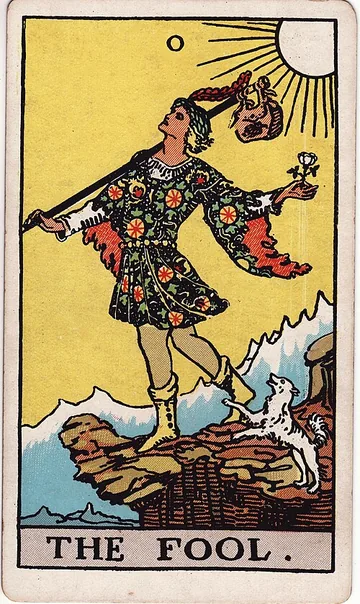
The traveler stands close to an edge, with a dog alongside and a small bundle over one shoulder. The bright landscape makes the journey inviting; the drop gives it a real boundary. Neither detail cancels the other.
In this question, the card might describe genuine excitement about learning while asking you to check the course’s cost, schedule, and withdrawal terms. If you have already checked those and keep waiting to feel completely ready, the same image could suggest trying a small first step. Your circumstances decide which reading is more useful.
A useful conclusion is concrete: request the syllabus, talk to a former student, or attend a trial class. You have turned an image into a question you can answer. Try a free one-card reading →
What are Major and Minor Arcana?
The 78-card deck has 22 Major Arcana cards, including The Fool, and 56 Minor Arcana cards in four suits of 14: Wands, Cups, Swords, and Pentacles. A Major card can bring a broad theme into focus; a Minor card can give you a scene of work, conflict, exchange, movement, or feeling. Neither group is automatically more important. Read the image in its position and beside the other cards. The card directory lets you explore each suit at your own pace.
Three-card example: read a sequence
Now ask, “How can I move a small project forward?” Before drawing, give the three places clear jobs: past, present, and future. The third place is a possibility to consider, not a guaranteed event. Imagine drawing these three cards in order:
Past · Two of Wands
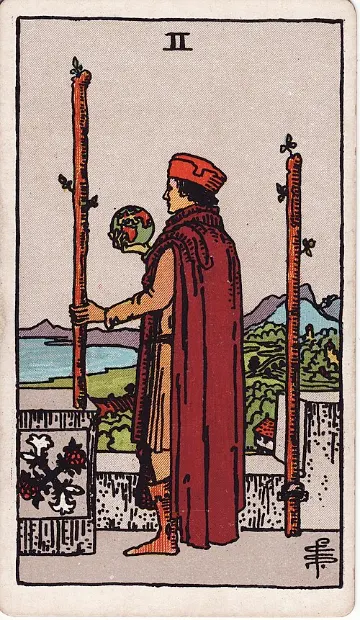
Two of Wands shows a figure holding a globe behind a parapet. In the past position, that image could recall the time you spent imagining the project from a secure distance. Which part of your plan exists on paper, and which part has been tested?
Present · Three of Pentacles
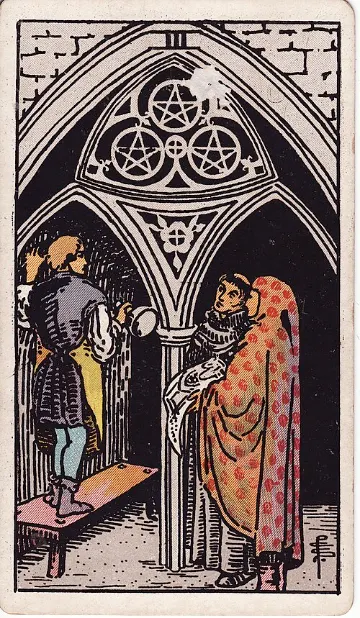
In Three of Pentacles, a worker and two visitors attend to the same building. In the present position, the scene may shift your attention from private planning to useful feedback. Who can look at a draft, and what standard should they use?
Future · Six of Swords
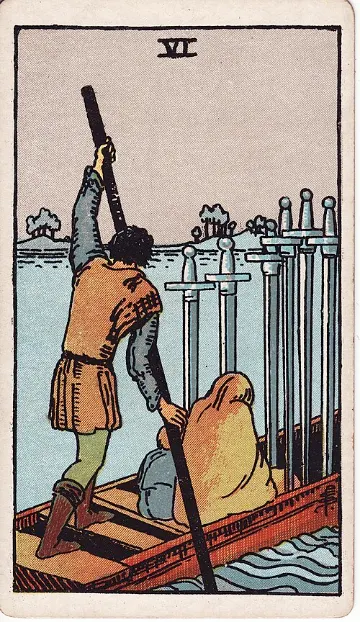
Six of Swords depicts a crossing with a guide, passengers, and six swords still in the boat. As a future prompt, it might ask what help and existing constraints you will carry into a trial launch. It does not promise a smooth arrival.
Read together, the pictures move from looking outward, to discussing work, to making a crossing with support. One grounded reading is: show a draft to someone who can improve it, then test a modest version of the project. You could reasonably read the sequence differently if your actual circumstances differ. The useful skill is to explain why each card and position led you there. Try a free three-card reading →
Do you need to read reversed cards?
No. Begin with upright images until you are comfortable describing them and keeping a question in view. A reversed card can later suggest a theme turned inward, delayed, or under strain; it is not automatically a bad sign. This site’s free draws show upright cards, while each card guide discusses reversed context if you want to compare it.
What if a card looks alarming?
Describe what is pictured before turning its title into a forecast. A difficult card may point to a concern, assumption, or needed conversation, but it cannot establish a hidden fact or decide an outcome for you. Return to the question you wrote and identify what evidence or support would help. For more ways to give each card a job, see the one- and three-card spread guide.
Keep a short record of the question, card names, visible details, your interpretation, and what you tried next. When you revisit it, notice where the reading sharpened your thinking and where you may have stretched a symbol too far. That habit teaches you more than collecting a longer list of keywords.