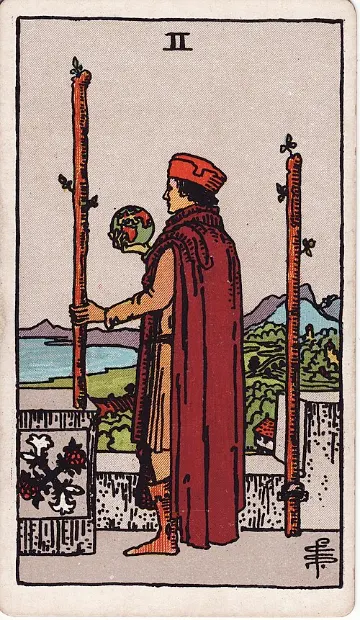
A figure on a high terrace holds a small globe and looks over land and water, with one wand near the hand and another fixed to the wall. The Two of Wands sets a wide horizon against an established place to stand. Modern readers often see a choice about expansion or direction, but Waite's upright account is more conflicted: riches and magnificence sit beside sadness and dissatisfaction. His reversal includes surprise and wonder as well as fear. In love or work, the card asks what an attractive future offers, what the present position already gives, and what evidence could turn ambition into a choice.
Look at the image
Pamela Colman Smith places a figure on a high terrace between two wands. One stands by the left hand; the other is fixed to the wall on the right. The figure holds a small globe and looks across sea and shore. A rose-and-cross emblem appears on the stone below. The globe can be held, but the landscape beyond the parapet cannot, and nothing in the picture shows a departure already underway. The terrace provides a secure vantage point as well as a boundary. Ask what the figure can actually see from here and which part of the horizon still exists only as a possibility.
Upright: ambition and its cost
Waite's upright account is deliberately divided. He gives riches and magnificence, then describes an affluent figure troubled by the sight of a world that still lies beyond his reach. A modern upright reading often turns that tension into a choice about growth: take a new role, widen a project, or remain where existing resources are strong. Name what is already working before treating the horizon as an automatic improvement. Then compare the two routes by timing, cost, partners, and what each would make possible. Ambition is useful when it has a purpose. Without one, even a larger territory can leave the figure on the terrace dissatisfied.
Reversed: surprise can change the map
Waite's reversed meanings include surprise, wonder, enchantment, and emotion, but also trouble and fear. The reversal is not simply a person too timid to leave home. A new offer, an unexpected response, or a change in circumstances may make the original plan feel different. Contemporary readers sometimes use it for indecision or a stalled expansion; that may fit when the choice has been delayed despite available facts. Ask what changed and whether the change improves or weakens the option. If fear is present, identify the actual risk and a way to test it. If excitement is present, check whether the invitation has terms as good as its first impression.
Two of Wands in love and relationships
In love, the Two can appear when two people are deciding what kind of future to build from a relationship that already exists. The horizon might mean a move, more time together, or a shared project; it need not mean leaving someone behind. Upright, both can name what they value in the present and what a next step would require. Reversed, an unexpected invitation or change of plan may bring excitement and worry at once. Discuss the practical choice rather than asking one partner to prove love by surrendering their own direction. A shared horizon works best when both people can describe the route and their part in it.
Two of Wands as feelings
When asking about your own feelings, the Two may reflect attraction to a wider possibility alongside appreciation for a familiar place. That can be anticipation or restlessness, depending on what you want to change. If you ask about someone else's feelings, the figure's gaze cannot tell you what they intend. Notice whether they include you in concrete plans, ask about your preferences, and act on what you decide together. Reversed, surprise or fear may be part of the emotional picture, but a delayed decision is not a private confession. Ask what future they are willing to discuss now rather than filling the distant landscape with assumptions.
Two of Wands in career and money
At work, the Two can mark a decision between developing a stable role and expanding into a new market, position, or venture. The figure's terrace is an asset: existing clients, skills, savings, or a team can make exploration possible. List what each option needs and what it would displace. An impressive title without pay, authority, or support may be a painted globe rather than a real opportunity. Reversed, new information may alter the calculation; get the terms in writing before moving resources. The card favors a direction chosen from actual capacity, not a forecast that every horizon will pay for itself.
Ace versus Two of Wands
The Ace of Wands shows a cloud-hand offering one living wand: the first surge of energy and a chance to begin. The Two places a figure on a terrace with a globe and two wands, facing a choice from an established position. If both appear, test the idea under the Ace before promising a large expansion under the Two. A small result can show which route deserves attention. The Two does not erase the Ace's excitement; it asks where that energy should go and what existing commitments will travel with it. A beginning and a plan are related stages, but they call for different evidence.
Is the Two of Wands a yes or no card?
For a defined next step supported by resources and an understood tradeoff, the upright Two can lean yes. It does not answer every question about the distant result. Reversed suggests pausing when the decision depends on an unexpected offer whose terms have not been checked, or when the original plan has lost its purpose. Ask “Should I pilot this service in one new neighborhood before opening a second site?” and compare cost, demand, and the work it takes from the current one. “Will a bigger world satisfy me?” is closer to Waite's conflicted figure than to a simple yes-or-no question.
A reading example: a second bookshop
A bookshop owner has a profitable small store and is invited to lease a second location. The Two of Wands appears while they weigh the offer. They calculate the new rent, staffing, stock, and the time they currently spend keeping the first shop healthy. Instead of signing at once, they ask to run three weekend pop-ups near the proposed site and track sales and repeat interest. The trial reveals a strong audience for events but weaker demand for daily retail. They choose regular pop-ups before another lease. The horizon remains open, while the terrace supports an expansion sized to what they have learned.
Questions to ask
- What does my current position make possible?
- Which part of the new opportunity has been tested?
- What would I give up by choosing this route?