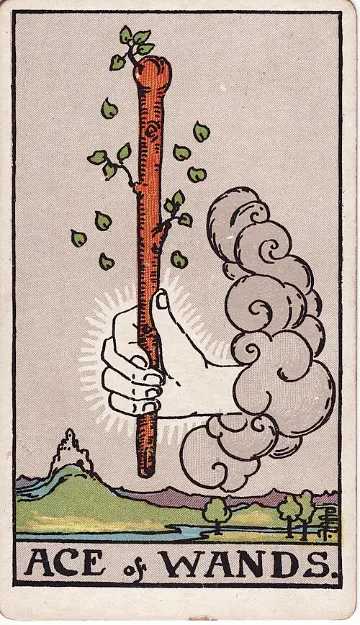
A hand from a cloud grips a living wand as leaves sprout and fall around it. A small castle stands on a distant hill. The Ace of Wands is a beginning with force behind it, before an idea has acquired a plan or proof that it will work. Waite's upright meanings include creation, invention, and enterprise, with birth or family and even money in alternative glosses; his reversal is more severe than a delayed spark. In love or work, the card asks what deserves a first test now and what would have to be true for that initial energy to grow into something durable.
Look at the image
Pamela Colman Smith gives the Ace a single upright wand held by a hand emerging from a cloud. Shoots grow from the wood while loose leaves hang in the air around it. Far below, a small castle sits on a hill beyond open land and trees. There is no flame on the wand and no visible path to the castle. The object is immediate; any destination is distant. The hand offers a beginning with life in it, but the picture does not show who takes it or what they build. Ask what is within reach now and what part of the distant goal still needs a route.
Upright: begin something living
Waite connects the upright Ace of Wands with creation, invention, enterprise, and a source or beginning. His lists also include birth and family, with fortune or inheritance in another account. Those are historical possibilities, not a promise that one card predicts a child or sudden wealth. A contemporary upright reading often fits a creative idea, attraction, proposal, or new project that has enough energy for a first action. Make a sample, request a conversation, or test a small audience while the interest is fresh. The wand has new leaves, but it is still one piece of wood. A beginning gains direction through the next choice, not through excitement alone.
Reversed: more than a blocked spark
Waite's reversed Ace includes fall, decline, ruin, and joy clouded by events. That older account is harsher than the modern shorthand of “creative block.” A current reading may still use the reversal for a delayed launch, energy spent too quickly, or an idea with no workable conditions. Identify which story the situation supports. Did a project actually lose funding or trust, or is the first step simply waiting for a clear brief? If damage has occurred, name what must be repaired before relaunching. If the obstacle is uncertainty, choose one bounded test. The reversal does not turn every hesitation into failure, but it does ask whether the proposed start still has sound ground beneath it.
Ace of Wands in love and relationships
In love, the Ace can signal attraction or a fresh willingness to reach out. Upright, it may support making an invitation, trying a new shared activity, or renewing attention in an established relationship. A strong spark matters, but the other person must want the same step. Reversed, desire may be present while timing, consent, or practical conditions do not support acting on it. Ask what kind of connection each person is offering, not only how intense the first moment feels. The hand and wand show an opening; they do not show two people deciding together. A relationship begins to take form when interest becomes a mutual plan.
Ace of Wands as feelings
When asking about your own feelings, the Ace may reflect excitement, curiosity, or a sudden urge to make something happen. It can be useful to distinguish that energy from a settled decision. If you ask what someone else feels, the single hand does not speak for them. Notice whether they make a clear invitation, respond to yours, and follow through after the first enthusiastic message. Reversed, a lack of action may reflect hesitation, changed priorities, or circumstances that need attention; it need not be assigned a hidden motive. A direct conversation can turn a spark into a shared choice or reveal that the energy belongs to only one person.
Ace of Wands in career and money
At work, the Ace can fit a pitch, first commission, invention, or idea for a new service. The useful question is what a small pilot would cost and teach. Set a limited scope, name the person who can approve it, and decide what result would justify more time or money. Waite's alternate associations with fortune and inheritance should not turn the card into a forecast of income. Reversed, a launch may need repair after a real setback, or simply better conditions before spending. An exciting proposal becomes an enterprise when someone can show the first customer, working sample, or agreed next step.
Ace versus Two of Wands
The Ace offers a living wand from a cloud; the Two of Wands shows a figure holding a globe between two staffs while looking out from a built position. The Ace is the impulse or opening. The Two is closer to choosing a direction from existing resources. If both appear, do not try to solve the whole route before touching the new idea, but do not mistake the first burst of energy for a plan. Make one small test under the Ace, then use what it reveals to decide among paths under the Two. Inspiration and deliberate choice can belong to the same project at different moments.
Is the Ace of Wands a yes or no card?
For a reversible first step that tests a promising idea, the upright Ace can lean yes: send the invitation, make the sample, or ask for the meeting. It is not a blanket yes to a costly launch or a promise of a finished result. Reversed asks what has changed and whether the conditions for beginning are still present. A narrow question helps: “Should I run one workshop session before booking a full series?” can be answered with time, cost, and interest in view. “Will this idea make me successful?” jumps from the hand to the distant castle without any of the path between them.
A reading example: testing a workshop
An artist wants to teach weekend printmaking classes and draws the Ace of Wands. Rather than renting a studio for six months, they ask a local venue about one afternoon, price the materials for eight participants, and share a short invitation with the audience they already reach. They set a minimum number of sign-ups that covers the session's costs and prepare a sample print so people can see what they will make. If enough people register and the class works well, they can plan a series. If not, the single session still reveals what to change. The Ace becomes a first experiment instead of an expensive promise about the castle on the hill.
Questions to ask
- What first step can test this idea soon?
- Who else needs to agree before it becomes a shared plan?
- What result would justify a larger commitment?