
The Sigillum Dei Aemeth is among the most reproduced figures associated with John Dee. The familiar design is easy to recognize and easy to mislabel. Dee’s manuscript drawing, the surviving engraved wax, and later redrawn charts are related witnesses with different dates and levels of certainty. This reading room starts with the source attached to each image and claim.
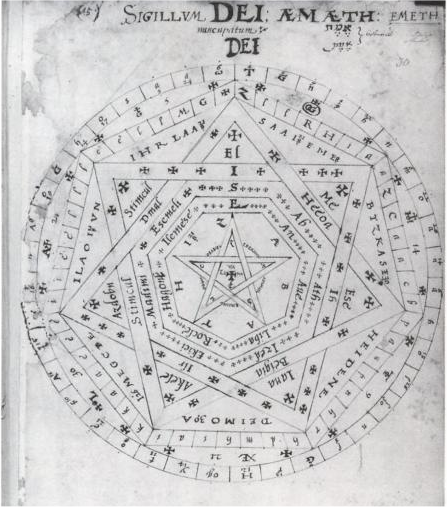
MANUSCRIPTThe historical image is public domain according to its Commons file record. We link to the British Museum’s object photographs instead of republishing them.
Start with what survives
| Dee’s conference book | Sloane MS 3188 records the 1581–83 sessions and a drawn seal. It documents what Dee wrote. |
|---|---|
| Surviving wax objects | British Museum 1838,1232.90.a–c: one large and two smaller discs. They closely follow the diagram; manufacture in Dee’s lifetime remains uncertain. |
| Earlier and later texts | Liber Juratus witnesses predate Dee; Golden Dawn and Crowley presentations postdate him. Neither is a facsimile of his manuscript. |
The British Library catalogues Sloane MS 3188 as a five-book record of Dee’s conferences from December 1581 to May 1583. A modern edited contents guide locates the seal instructions in March 1582. The British Museum’s large disc closely matches a manuscript design, but its first documented sighting is in 1692. That gap belongs in any accurate caption.
What the name refers to
Sigillum Dei can refer broadly to a medieval “Seal of God” tradition preserved in manuscripts of the Liber Juratus. Dee’s Aemeth form is the figure in his own conference record and the seal discussed by later writers. The word “Enochian” is often applied to Dee’s wider Angelical corpus, but the Heptarchia, the Calls, and the Great Table have separate manuscripts and histories.
Core source records
- British Library, Sloane MS 3188 ↗Catalogue of Dee’s 1581–83 conference record; distinguishes it from his later Sloane MS 3191 compilation and notes Ashmole’s copy.
- British Museum, magical disc 1838,1232.90.a ↗Large engraved wax disc, 23.2 cm diameter. Curator compares the inscription with Dee’s diagram and explicitly cautions that manufacture in Dee’s lifetime is uncertain.
- British Museum, magical disc 1838,1232.90.c ↗One of two smaller surviving discs; listed as an associated late-sixteenth-century wax object, not a fourth surviving support.
- British Library, Sloane MS 313 ↗Catalogue records medieval and later witnesses of the Liber Juratus or Sworn Book of Honorius; evidence for a pre-Dee seal tradition.
- Wikimedia Commons, Sloane 3188 Sigillum diagram ↗Dee’s historical drawing is marked public domain and free of known restrictions; source image is a 447 × 507 reproduction.
- Aleister Crowley, Liber Chanokh (Liber LXXXIV) ↗Twentieth-century primary witness to later presentation of the seal and wider Angelical corpus; not a source for Dee’s original wording.
Source method: manuscript and museum catalogues establish holdings and object details; editions help locate text; later ceremonial accounts document reception. A historical image’s public-domain status does not transfer to modern museum photographs or edited transcriptions.