
John Dee’s Holy Table has become an instantly recognizable image of Enochian magic. The common square diagram is a printed witness to a vanished object, not the original furniture itself. Dee’s early conference notes, a seventeenth-century plate, Oxford’s marble copy, and the British Museum’s wax discs each answer a different historical question. Here they are separated by source, date, and material.
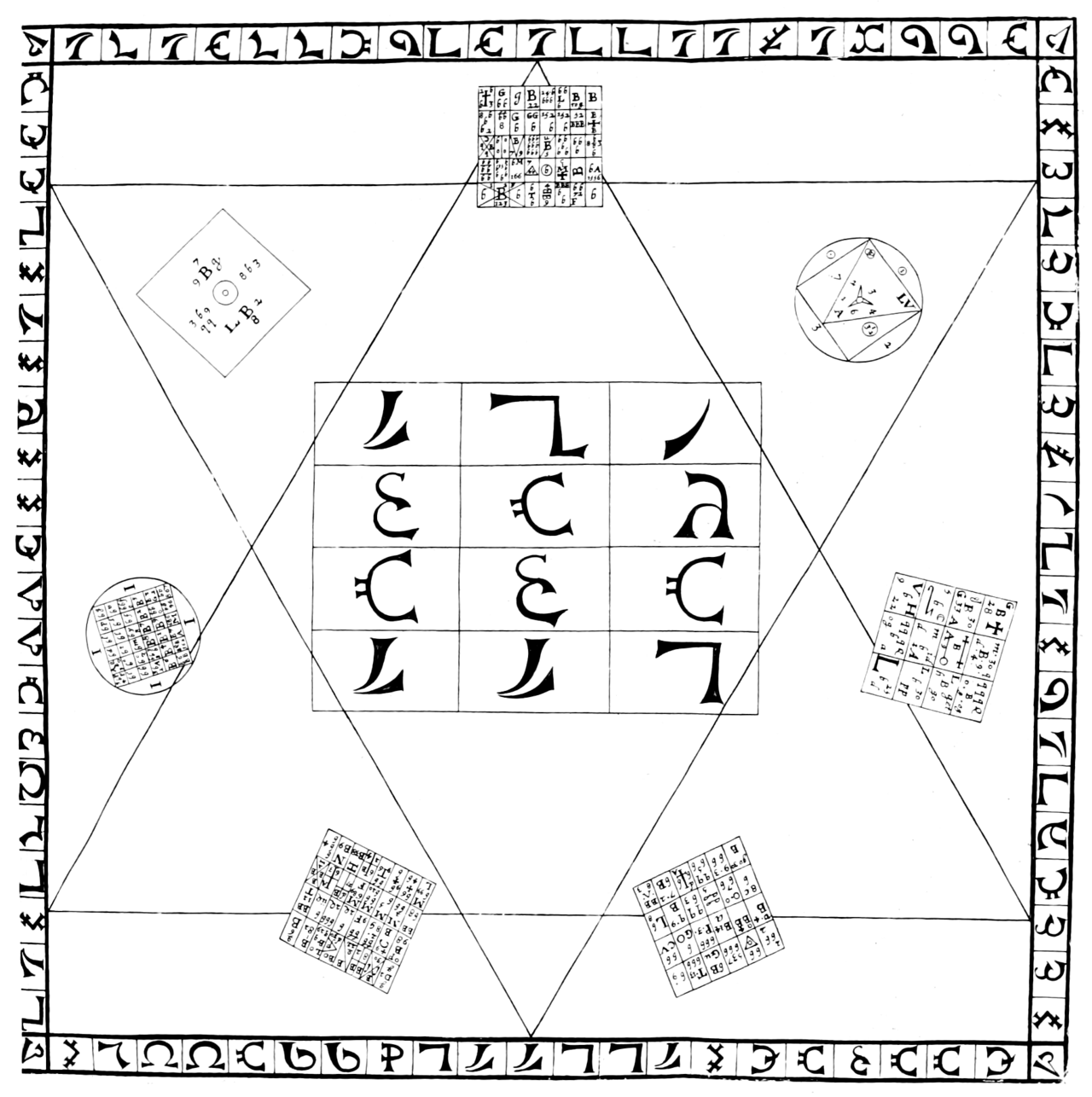
The engraving appeared in the 1659 Relation, decades after the early conferences. The lost wooden table and later Oxford marble copy were different physical objects.
Choose a source-led guide
What does “Table of Practice” mean here?
The name often points to Dee’s square ritual furnishing. It should not be confused with the large letter grids of Liber Loagaeth, the four-part Great Table, or the round Table of Nalvage described in another vision. All circulate under broad “Enochian table” searches, but they have different forms and documentary histories.
The material boundary
The History of Science Museum states that the painted wooden original is lost and its marble object, inventory 15449, copies the 1659 engraving. The British Museum catalogues one large and two smaller wax discs associated with a proposed arrangement under the table and its feet; it cannot establish with certainty that the discs were manufactured during Dee’s life. Read those qualifications with the images, not as fine print after them.
Core records
- British Library · Sloane MS 3188 ↗Catalogue for Dee’s five books of conferences, 22 December 1581–30 May 1583. The volume is a manuscript witness, not the surviving table.
- History of Science Museum · Holy Table, inv. 15449 ↗Museum account of the lost painted wooden original, the mid-seventeenth-century marble copy, and its relationship to the engraving published in 1659.
- British Museum · wax disc 1838,1232.90.a ↗Object record describing the large engraved wax disc, two smaller companions, the proposed table arrangement, and the limits of Dee-lifetime attribution.
- Folger Shakespeare Library · 1659 Relation catalogue ↗Catalogue for Meric Casaubon’s posthumous printed edition; the engraved plate belongs to this later editorial witness.
- Cornell · digitized 1659 Relation ↗Digitized copy of the printed edition, useful for checking plate placement and the surrounding book.
- Wikimedia Commons · Holy Table plate ↗The 1659 engraving is marked public domain. The local image is a reduced-size version already used by this site.
The historic design, physical copy, and interpretive reconstruction are separate evidence layers. Descriptions here document reported practice and surviving evidence; they do not claim a demonstrated supernatural effect.