
The British Library identifies Sloane MS 3189 as Liber Mysteriorum Sextus et Sanctus, also called Liber Logaeth or The Book of Enoch. It attributes the 1583 transcription to Edward Kelley and describes letters and numbers in 49-row by 49-column grids from folio 10r onward. The title “Book of Enoch” is the name used in this sixteenth-century record; it is not proof that the text is the ancient work now called 1 Enoch.
The book as a historical object
The manuscript’s shelfmark and surviving folios distinguish its material record from stories about how its contents were received. Its physical leaves include later titles and arrangement notes, so a table-only online transcript gives an incomplete picture of the bound book. The manuscript guide follows those layers and shows how named folios differ from generic “Enochian table” images.
Why the counts disagree
A leaf has two faces; a page and a ruled table may be counted differently. James R. Davila’s scholarly chronology describes an early holy book in forty-eight pages of 49 by 49 grids. Whitby’s physical inventory instead separates opening prose, ninety-five filled small tables, two empty small tables, and four oversized tables. The British Library gives the whole work’s folio range rather than a definitive count of identical finished grids. The counting guide keeps those units separate.
Read one leaf before counting the whole book
Leaf 1b begins “Oxar varmol pan sampas” and places whole words in most cells before ending with nine rows of single letters. Leaf 2a begins “alla opnay qviemmah” and shifts to one character per cell across the matrix. This small comparison exposes the main analytical problem: Loagaeth changes format before a reader ever reaches the disputed total, so “page,” “face,” and “table” cannot be treated as interchangeable labels.
Keep the neighboring texts in view
Dee and Kelley’s later Angelical Keys are catalogued in Sloane MS 3191 and dated to 1584. The Calls are historically connected to Loagaeth through grid-reference extraction, but their ordered invocations and paired English translations have a different textual form from the untranslated squares. The thirty named Aethyrs and earthly parts have their own manuscript setting. Crowley’s twentieth-century Liber Chanokh is an important reception of the corpus, but it is not Kelley’s 1583 transcription.
Core sources
- British Library, Sloane MS 3189 catalogue ↗Shelfmark, folios, Kelley attribution, physical description, provenance, and current image availability.
- James R. Davila, “The Ninety-Four Books of Ezra and the Angelic Revelations of John Dee” (2018) ↗Academic chronology and separate discussion of the holy book and subsequent Calls.
- Christopher L. Whitby, John Dee’s Actions with Spirits (PhD thesis, 1982) ↗Scholarly manuscript study and transcription of Sloane MS 3188, with a material inventory and analysis of Loagaeth and the later Keys.
- Joseph H. Peterson, edited transcription of Liber Loagaeth ↗A modern editorial transcription with an introduction explaining textual and numbering problems; editorial work remains copyrighted.
- British Library, Sloane MS 3191 catalogue ↗The 1584 Keys and later Liber Scientiae material in a separate manuscript.
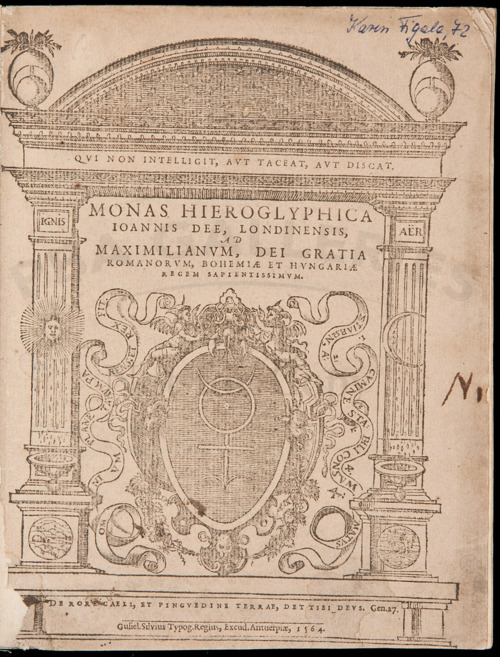
- Wikimedia Commons, 1564 Monas Hieroglyphica title page ↗Image source and public-domain rights record; the title page is contextual, not a Loagaeth leaf.
Historical image: 1564 printed title page, marked public domain in its linked Commons file record.