Grimoires
Grimorium Verum claims Memphis and 1517, yet an [1817] British Library record and earlier French relatives expose a longer transmission.

Was Grimorium Verum really printed in 1517?
The French title page announces “A Memphis, Chez Alibeck, l’Egyptien. 1517.” It also presents the book as a Hebrew translation by Plaingière and invokes Solomon in its long Latin title. These are the print’s claims to authority, not a verified publication history. The British Library holds a 69-page Alibeck copy under shelfmark 8632.aa.5; the catalogue transcription gives its imprint as “1517 [1817],” with 1817 supplied in brackets rather than printed on the book. That distinction matters more than deciding the text must have been composed in exactly 1817. Related material survives in earlier French manuscripts, while no known surviving 1517 printing establishes the title page’s date. The arresting combination of an Egyptian place-name, a Solomonic title, and a supposed Hebrew translation makes the cover a historical clue: it shows how this edition wanted readers to understand its authority.
What is inside the True Grimoire?
The opening pages promise three parts, but the Alibeck printing behaves more like a layered working book than three balanced treatises. It first establishes superior spirits, their deputies, characters, and attributed offices. It then turns from catalogue to preparation: prayers and ritual authority, tools or materials, and formulae establish the conditions under which an address is supposed to occur. Conjurations make the hierarchy operational by naming a superior and directing a subordinate through that chain. The last movement breaks into short “secrets” for practical aims, where a named spirit, sign, substance, or compact recipe may replace the fuller ceremonial frame. That sequence explains the book’s uneven tone. A solemn Latin divine name can stand beside French prose, an administrative list, and a terse experiment because the compiler is joining authorization, spirit taxonomy, and recipes. Reading only the spirit list loses how the book turns ranks into procedure; reading only the recipes loses the superior powers that are meant to authorize them.
The spirit hierarchy and its changing seals
Three superior figures head the printed hierarchy: Lucifer, Béelzébuth, and Astaroth. Their immediate subordinates form a second tier: Satanachia and Agalierept under Lucifer, Tarchimache and Fleruty under Béelzébuth, and Sargatanas and Nebiros under Astaroth. Duke Syrach then introduces a third list of eighteen spirits beginning with Claunech and Musisin. The structure is administrative rather than the Ars Goetia’s sequence of seventy-two individually ranked entries. A Syrach spirit’s office belongs to its place under the duke, while a superior’s name can recur in the book’s authorization and conjurations. This makes a worked comparison useful: Claunech cannot simply be treated as “Goetic spirit number X,” because the Verum supplies a different chain of command and a different surrounding procedure. The drawn characters also identify witnesses. Peterson marks figures missing from the Alibeck copy and compares manuscripts such as Wellcome MS.983; a complete modern plate may silently combine branches. A missing seal or subordinate relationship can reveal more about transmission than a polished redrawing.
The manuscripts behind the printed book
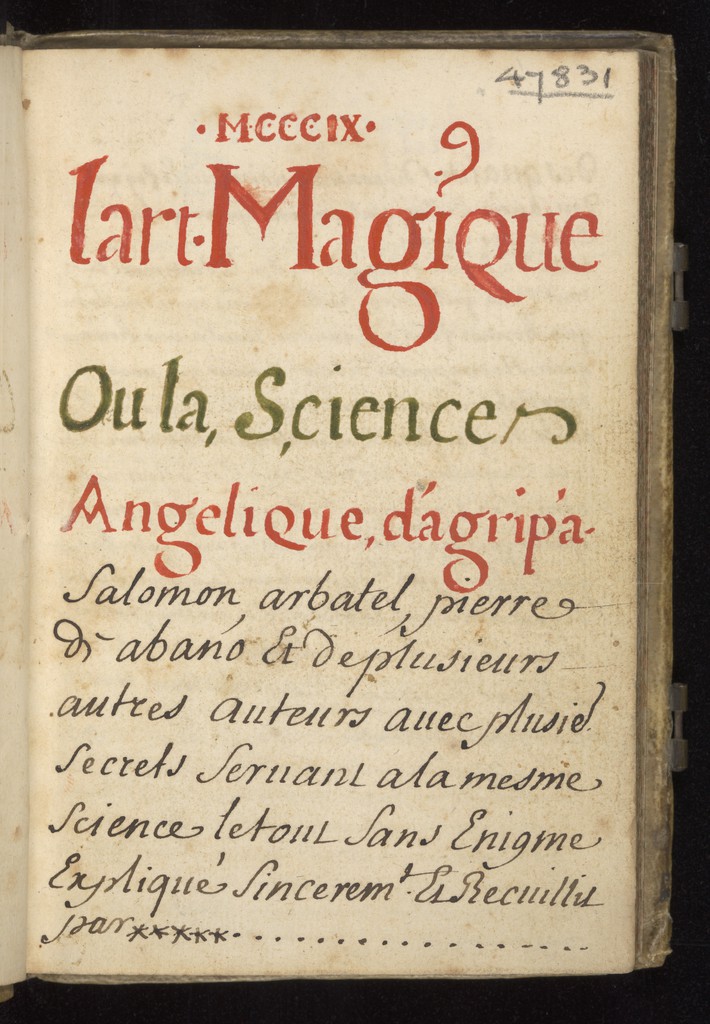
Wellcome Collection dates its French manuscript L’Art Magique, MS.983, to about 1709. Its first tract is a pseudo-Solomonic grimoire related to the later printed Grimorium Verum; the same bound volume also contains material attributed to Pietro d’Abano and a treatise concerning Uriel. It is not an Alibeck printing and does not bear the printed book’s Memphis title page. Even its date calls for care: Wellcome notes the puzzling “MCCCIX” on the manuscript title page and supplies an approximate date. Another French witness, Wellcome MS.4667, is catalogued to the mid-eighteenth century and preserves related Solomonic material. Together, these records show a family of texts in circulation before or alongside the later printed editions, rather than a single book descending unchanged from 1517. The manuscript images are especially revealing where a printed edition refers to a character but omits its drawing.
How the later editions differ
The Alibeck copy is only one stop in the book’s print history. Joseph H. Peterson compares it with a French Blocquel edition of about 1830 and Italian printings by Bestetti in 1868 and Muzzi in 1880. The Italian versions were once treated as evidence of an independent, fuller source, but Peterson’s comparison finds them dependent on the French branch. That does not make every image or spelling interchangeable. A figure absent from Alibeck may appear in a later print, while an editor may restore it from a manuscript whose lines and labels differ again. For example, the Alibeck text names Syrach’s spirits and points to their characters, yet several characters do not survive on its pages; a modern edition’s complete-looking sequence can combine material from several witnesses. Each copy records decisions about what to include, redraw, translate, or leave unexplained.
Questions to explore
- Why does the title page say 1517 when the British Library catalogue supplies [1817]?
- Which named spirits and figures are present in the Alibeck copy itself?
- How does Wellcome MS.983 differ from the later printed book?
- Where did a modern edition obtain a figure missing from its base text?