Grimoires
The Ars Goetia’s seventy-two-spirit catalogue arose through earlier lists, seventeenth-century manuscripts, and modern editions, not Crowley or biblical Solomon.

Where did the Ars Goetia come from?
The Ars Goetia is the first part of the Lemegeton, a compilation of ritual texts known from seventeenth-century manuscripts. Its title invokes Solomon, but that attribution is a claim of authority within the work, not evidence that the biblical king wrote it. The spirit catalogue has an identifiable earlier trail. Johann Weyer published the Pseudomonarchia Daemonum as an appendix to his De praestigiis daemonum in 1577, drawing on a book of spirit offices that he said he had seen. Reginald Scot included an English version in The Discoverie of Witchcraft in 1584; Joseph H. Peterson’s comparison finds that later Goetia wording and errors point especially to the expanded 1665 Scot edition. The Lemegeton compiler joined inherited descriptions to a more elaborate ritual setting. The dates belong to surviving texts and editions, not to the age claimed by their Solomonic framing.
How did Weyer’s 69 spirits become 72?
Weyer's published list contains sixty-nine entries, although one of its own descriptions refers to seventy-two. The Goetia numbers seventy-two. That difference is more involved than adding three names at the end: the English Scot version omitted Weyer’s Pruflas, while the Goetia contains four spirits absent from Weyer’s list. The order of the shared names also changes substantially. Peterson traces many descriptions through Scot’s translation and notes places where a mistranslation or altered spelling survived into the later compilation. This is why an entry can have a different number, name form, or office when two historical lists are placed side by side. Seventy-two became the standard number for the Goetia, but it should not be projected back onto every earlier catalogue. The source trail is a history of selection and rewriting, rather than an unbroken list copied from antiquity.
What are the five books of the Lemegeton?
The Goetia is only the first part. The larger Lemegeton also contains the Theurgia-Goetia, Ars Paulina, Ars Almadel, and Ars Notoria. These parts concern different classes of spirits, angelic or planetary schemes, ritual figures, and prayers; they were assembled from material with separate histories. Some manuscripts contain four parts and leave out the Ars Notoria, so the five-book table of contents is not a guarantee about every copy. The title “Lesser Key of Solomon” is common in modern publishing, while surviving manuscripts often call the work the “little key.” It is also distinct from the Key of Solomon, or Clavicula Salomonis, familiar in S. L. MacGregor Mathers’s separate 1889 edition. That Key is organized around ceremonial preparations and planetary pentacles; it is not another name for the Goetia’s seventy-two-spirit book. The shared Solomonic claim makes the names easy to confuse.
What do the seals and ranks belong to?
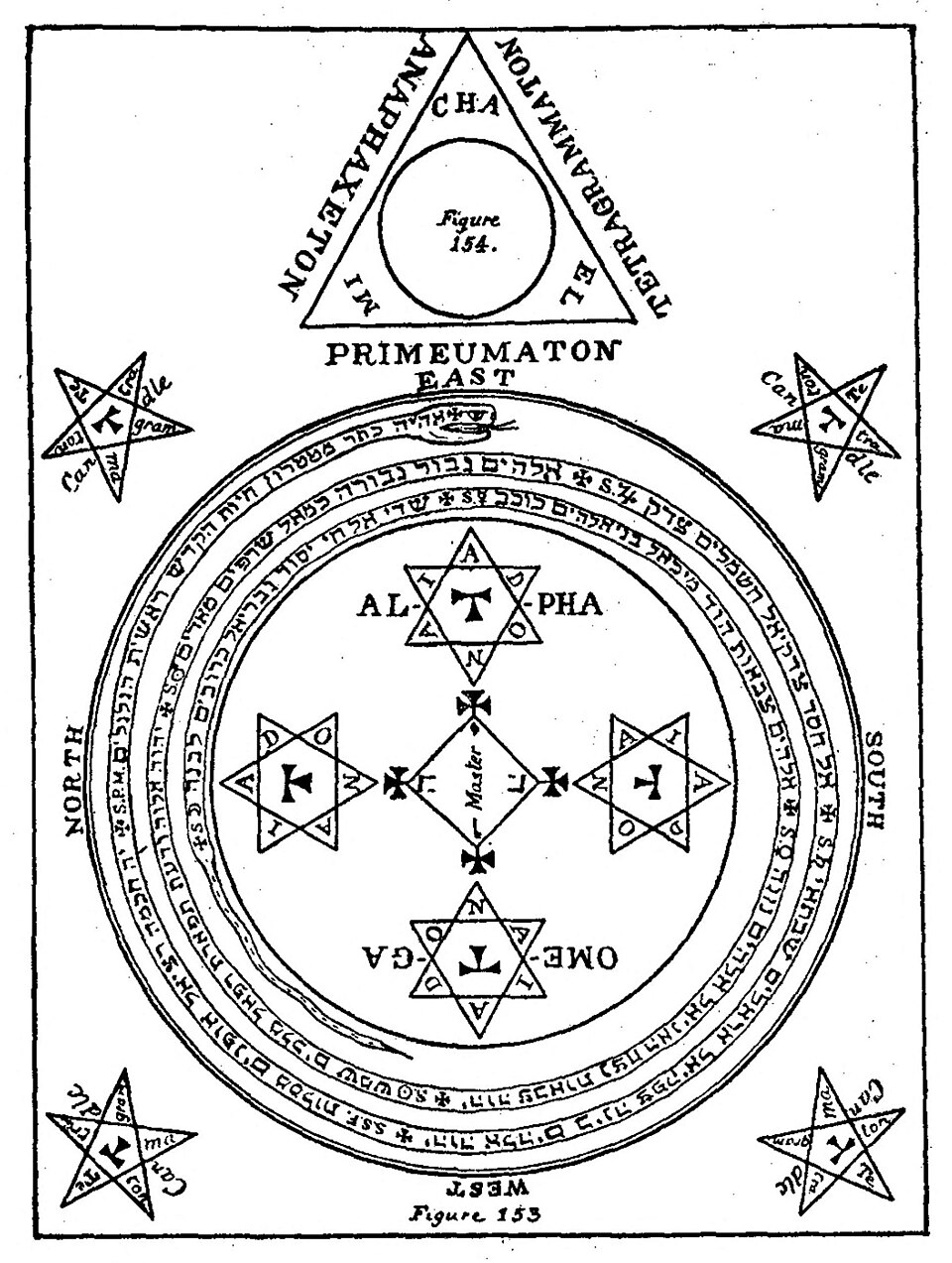
Each Goetia entry can pair a spirit’s name with a rank, an attributed office, a description of its appearance, the number of legions it commands, and a drawn seal. “King,” “duke,” or “president” is the text’s hierarchy, not a title independently established outside it. The familiar seals should also be located in a particular manuscript or printed edition. Peterson observes that the earlier Offices of Spirits material he examined did not carry the same spirit sigils; the Goetia’s drawings belong to its later transmission. Copying can change a line or name, and modern reproductions can flatten those differences into one supposedly fixed symbol. The ritual circle pictured above is from the Mathers–Crowley print edition of 1904. It is a diagram for that edition’s ceremonial setting, not a seal for one of the seventy-two spirits and not an image of every seventeenth-century witness.
What changed with the 1904 edition?
S. L. MacGregor Mathers and Aleister Crowley’s 1904 publication gave English readers an influential printed Goetia with diagrams and editorial framing. It did not create the Lemegeton or invent its spirit sequence. Peterson’s manuscript-based transcription of British Library Sloane MS 3825, with variants from other witnesses, lets readers compare the older wording with the printed version. His edition also identifies alternate spellings in the Mathers–Crowley book that he cannot substantiate in the manuscripts he examined. Public-domain scans of later printings circulate widely, which helps explain why a particular line drawing is often encountered without its publication date. Each named spirit is a claim made by a particular source, whose edition belongs alongside the figure.
Explore the 72 Ars Goetia entries and seals →