
Jacques-Albin-Simon Collin de Plancy first published the Dictionnaire Infernal in Paris in 1818. The book was organized as a dictionary rather than a continuous grimoire: readers could move alphabetically among demons, divination, apparitions, trials, folklore, magic books, and named people. The title remained stable while the work around it changed markedly across the nineteenth century.
- First edition
- Paris, 1818
- Later witness
- Sixth edition, 1863
- 1863 extent
- VIII + 723 pages
An encyclopedia of the infernal world
The word “dictionary” describes the reading experience. An entry might define a spirit from a learned demonological source, summarize a reported haunting, identify a form of divination, or recount a claim about witchcraft. Neighboring entries may come from very different centuries and genres. This arrangement turned a scattered body of lore into a browsable reference work for a general French-reading audience.
That format also explains why the book cannot be reduced to a list of demons. Its long subtitle promises a universal repertory of beings, characters, books, facts, and things connected with spirits, demons, sorcerers, commerce with hell, divinations, hidden sciences, grimoires, cabala, and popular errors. The entries preserve Collin de Plancy’s selection and editorial voice; they do not form a single historical tradition merely because they share one alphabet.
The 1818 starting point
The first edition appeared in Paris from P. Mongie aîné in 1818. Its early date matters because the familiar demon portraits seen across the web belong to a much later state of the book. A scan or description labeled only “Dictionnaire Infernal” may therefore represent substantially different content depending on its edition.
Collin de Plancy’s religious outlook also shifted during the decades in which the title was revised. Early versions often treat marvels and ecclesiastical claims with a skeptical or satirical edge. Later versions were recast after his return to Catholicism and became more compatible with orthodox judgment. The changing tone is part of the publication history, not a minor spelling variation.
Expansion through later editions
The title was repeatedly reworked rather than simply reprinted page for page. The Library of Congress describes an 1844 edition of 582 pages, while the Bibliothèque nationale de France records the sixth edition published by Henri Plon in 1863 as VIII plus 723 pages. Page counts alone do not prove what changed in each entry, but they make the physical expansion visible.
The 1863 title page advertises a sixth edition enlarged with 800 new articles and illustrated with 550 engravings. Those claims describe the publisher’s expanded package: a denser encyclopedia joined to a major visual program. The resulting volume is the edition most readily recognized today, even though it arrived forty-five years after the first.
Worked comparison: Astaroth in 1818 and 1863
The Astaroth headword shows how completely one entry could be rebuilt. On page 56 of the 1818 first volume, Astaroth occupies only four short lines: he is the demon of riches and hell’s grand treasurer, permitted to offer an opinion when new laws are proposed even though he does not sit on the infernal council. The next headword, Astarté, then explains Astaroth as the sun and Astarté as the moon, calling such stories allegories like those of ancient mythology. The sequence turns the infernal office into a dry bureaucratic joke and then supplies a rationalizing exit from it.
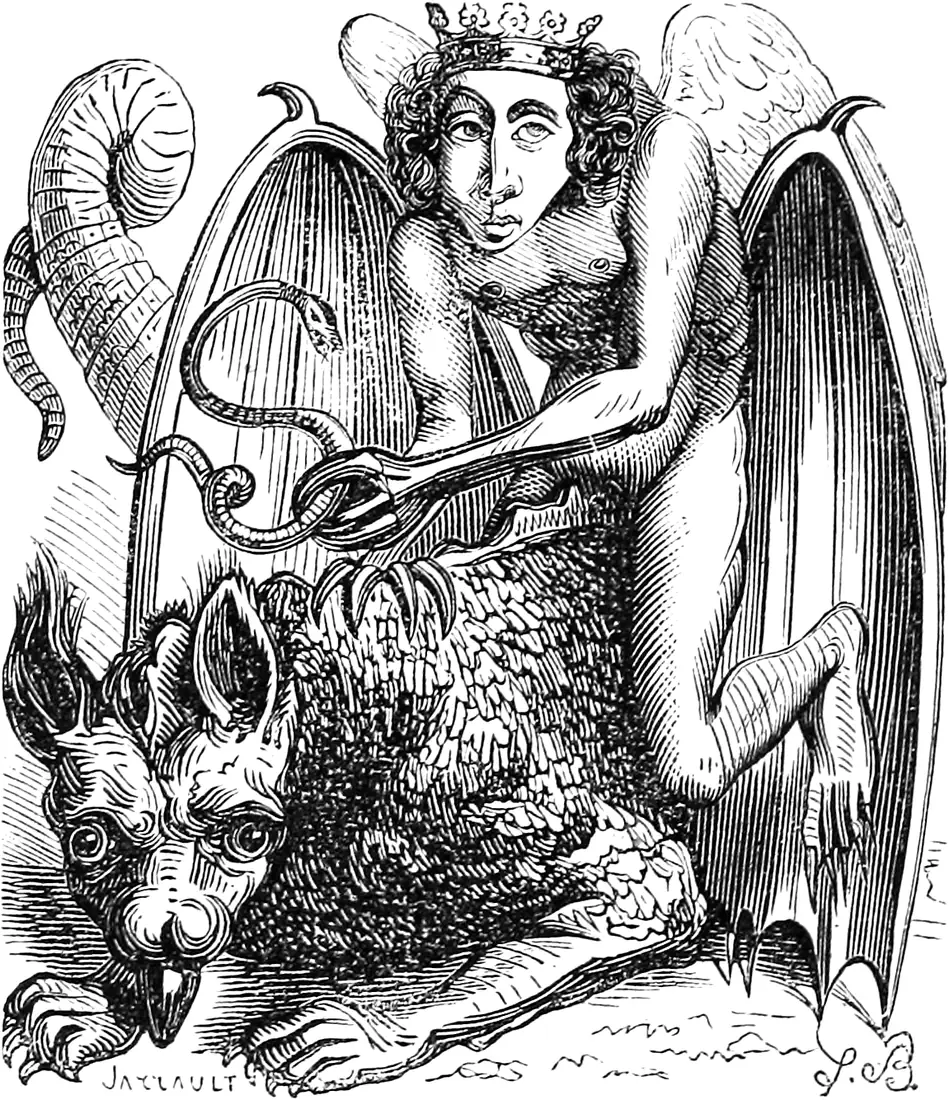
The 1863 entry keeps the treasury office but builds a much larger dossier around it. Astaroth is now a powerful grand duke shaped like an ugly angel, riding an infernal dragon and holding a viper. The entry adds the west, Wednesday, friendship with great lords, forty legions, knowledge of past and future, instruction in the liberal arts, a claim that his punishment was unjust, the danger of his stench, reported possessions, and the serpent form attributed to him in an English Faust tradition. Collin de Plancy names Wierus for much of this material. Instead of reducing the figure to solar allegory, the later article gathers rank, appearance, powers, ritual caution, and literary reception into one reference file.
Le Breton’s engraving makes that accumulation look like one coherent being. Crown, wings, human torso, viper, and dragon mount appear together at a glance, while the printed prose had assembled them as separate clauses from different traditions. The picture stresses rank and body but leaves the entry’s invisible offices and claims; treasurer, teacher, keeper of secrets, commander of forty legions; outside the frame. It therefore does more than decorate the page: it gives the composite dossier a stable face that can be remembered and detached from the surrounding dictionary.
That visual consolidation helps explain why the sixth edition dominates modern reception. A reader of 1818 meets a compact satirical official whose story is immediately allegorized; a reader of 1863 meets an illustrated demonological profile with enough attributes to function as a self-contained character. Reproductions of the portrait preserve the crown, viper, wings, and dragon even when the entry’s named sources and contradictory layers disappear. The familiar online Astaroth is consequently a product of the sixth edition’s editorial expansion and page design, not an image carried unchanged from the first edition.
Source records and digitized editions
- WorldCat record for the 1818 Paris edition ↗
- Wikimedia Commons scan of the 1818 first edition, volume 1 ↗
- Library of Congress record for the 1844 edition ↗
- Bibliothèque nationale de France record for the 1863 sixth edition ↗
- Library of Congress record and digital copy for the 1863 edition ↗
- WorldCat record for the illustrated 1863 sixth edition ↗
- Wikisource transcription and scan of the 1863 Astaroth entry ↗
- Wikimedia Commons record for Le Breton’s Astaroth engraving ↗