
From Tobit and Sarah to gambling lore, Asmodée’s 1863 dossier sprawls; Le Breton answers with a three-headed dragon rider, while Ars Goetia 32 names Asmoday.
- 1863 headword
- Asmodée
- Ars Goetia
- No. 32 · King
- Legions
- Dictionnaire 72 · Goetia 72
What Collin de Plancy’s Asmodée entry says
Asmodée receives one of the dictionary’s longest demon articles. Collin de Plancy calls him destructive, links him with gambling houses, dissipation, and error, then retells traditions involving Solomon, Tobit, Sarah, Raphael, Egyptian serpent worship, and later literature. The entry eventually reaches Weyer’s infernal king: three heads, serpent tail, goose feet, fiery breath, dragon mount, banner and lance, instruction in mathematical and mechanical arts, invisibility, treasure, and seventy-two legions.
The article is a reception history organized under one name. Biblical and rabbinic stories, travel claims, antiquarian equations, demonological catalogue, possession narrative, and Le Sage’s novel sit beside one another. Its structure shows why “Asmodée” cannot be reduced to the three-headed figure even though that figure supplies the famous illustration.
Reading Louis Le Breton’s 1863 portrait
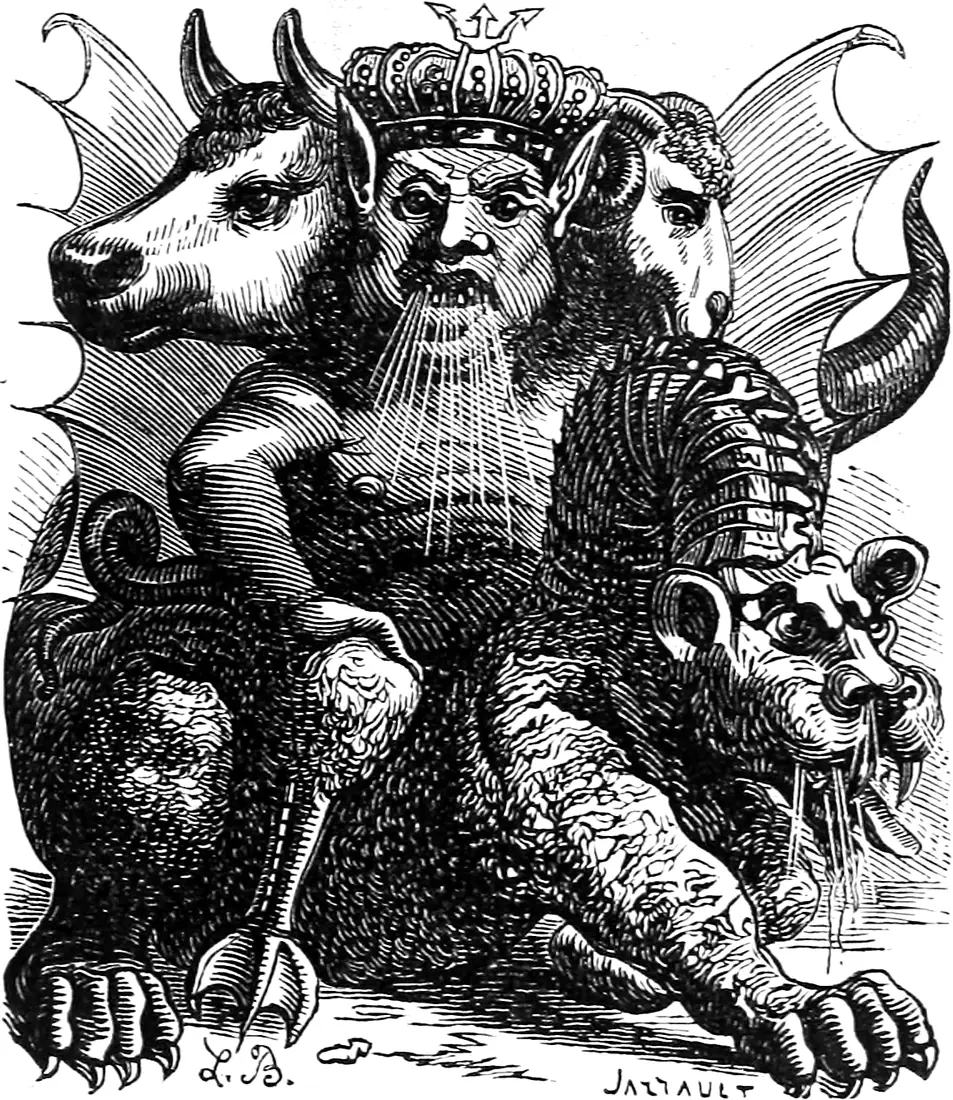
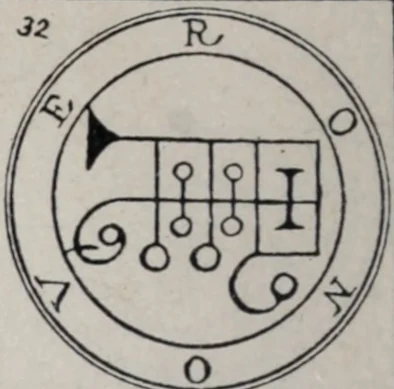
Le Breton selects the Weyer section and builds a crowded mounted portrait. Bull, human, and ram heads rise above a torso with banner and lance; goose-like feet and a serpent tail complicate the body; a dragon supports the whole group. The stacked attributes create visual excess appropriate to a king whose dictionary entry already carries many traditions.
The engraving is an editorial extraction from a much longer article. Asmoday’s Goetia seal belongs to the numbered grimoire entry and depicts none of the narrative scenes involving Solomon, Sarah, Raphael, or the gaming house. Portrait and seal identify two layers within a reception extending far beyond either image.
Asmodée and Ars Goetia spirit 32
The Goetia shares the three heads, serpent tail, goose feet, fiery breath, dragon, banner and lance, kingly rank, mathematical and craft instruction, treasure, and seventy-two legions. It also places Asmoday under Amaymon.
The Dictionnaire supplies gambling, dissipation, Solomon and Tobit traditions, Egyptian travel lore, possession, and literary reception, while also adding invisibility and special rings. The Goetia concentrates on the catalogue offices and claims invincibility rather than recounting the larger Asmodeus tradition. The French name Asmodée and English Asmoday mark different reception settings.
Worked comparison: finding the illustrated paragraph inside a long dossier
Move through the Dictionnaire entry and underline only details visible in the engraving: three heads, tail, feet, dragon, banner, and lance. They cluster in the Weyer paragraph well after the opening discussion of gambling and the Solomon and Tobit stories. The image therefore maps to one embedded source layer rather than to the whole article.
This placement changes how the portrait should be read. It is a rendering of the catalogue Asmodée within an encyclopedia of many Asmodeus traditions. The matching Goetia description confirms that layer, while its seal remains a separate sign and the other narrative layers remain unillustrated.