
Le Breton’s 1863 Byleth contains three feline musicians and no horse; the prose supplies one white horse and 80 legions, Ars Goetia 13 gives Beleth 85.
- 1863 headword
- Byleth
- Ars Goetia
- No. 13 · King
- Legions
- Dictionnaire 80 · Goetia 85
What Collin de Plancy’s Byleth entry says
The dictionary’s Byleth is a strong and terrible king on a white horse, preceded by cats sounding horns and trumpets. The article devotes most of its space to a ceremonial encounter: a hazel wand, a southeast-facing triangle, binding formula, wine set inside the triangle, elaborate courtesy, and a silver ring held before the face. After this staged negotiation it promises exceptional power, recalls Byleth’s former celestial rank, and counts eighty legions.
This is more than a list of powers. The entry dramatizes rank through protocol: direction, boundary, gift, greeting, compliment, and jewelry all regulate the meeting. Collin de Plancy’s skeptical closing comment about a hoped-for heavenly throne interrupts the inherited ritual description and reminds the reader that the dictionary has an editorial voice.
Reading Louis Le Breton’s 1863 portrait
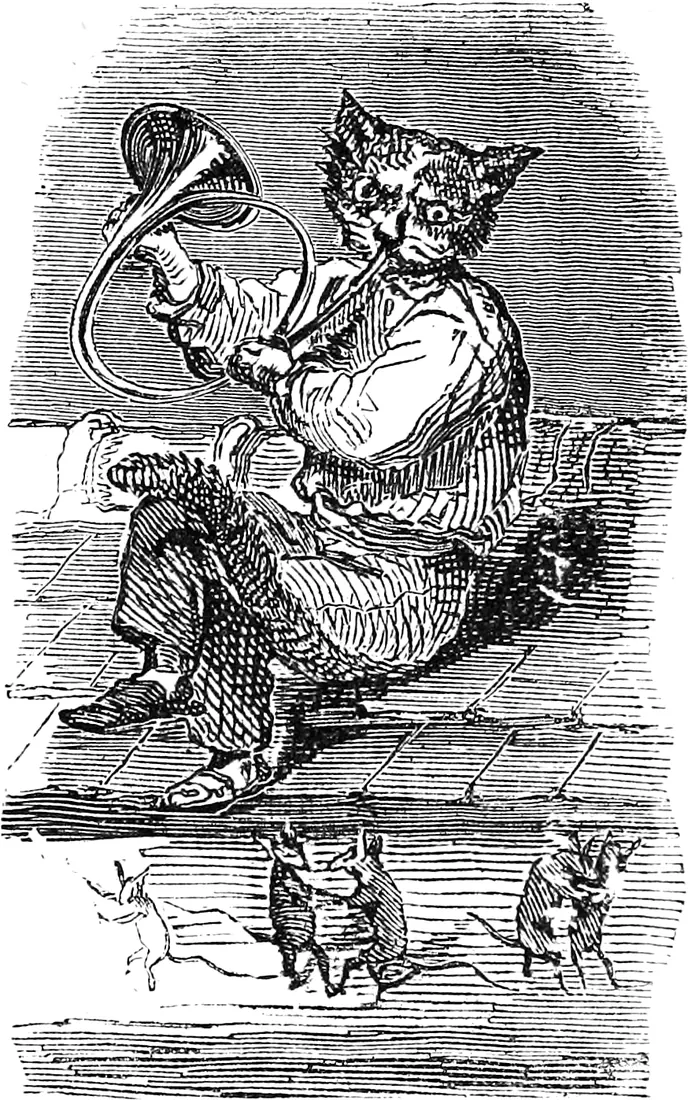
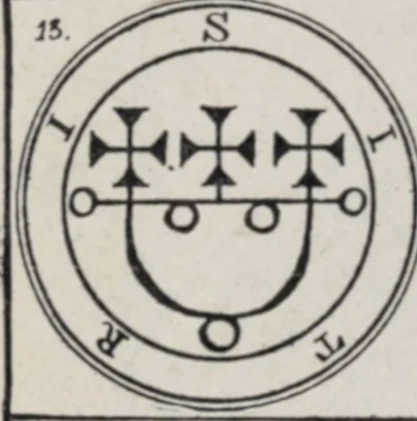
Le Breton centers the engraving on a seated feline musician in human clothing who blows a large coiled horn. Two smaller cats stand below the platform, one facing forward and one in profile. The pale horse, crown, royal rider, triangle, wine, wand, and ring described in the surrounding article do not appear; the vignette selects the French entry’s strange cat heralds instead of the king they announce.
The image makes music and species, rather than royal arrival, the identifying event. Enlarging one cat into an anthropomorphic horn player gives the sound a performer, while the pair below turns the plural musicians into a compact group. Beleth’s Goetia seal and catalogue prose preserve the king and ceremonial encounter that this Byleth vignette leaves offstage, so the two visual records emphasize different parts of the transmission.
Byleth and Ars Goetia spirit 13
Both traditions describe a fearsome king on a pale horse announced by music and give a long account of controlling the encounter. Royal courtesy, a triangle, a wand or staff, a silver ring, and a former place among Powers recur in both.
The Dictionnaire turns the musicians into cats, adds wine and a sequence of compliments, and reports eighty legions. The Goetia print calls the spirit Beleth or Bileth, speaks of musicians rather than feline players, focuses the office on love, and reports eighty-five legions. The five-legion difference is a clean witness-level divergence.
Worked comparison: eighty or eighty-five legions?
Record the number printed at the end of each entry without averaging it. Byleth in the 1863 dictionary has eighty legions; Beleth in the Goetia edition has eighty-five. The three visible feline musicians are not a miniature legion count, and the seal carries no numeral explaining the host. The discrepancy belongs in the comparison rather than being silently normalized.
The same method applies to names and musicians. Byleth and Beleth, cats and unnamed players, eighty and eighty-five are evidence of transmission. The engraving intensifies the French cats while omitting the king and horse, and the Goetia seal maintains the catalogue connection without restoring that missing procession. Agreement and difference therefore remain visible at the same time.