
Sigil of Beleth
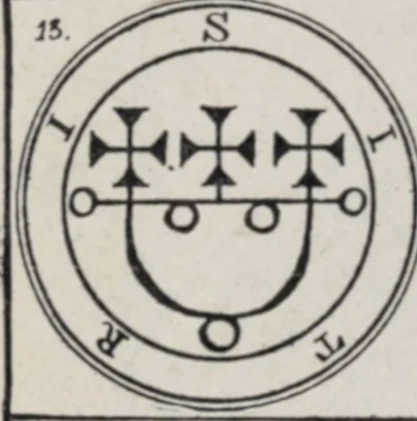
At a glance
- Entry
- 13 of 72
- Rank
- King
- Legions
- 85 in the text
- Also written
- Bileth, Bilet
Description in the text
Beleth receives one of the longest ceremonial entries in the catalogue. It attributes to him the power to bring about love and places particular emphasis on his royal status and formidable arrival.
Read entry 13 on page 25 of the 1916 edition
Appearance
A fearsome king on a pale horse, with trumpets and other music before him.
Topics attributed to this entry
- Love
- Kingship
Reading this entry
Beleth, also spelled Bileth or Bilet, is a king who arrives on a pale horse with trumpets and other music. His entry is far longer than its single attributed office, causing love between people, might require. Most of the space concerns a furious arrival, a triangle, a wand, a ring, and the respectful reception due to a king. These are details of the grimoire’s ritual scenario, not instructions needed to understand the historical figure.
The account treats royal rank as consequential: the operator is told to combine firmness with courtesy and to acknowledge the king’s attendants. It also places Beleth in the Order of Powers and assigns him 85 legions. The ceremonial material distinguishes this entry from other love-related spirits such as Sallos or Zepar. A brief label like “love demon” misses how heavily the source emphasizes hierarchy and controlled encounter.
Read entry 13 on page 25 of the 1916 edition or compare the 1904 transcription.
A closer reading of entry 13
What the numbered text says
Beleth has a long entry because the catalogue pauses over courtly treatment and ceremonial control of a king. The pale horse and music establish an imposing arrival; the later claims about affection are brief by comparison. The passage names an Order of Powers and 85 legions, locating him in its internal hierarchy. Its elaborate encounter scene should be read as period ritual literature rather than practical advice or evidence that the claimed influence occurs.
About the printed seal
The source calls the drawing a noble seal. Number 13 appears on the 1916 third frontispiece, beside the surrounding entries. The printed mark identifies an entry in this edition; the prose does not decode its lines as horse, trumpet, or royal regalia.
Compare another entry
Compare entry 19: Sallos. Sallos is also assigned an affection office, yet his account calls the crocodile rider peaceable and spends almost no space on ceremony. Beleth is described as furious on arrival and receives an extended royal encounter. The same broad love category conceals a different literary emphasis.