
Sigil of Purson
At a glance
- Entry
- 20 of 72
- Rank
- King
- Legions
- 22 in the text
Description in the text
Purson is credited with discovering hidden treasure and telling the past, present, and future. His entry also says he answers questions about earthly and divine secrets and can bring forth familiars.
Read entry 20 on page 28 of the 1916 edition
Appearance
A lion-faced man riding a bear, carrying a viper, with trumpets sounding before him.
Topics attributed to this entry
- Hidden treasure
- Divination
- Familiars
Reading this entry
Purson is a king with a lionlike face, riding a bear, carrying a viper, and preceded by trumpets. The pageant recalls other royal entries, but his offices emphasize inquiry: hidden treasure, events across past, present, and future, and answers about earthly and divine secrets. The text even includes questions about the creation of the world. It says he can take either a human or airy body, adding a second kind of shape change to the initial portrait.
Purson is also credited with producing familiars. His 22 legions are described as drawn partly from the Orders of Virtues and Thrones, so the account embeds him in an angelic classification as well as the kingly rank. The combination of royal procession, cosmological questions, and mixed-order following makes this more specific than a generic treasure-finding entry. None of its promised answers are independently verified by the source.
Read entry 20 on page 28 of the 1916 edition or compare the 1904 transcription.
A closer reading of entry 20
What the numbered text says
Purson’s kingly procession mixes a lion-faced human, bear mount, viper, and trumpets. His knowledge claims are unusually expansive, moving from concealed treasure and threefold time to earthly and divine matters and creation. The entry also permits either human or aerial body and divides his 22 legions between Virtues and Thrones. These orders are part of the text’s imagined hierarchy; they should not be merged into a single unqualified “oracle” description.
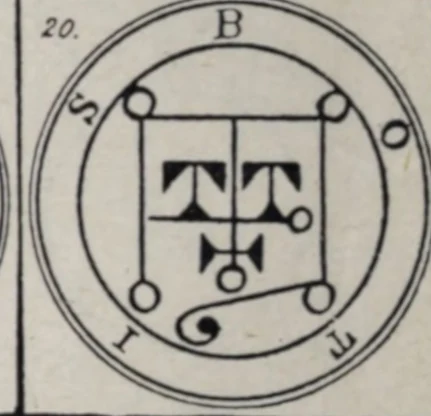
About the printed seal
The passage names a mark, seal, or character, three terms for its associated sign. Number 20 appears on the third 1916 frontispiece. The emblem identifies the entry; no source key says its strokes stand for the bear, viper, trumpet, or the two angelic orders.
Compare another entry
Compare entry 26: Bune. Bune too is associated with wealth and truthful answers, but his account places those claims beside the dead and tombs and explicitly discusses two seals. Purson’s kingly entry instead foregrounds knowledge over time, creation, and the distinction between Virtues and Thrones.