
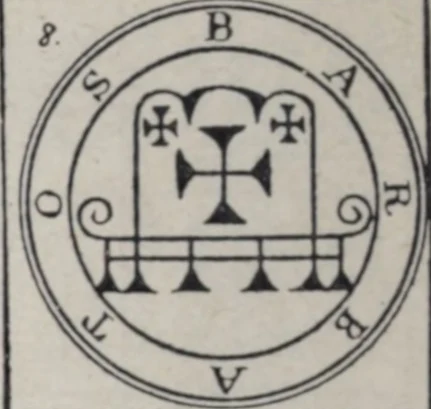
Three floating horns orbit Le Breton’s plumed, gun-bearing Barbatos in 1863; Ars Goetia 8 retains four noble kings without the forest hunter or their music.
- 1863 headword
- Barbatos
- Ars Goetia
- No. 8 · Duke
- Legions
- Dictionnaire 30 · Goetia 30
What Collin de Plancy’s Barbatos entry says
Collin de Plancy calls Barbatos a count-duke and likens him to Robin Hood. He appears as an archer or hunter in forests while four kings sound horns before him. His offices include interpreting birds, bulls, dogs, and other animals, finding treasure hidden by magicians, reconciling friends, and knowing past and future. The article gives him thirty legions and remembers a former place among celestial Virtues or Dominations.
The Robin Hood comparison is editorial shorthand for a nineteenth-century reader. It turns the forest archer into a familiar cultural type while the remaining clauses retain demonological rank and offices. Sound binds the scene together: horns announce the procession, and animal cries become intelligible speech.
Reading Louis Le Breton’s 1863 portrait
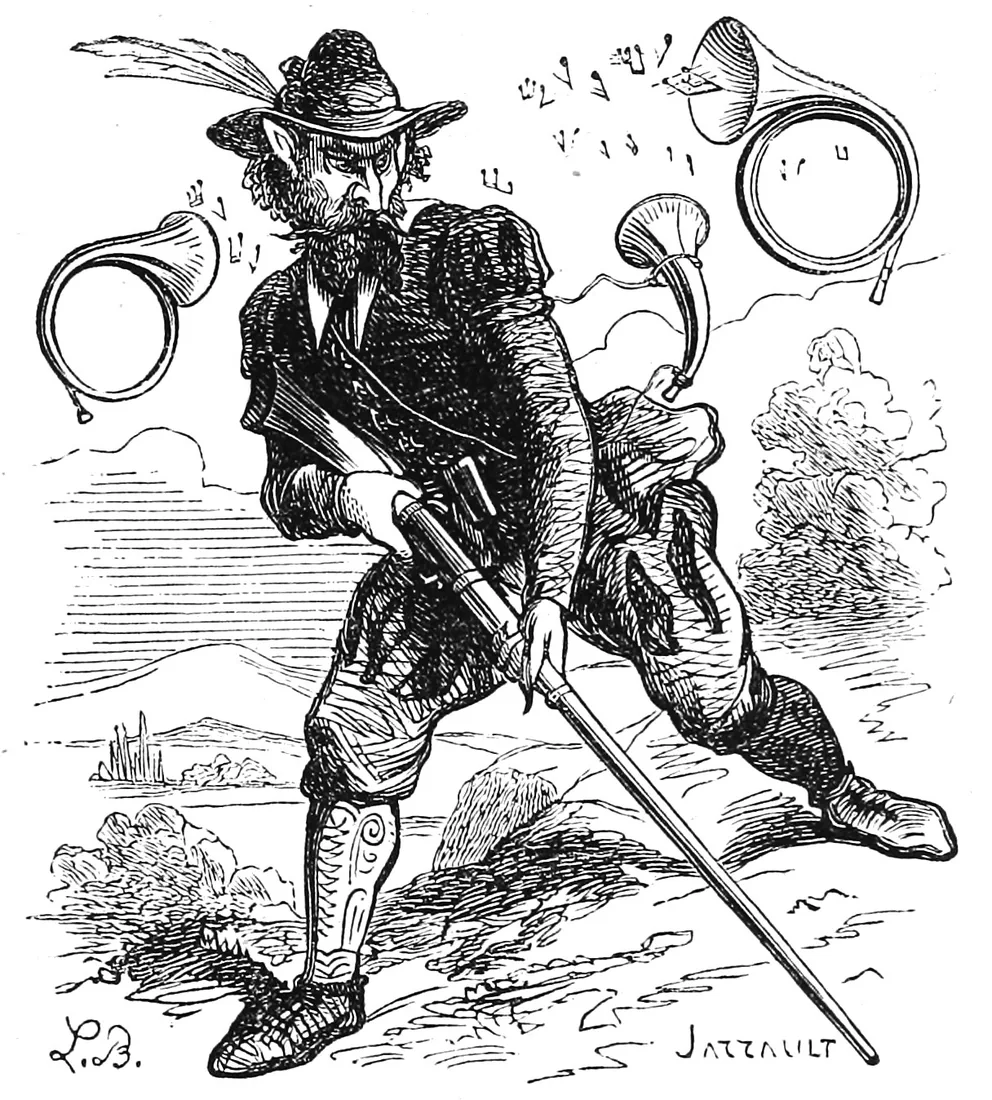
Le Breton presents a bearded hunter in a plumed hat striding through rocky woodland with a long gun held diagonally across his body. Three detached hunting horns float around him, turning the sounding procession into a visible ring of instruments even though the four kings themselves do not appear. The firearm, feather, boots, and game bag place the supernatural title inside a recognizable nineteenth-century hunting scene.
The illustration translates Collin de Plancy’s Robin Hood comparison into visual genre without copying it literally: this hunter carries a gun rather than a bow. The three floating horns preserve the entry’s acoustic display but not its count of four royal players. Barbatos’s Goetia seal has no forest, weapon, or music; it identifies the numbered catalogue record through a separate line design.
Barbatos and Ars Goetia spirit 8
The Goetia preserves the four noble kings and their companies, animal speech, enchanted treasure, knowledge of past and future, reconciliation, and thirty legions. It places the appearance under Sagittarius rather than describing a Robin Hood figure.
The Dictionnaire supplies the forest, hunter’s body, and explicit Robin Hood type that made Le Breton’s composition possible. It broadens the angelic ancestry and calls Barbatos both count and duke. The Goetia is more specific about the solar condition and about people in power among those who may be reconciled.
Worked comparison: where did the hunter come from?
Cover the image and list what the Goetia actually supplies: a duke, four kings, companies, Sagittarius, animal voices, treasure, time knowledge, and reconciliation. None requires a forest costume or firearm. Restore the Dictionnaire entry and the hunter type appears; restore the engraving and three free-floating horns make the shared musical arrival visible without drawing the kings. Text and image therefore contribute different steps to the familiar scene.
The exercise traces the woodland character to the French editorial layer and the procession to a shared catalogue layer. Le Breton then makes two further decisions: he equips the hunter with a long gun and replaces four royal heralds with three visible horns. The seal preserves identification without any of that narrative staging, so the three records should not be treated as interchangeable pictures.