Grimoires
The Key of Solomon joins prayer, planetary timing, circles, and pentacles in a manuscript tradition distinct from the Lesser Key’s Goetia.

What is the Key of Solomon?
The Key of Solomon is a book of ceremonial instructions that claims the authority of the biblical king. Its Latin title is Clavicula Salomonis. The surviving work belongs to a much later manuscript tradition, so its title is an attribution rather than evidence of a royal autograph. In one introductory story, Solomon passes the book to his son Rehoboam; that story tells us how the text presents its authority, not when it was written. What gives the Key its distinctive character is the combination of prayers, divine names, planetary timing, ritual circles, prepared objects, and pentacles. It is a text about arranging a ceremonial act, not a simple catalogue of named demons. The pages people read today often come from a particular translation or edited manuscript, and those versions do not agree in every detail.
What is inside the two books?
In S. L. MacGregor Mathers’s influential 1889 edition, the Key is arranged in two books. Book I discusses when to work, how to construct a circle, how prayers and conjurations fit into the ceremony, and how pentacles are made and used. Book II attends to preparation: washing, garments, instruments, writing materials, incense, and other objects named in the instructions. The organization makes the text easier to understand than a gallery of isolated symbols. A pentacle appears within a sequence of timing, words, materials, and actions; the surrounding chapters explain the role the book assigns it. This two-book description applies to Mathers’s edition, however, rather than every surviving copy. He himself described a French manuscript, Lansdowne 1203, as arranged in one book without chapters. The work traveled through manuscripts that could change both wording and order.
Pentacles and planetary hours
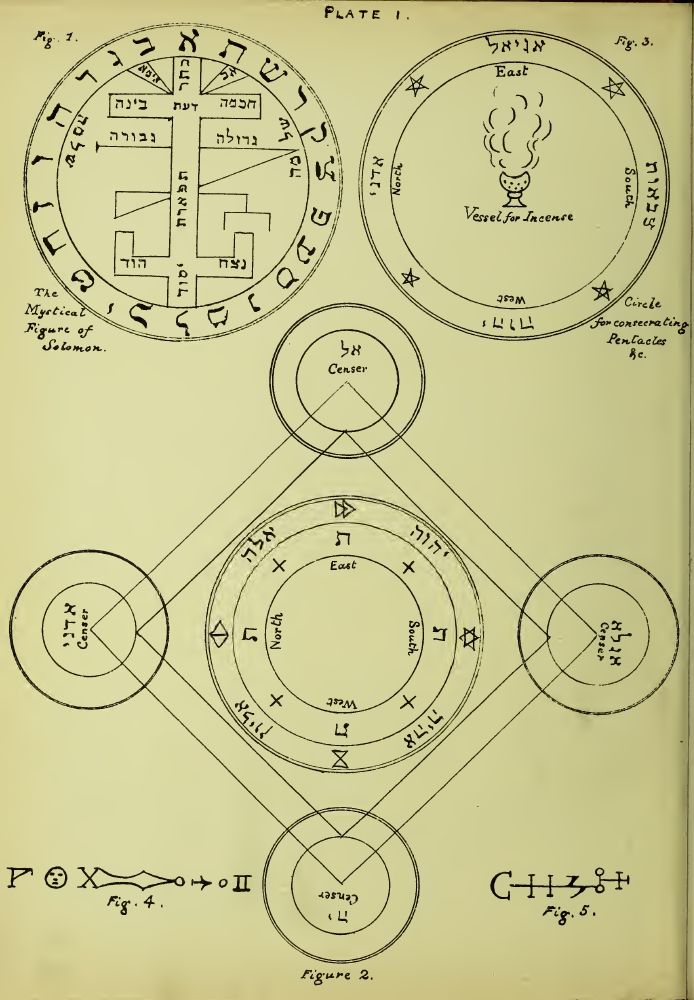
The Key’s pentacles are inscribed figures that the text associates with ritual purposes. Mathers’s edition groups them under Saturn, Jupiter, Mars, the Sun, Venus, Mercury, and the Moon. They are more than the five-pointed star that the word “pentacle” may suggest today: many are circles of divine names, letters, scriptural verses, and other marks. The text also assigns importance to days and hours ruled by planets. On the plate above, one drawing is labelled a circle for consecrating pentacles, while another lays out a larger ritual circle with directions and attendant spaces. Those labels make the image worth studying as a page from an 1889 edition rather than as an interchangeable occult emblem. Mathers compared several manuscripts and reconstructed portions of the Hebrew lettering, so even the familiar printed figures reflect editorial choices. A figure’s exact form and planetary assignment can vary between witnesses.
Is it the same as the Lesser Key?
No. The Lesser Key of Solomon, also called the Lemegeton, is a different compilation assembled later from several bodies of material. Its Ars Goetia section is famous for a list of seventy-two spirits with names, offices, and seals. Those seventy-two entries are not the contents of the Key of Solomon described here. The two works share a claimed connection to Solomon and some ceremonial vocabulary, which helps explain why search results and book covers often blur them. “Greater Key” is another common label for the Clavicula Salomonis, but the older book is generally titled simply the Key of Solomon. If you have a particular seal in mind, look first for the title and edition printed with it: a planetary pentacle from Mathers’s Key and a spirit seal from the Ars Goetia belong to different textual settings.
How did the 1889 edition shape what we see?
Mathers presented his English Key as a translation and edition from manuscripts held in the British Museum. His preface names witnesses in Latin, French, and Italian and describes differences among their chapters and drawings. He chose and arranged material, then supplied printed plates that readers could reproduce and circulate much more easily than a handwritten folio. Wellcome Collection preserves a digitized copy of the London edition, published by George Redway in 1889, including its illustrated plates. Its tidy presentation helped make this version a standard point of reference, but it did not erase the older variations. Pentacles that look similar can come from different manuscripts, editorial reconstructions, or later publications, each with a distinct historical form.
Compare Key of Solomon manuscripts, plates, and editions →
Questions to explore
- Does this image show a planetary pentacle from the Key or a spirit seal from the Ars Goetia?
- Which book and chapter surround a figure in the edition you are reading?
- What changes when a manuscript drawing becomes a printed plate?