
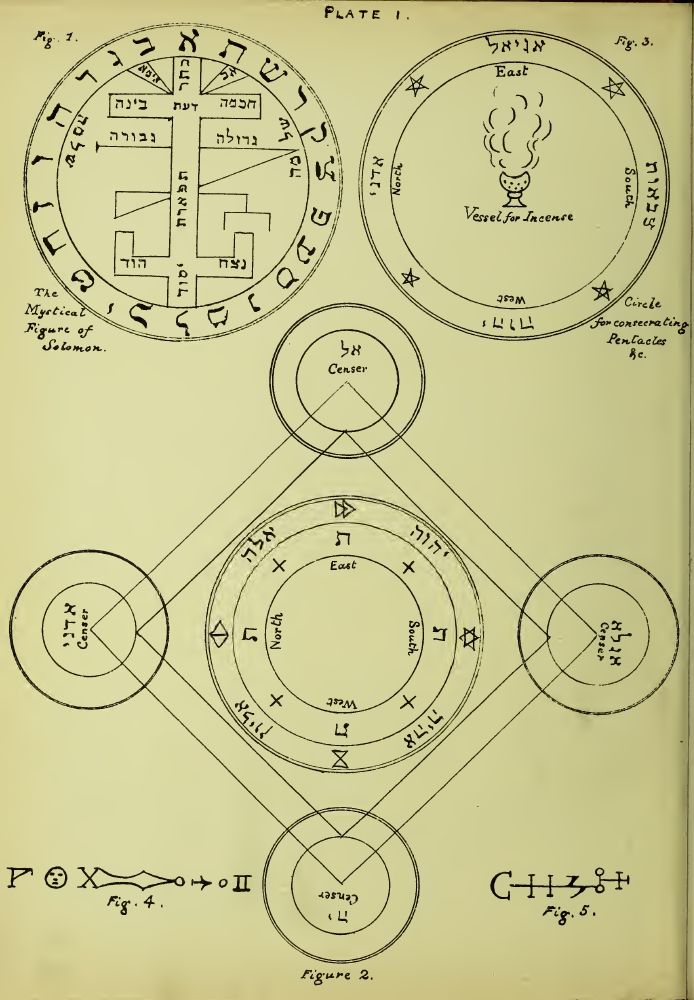
The Key of Solomon names a manuscript tradition attributed to the biblical king. Language, contents, and diagrams differ among the surviving copies. The 1889 Mathers edition made a particular English presentation and set of plates widely available.
Catalogued objects establish what survives; an editor’s treatment determines the resulting edition. It keeps the Clavicula separate from the later five-book Lemegeton, often called the Lesser Key. No page treats a legendary authorship claim as a dated historical fact.
The image is a public-domain plate from the 1889 print, not a photograph of a medieval manuscript. Its caption and source link stay beside it.
- French witness
- Sloane MS 2731
- Later copy
- Lansdowne MS 1203
- English edition
- Mathers, London 1889
Choose a guide
Why this archive matters
Search results frequently combine pentacles from the Key with spirit seals from the Goetia. The two source families need separate bibliographies. A shelfmark or dated edition also keeps an illustration from drifting away from its caption. The guides below compare manuscripts, the Mathers print, the diagrams’ setting, and the Greater/Lesser Key naming problem.
For the wider tradition, use the Occult & Esoteric History directory and grimoire bibliography. The Lemegeton reading room maps the five-part Lesser Key separately.