Publications
The Equinox is an edited periodical where ritual instruction, records, fiction, poetry, reviews, and polemic change one another by proximity.

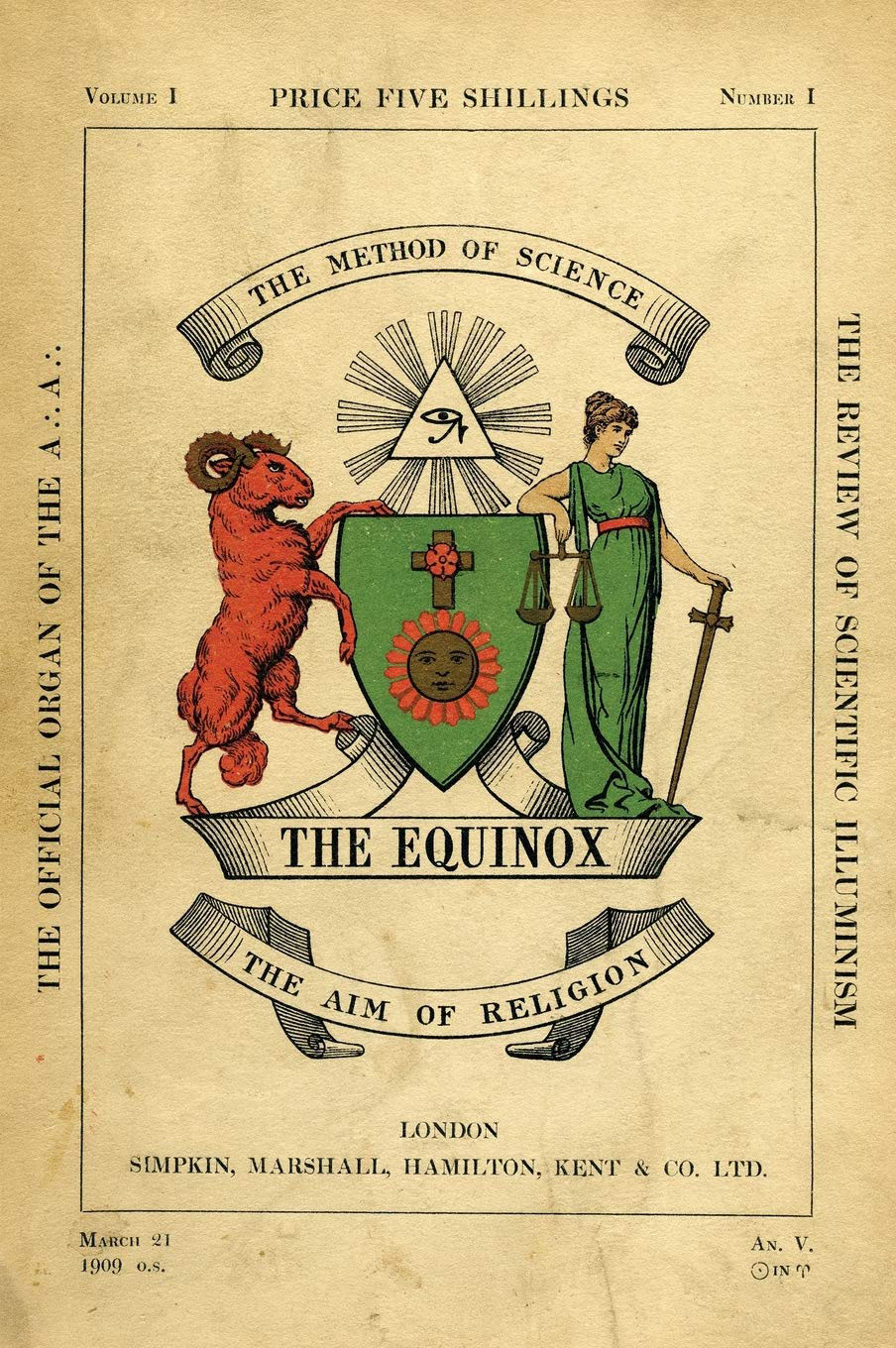
Ten early issues, many genres
The Equinox began in London in 1909 under Aleister Crowley’s editorship. Its first volume comprised ten issues through 1913, bringing together instruction, literary writing, review, polemic, and material connected with his esoteric organizations. It was a periodical, not a single grimoire that appeared in one finished state. The University of Pennsylvania’s Online Books Page records the early run and its later irregular publication history, while the issue index preserves dates and separate numbers. Even within Volume I, a signed article, an editorial notice, and a piece of fiction serve different purposes. Volume, issue, year, and article title locate each contribution and its author within the periodical.
Organization and self-presentation
“The Review of Scientific Illuminism” advertised disciplined inquiry while The Equinox also promoted Crowley’s religious and initiatory program. Its issues place ritual instruction beside creative writing, notices, reviews, polemic, and other contributors. Each excerpt therefore inherits an editorial setting, and reprinted older texts acquire the periodical’s headings, commentary, and priorities.
Later volumes and editions
The original first volume should be distinguished from Volume III number 1, issued in 1919, and from later publications that adopted the Equinox name. The Online Books Page notes that no Volume II appeared in the original run. The familiar title thus covers a serial with gaps and changes in publishing context, not one book completed at a single moment. A collected edition may rearrange or reprint items, obscuring their original sequence and credits. It can place an early contribution beside later commentary, making separate stages of Crowley’s work appear continuous. A paragraph in a later anthology therefore cannot automatically be treated as Crowley’s final view or as evidence that a ceremonial claim is true.
Inside one issue: Volume I, number 1
The first issue shows how deliberately the magazine mixed functions. An editorial and “An Account of A∴A∴” introduce the institution and its public voice. Liber Librae supplies a compact ethical rule, while Liber Exercitiorum turns to practices such as posture, breath, concentration, and record keeping. Those instructional pieces sit beside poems, fiction including “The Wizard Way,” reviews, and argumentative essays, so the reader moves repeatedly between official curriculum and literary experiment. “The Temple of Solomon the King” begins a serialized history that interprets Crowley’s initiatory lineage; it is not the same kind of document as a numbered exercise. “The Herb Dangerous” opens a series on drugs and altered experience, adding a medical and cultural register that requires its own critical context. The separately issued supplement, John St. John, presents a dated magical diary and makes disciplined record keeping part of the issue’s self-image. Read in order, the number builds an ecosystem: institutional authority frames exercises, literature models identities, serial history supplies a past, and the diary stages experiment. Extracting Liber E or one diary entry as though it were the entire Equinox hides the editorial argument created by their neighbors.
Questions to explore
- How did the magazine join ritual instruction, poetry, and organizational news?
- Why did the missing second volume make later numbering confusing?
- How can a modern collection alter the original issue order?