Traditions
Crowley’s three-chapter 1904 Cairo text became scripture for a twentieth-century movement through publication, commentary, and ritual reception.

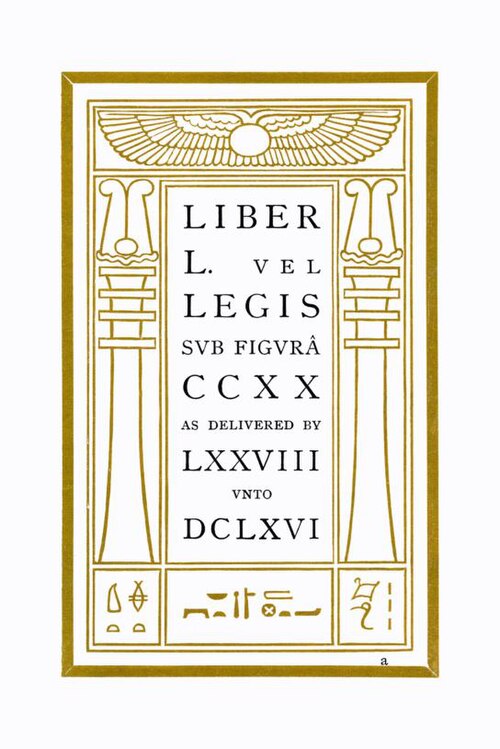
A text and its origin story
Liber AL vel Legis, commonly called The Book of the Law, occupies a foundational place in Thelema. Crowley said he received or transcribed it in Cairo in April 1904, attributing its voice to Aiwass. A historical account can record that claim and study the surviving text without treating its reported source as independently verified. The book’s three chapters are compressed, poetic, and frequently difficult, which is one reason later commentary matters so much. Even readers within Thelema disagree about how particular passages should be understood. The emergence of a movement from this text involved more than one event in Egypt: Crowley published it, annotated it, placed it within a larger set of writings, and organized communities around the ideas it suggested. The history of Thelema is thus also a history of editing, reading, and institutions.
Three chapters that change voice and scale
The book’s three chapters are not three repetitions of one lesson. The first is voiced through Nuit and expands outward: stars, infinite space, love, and individual centers of experience supply its imagery. The second turns to Hadit, described through the language of an infinitely small point, motion, and the inward center. The third speaks through Ra-Hoor-Khuit in a sharper, martial register. Reading the chapters in sequence therefore creates a movement from encompassing space, through the point of experience, to forceful proclamation. A phrase about “will” in the first chapter does not automatically carry the same tone as a command in the third. The speakers also address Crowley, an implied community, and the reader in different ways. This shifting address helps explain why isolated lines can sound simpler than the book around them. The text produces meaning through collisions among its voices, images, numbered verses, and abrupt changes of tone; a summary that extracts only its best-known motto removes that structure.
Will, freedom, and interpretation
Thelema is commonly introduced through the word “will,” yet that word has a specialized and developing role across Crowley’s writings. In The Book of the Law it appears beside images of course, orbit, law, desire, and the new aeon rather than as a dictionary definition. Crowley’s later discussions of True Will interpret it as a life’s direction or vocation rather than a passing impulse, but those later explanations should not be silently inserted into every difficult verse. Readers within Thelema also disagree about the ethical and practical consequences. A useful comparison keeps three layers visible: the wording and speaker of the verse, Crowley’s later commentary on it, and the institutional teaching built around that commentary. The vocabulary of divine figures and ritual places the work in a twentieth-century religious setting as well as in the longer history of Western esotericism. Crowley combined earlier ceremonial traditions with meditation and yoga, but the resulting system has its own internal vocabulary.
From first publication to later interpretation
The Book of the Law does not have one uncontested meaning. Its striking phrases change emphasis when separated from their chapter, Crowley’s later publications, and the history of the people who used them. Academic studies of Crowley and early Thelemites show how the text gathered followers, organizational structures, disputes, and new interpretations. Early printings, later commentary, and practitioner explanations therefore belong to different moments in the movement’s history. The gap between the text’s first appearance and its later significance is part of the story. Crowley’s own position changed as he reconsidered the manuscript and framed it within a growing set of “Class A” texts. Successive organizations then made reading lists, rituals, and teaching structures around it. Those institutional settings affected which passages became central and how newcomers encountered the book.
Questions to explore
- What does the source text say, apart from Crowley’s later commentary?
- How is True Will defined in the particular author being read?
- Which later communities shaped the interpretation now being presented?