
Kingdom or sovereignty is the compact gloss, but it is only the first layer. The numbered circle, pillar position, the elements and Earth attribution, and the four Tens belong to later arrangements that must be read separately.
- Number
- 10
- Hebrew
- מלכות
- Common gloss
- Kingdom or sovereignty
- Hermetic sphere
- the elements and Earth
- Divine name row
- Adonai ha-Aretz
- Tarot rank
- the four Tens
EARLIEST LAYER ON THIS PAGE
Malkuth as a Hebrew word
Psalm 145:11–13: The psalm repeats malkhut as divine kingship or kingdom and describes its enduring rule. The term names sovereignty in praise; it is not yet the bottom circle of four-colored Hermetic charts.
SEFER YETZIRAH LAYER
The 10th count is not yet Malkuth
In one long recension, the tenth count seals north, completing six directions after spirit, air, water, and fire. The text’s warning “ten and not eleven” also explains why later diagrams debate whether Daath can be drawn without counting it as another sefirah.
PRINTED DIAGRAM · 1653
What Kircher makes visible
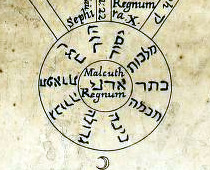
Kircher places Malcuth alone at the bottom and labels it Regnum, “Kingdom.” Only a small set of lines reaches it, visually narrowing the many upper distinctions into a final sphere. The Moon sign below and Regnum label belong to this particular early-modern synthesis.
GOLDEN DAWN AND CROWLEY
the elements and Earth, Sandalphon, and the four Tens
Golden Dawn tables align row 10 with the elements or Earth, Adonai ha-Aretz, Sandalphon, Ashim, and four Tens. Crowley’s row treats manifestation as a common address across separate columns.
MODERN SYNTHESIS
How the shorthand was assembled
Modern Hermetic writing calls Malkuth body, matter, environment, result, or the world as encountered. The reading combines the kingdom noun, bottom placement, elemental attribution, and the completion implied by ten.
WORKED COMPARISON
Read Malkuth across three layers
Read the psalm’s kingdom as rule, then look at Kircher’s lowest isolated circle, and finally compare the four Tens as completed suit sequences. The three endings are political, spatial, and numerical. Modern “manifestation” is their synthesis.