
Sigil of Sitri
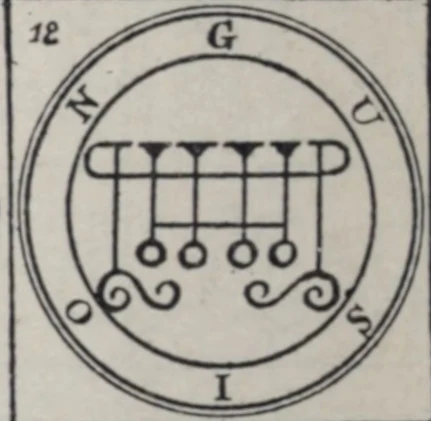
At a glance
- Entry
- 12 of 72
- Rank
- Prince
- Legions
- 60 in the text
Description in the text
Sitri is associated with kindling desire between women and men. His entry also describes an ability to cause people to reveal their naked bodies, reflecting the text’s strongly erotic framing.
Read entry 12 on page 25 of the 1916 edition
Appearance
A leopard-headed figure with griffin wings, later appearing in attractive human form.
Topics attributed to this entry
- Desire
- Revelation
Reading this entry
Sitri first has a leopard’s head and griffin wings, then takes a beautiful human form when commanded. The two-stage appearance follows a familiar pattern in the catalogue, but the attributed office is unusually explicit: kindling desire between women and men and causing people to expose their bodies. This is the language and gender framing of the historical text. It should be read as an account of a coercive fantasy, not as a model for consent or relationships.
The prince’s 60 legions and seal are given without an extended story, ritual exception, or origin. The visual shift from hybrid creature to attractive human figure echoes the entry’s concern with appearance and desire, although the text itself does not state a symbolic explanation. That distinction between what the passage reports and what a reader might infer is useful throughout the Goetia.
Read entry 12 on page 25 of the 1916 edition or compare the 1904 transcription.
A closer reading of entry 12
What the numbered text says
Sitri’s hybrid initial form and later beautiful human form precede an office centered on attraction and compelled exposure. The source speaks in a binary account of women’s and men’s desire, reflecting its period and point of view. Those are descriptions of coercive power attributed by the grimoire, not a claim about real relationships or permission to violate another person’s privacy.
About the printed seal
Seal 12 on the 1916 plate is the printed identifier for this prince. It is distinct from the leopard head and griffin wings specified in the prose. The source does not interpret the seal’s linework as a sexual symbol.
Compare another entry
Compare entry 4: Samigina. Samigina also moves from animal to human shape, yet that change leads into learning and an account of the dead. Sitri’s text links a striking hybrid appearance to an erotic office. A shared transformation pattern does not make the two entries equivalent in purpose or tone.