
Crowned Gomory rides a camel in Le Breton’s 1863 plate, turning the Dictionnaire’s female form into its sharpest identifier; Gremory is the Ars Goetia spelling.
- 1863 headword
- Gomory
- Ars Goetia
- No. 56 · Duke
- Legions
- Dictionnaire 26 · Goetia 26
What Collin de Plancy’s Gomory entry says
Gomory is a powerful infernal duke who appears as a woman wearing a ducal crown and riding a camel. The dictionary credits her with answers about present, past, and future and with revealing hidden treasures. Twenty-six legions are under her command. The article is concise and gives no alternate body or anecdote, so the gendered title, crown, mount, time knowledge, and treasure form its complete profile.
A grammatical tension runs through the notice: a figure titled duke appears as a crowned woman. Collin de Plancy reports both without explaining whether the form, rank, or name should control gendered language. Preserving that tension is more informative than silently changing the rank to duchess.
Reading Louis Le Breton’s 1863 portrait
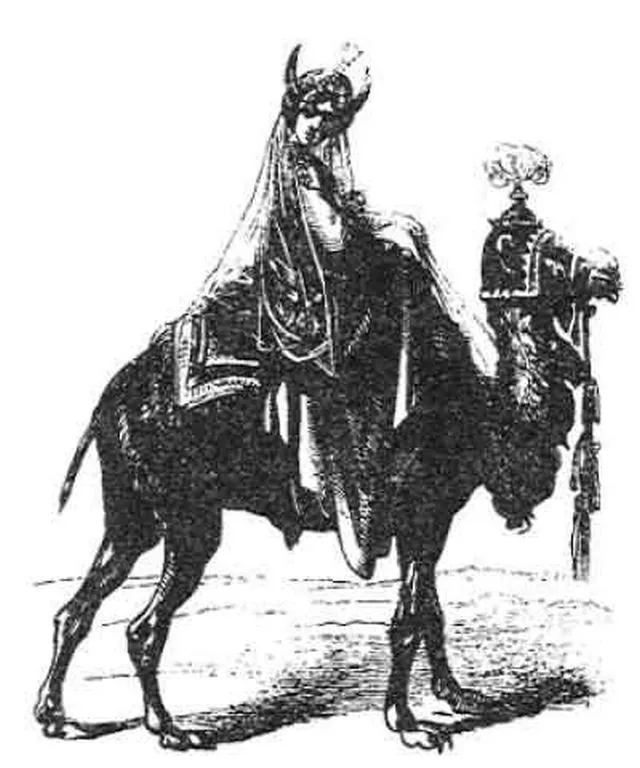
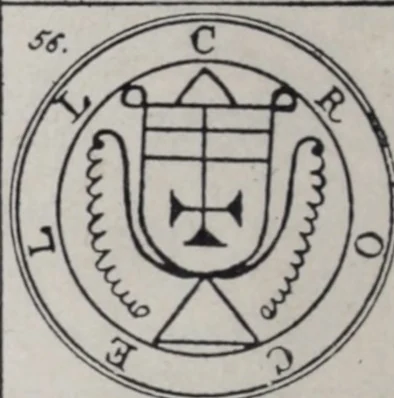
Le Breton places a composed crowned rider on a tall camel, using the animal’s neck and legs to create a vertical procession. Drapery and crown mark the human figure while saddle and reins connect her firmly to the mount. The still pose conveys rank; time and buried treasure remain outside the visible scene.
The Goetia description makes the crown even stranger by tying it around Gremory’s waist rather than placing it on the head. Le Breton follows the Dictionnaire’s simpler crowned woman. The Goetia seal introduces another representation but cannot decide crown placement.
Gomory and Ars Goetia spirit 56
Both sources present a duke in a woman’s form riding a camel, connect the office with past, present, future, and hidden treasure, and give twenty-six legions. Gomory, Gremory, and Gamori are name variants around that stable core.
The Dictionnaire places the ducal crown on the figure in an ordinary way and stops after time and treasure. The Goetia specifies a beautiful woman, places a duchess’s crown at the waist, and adds the coercive procurement of women’s love. Le Breton’s head-worn crown therefore follows the French article rather than the English printed detail.
Worked comparison: where is the crown?
Locate the crown in three witnesses. The Dictionnaire says only that Gomory has a ducal crown; the engraving puts it on the head; the Goetia text ties a duchess’s crown around the waist. This is a precise difference that can be checked without treating one source as a careless version of another.
The exercise shows why illustration should be compared with its own page before being used to visualize a different book. Le Breton’s composition faithfully resolves the French ambiguity, while the Goetia preserves an unusual waist-level detail and its own seal. The time and treasure offices remain steady across that visual disagreement, which makes crown placement a traceable local variant rather than a reason to split the figures into unrelated entities.