
White hair, beard, horse, and pointed spear make Le Breton’s 1863 Forças visibly vigorous despite his age; the Ars Goetia uses the spelling Furcas.
- 1863 headword
- Forças
- Ars Goetia
- No. 50 · Knight
- Legions
- Dictionnaire 29 · Goetia 20
What Collin de Plancy’s Forças entry says
Forças, Forras, or Furcas is a knight and great infernal president who appears as a vigorous old man with long white hair and beard, mounted on a large horse and carrying a sharp dart. He knows herbs and precious stones and teaches logic, aesthetics, palmistry, fire divination, and rhetoric. The dictionary also attributes invisibility, ingenuity, eloquence, recovery of lost things, discovery of treasure, and twenty-nine legions.
The article combines an old teacher’s disciplines with a mounted warrior’s body. Verbal arts, natural properties, divinatory practices, social skill, and recovery all gather under a figure whose rank is unusually knightly. The three printed name forms make the entry itself a small concordance.
Reading Louis Le Breton’s 1863 portrait
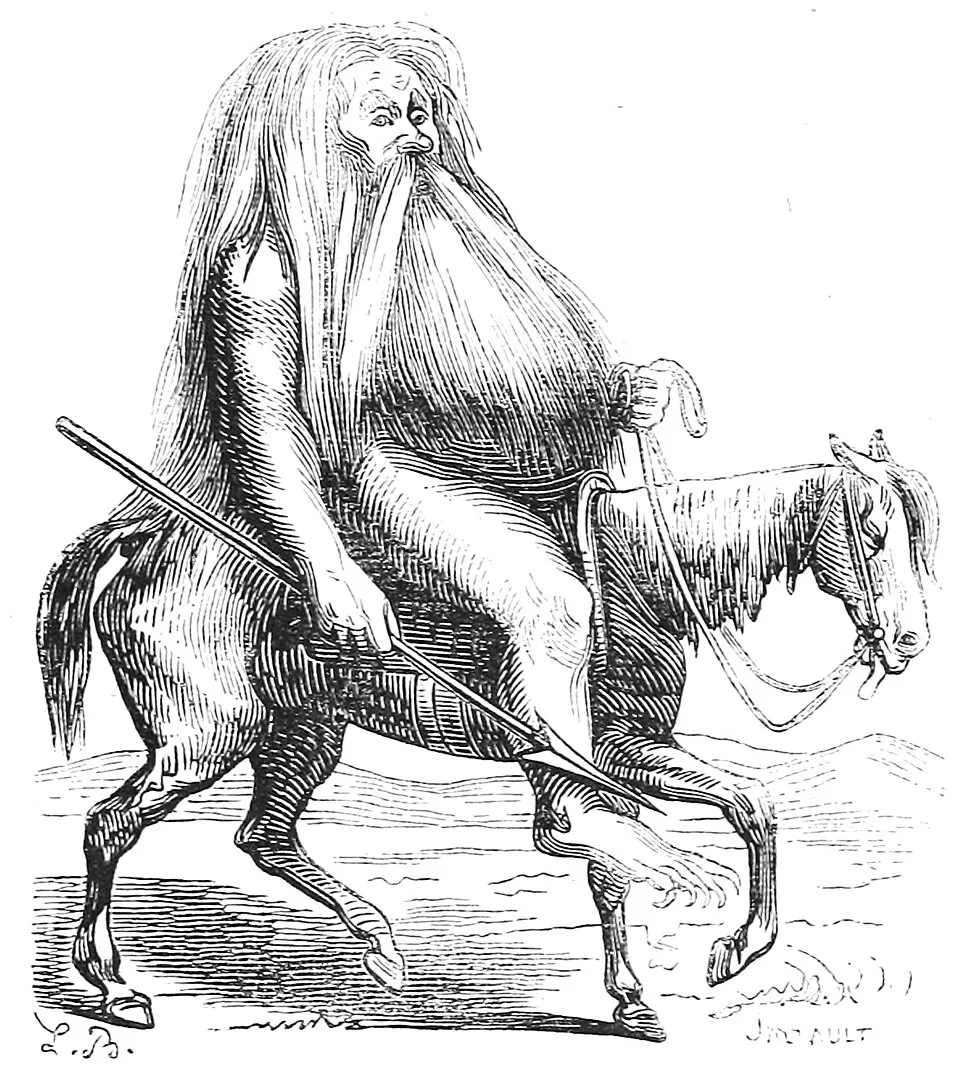
Le Breton shows a bearded elder riding in profile with a long pointed weapon held across the body. Flowing hair and beard emphasize age, while the horse and spear maintain physical force. The composition makes the paradox legible: this is both learned elder and armed rider, without needing books, herbs, stones, or flames.
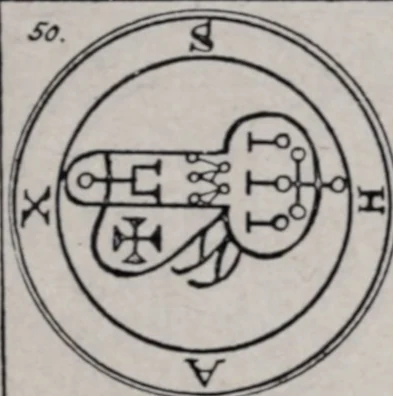
Furcas is the only Goetia spirit given the rank of knight in the local catalogue, though the Dictionnaire also calls him a great president. The Goetia seal marks number 50; the engraving visualizes age, horse, and weapon. Rank disagreement and visual agreement can coexist.
Forças and Ars Goetia spirit 50
Both descriptions retain the old bearded rider, pale or large horse, sharp weapon, philosophy or logic, rhetoric, palmistry, fire divination, and instruction. The learned office is substantially shared.
The Dictionnaire adds precious stones, herbs, aesthetics, invisibility, ingenuity, eloquence, lost objects, treasure, the title of president, and twenty-nine legions. The Goetia lists philosophy, astrology, rhetoric, logic, chiromancy, and pyromancy under a knight who governs twenty legions. The nine-legion gap is the largest numerical divergence in this profile set.
Worked comparison: twenty or twenty-nine legions?
Keep the edition columns separate. Goetia Furcas: knight, twenty legions. Dictionnaire Forças: knight and great president, twenty-nine legions. The engraving verifies neither count, and the seal’s position at number 50 is a catalogue number rather than a legion total. Three different numbers therefore describe three different things.
This clean example exposes the danger of merging fields from multiple witnesses into one synthetic profile. The useful result is a comparison: shared rider and curriculum, expanded French offices, changed rank, and a nine-legion difference. The Dictionnaire’s extra recovery and treasure claims also change the practical range of the figure, while the Goetia’s shorter list concentrates more tightly on learned disciplines. The spear-bearing elder remains the common visual anchor across both.