Ritual history
Grimoire circles distribute space, names, authority, and protection between the human operator and the spirit being addressed.

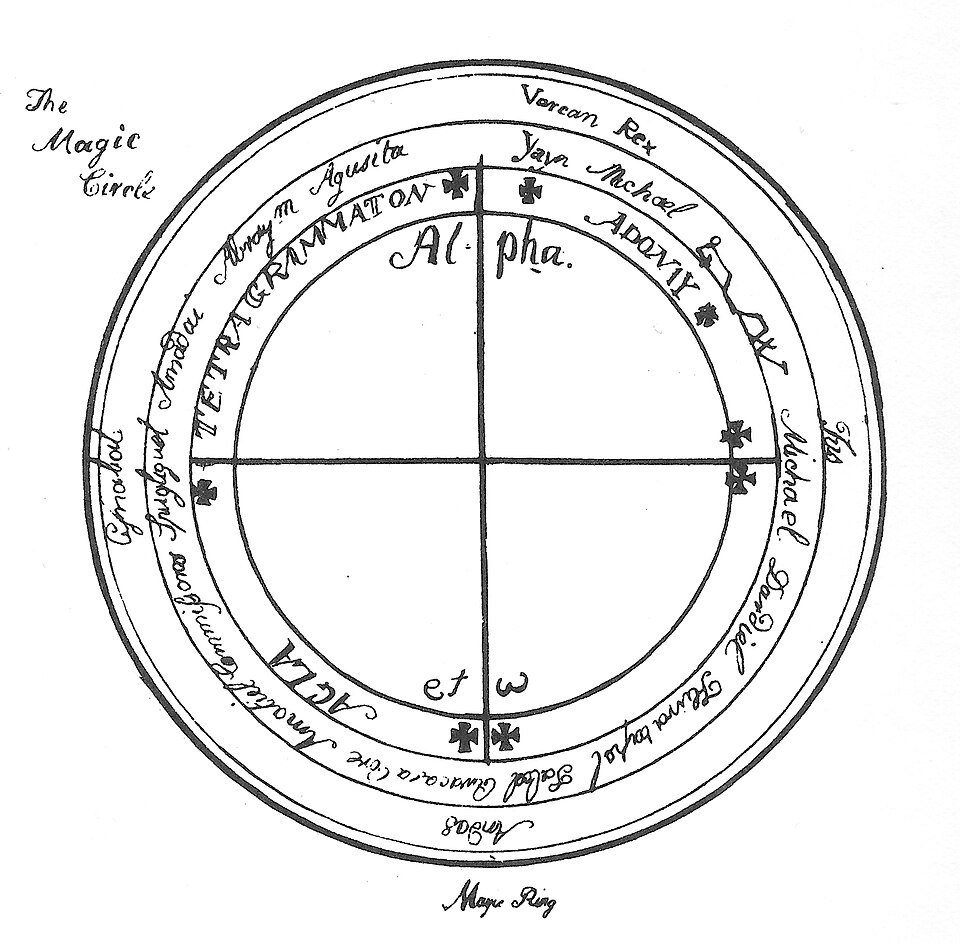
A visual grammar of space
Circles in grimoire manuscripts are not interchangeable decorative motifs. A particular drawing may mark where a human operator was instructed to stand, where a reported spirit should appear, or how divine names and signs were arranged around the activity. The Folger Shakespeare Library describes two circles in its late-sixteenth-century Book of Magic, one for the summoner and another associated with a spirit called Birto. Its curator explains the prayers and timing that the manuscript sets around those images. Those are historical instructions in a source, not evidence that an apparition occurred. The diagrams give historians a way to see how a writer imagined controlled space. They also show that text and image were meant to be read together. A circle cropped out of a page and labelled simply “protection sigil” loses important information about the roles assigned within that specific manuscript.
Authority, prayer, and boundaries
Many Western ceremonial manuscripts place names of God, prayers, psalms, or Christian signs near their circles and invocations. To their users, these elements could establish authority, make a space appropriate for a ritual, or frame a request as religiously legitimate. The same manuscript can therefore contain a command addressed to a spirit and a prayer addressed to God. Modern labels that sharply divide “spell” from “prayer” may not describe the writer’s categories very well. In some texts a circle is described as protective; in others its function depends on accompanying words, implements, or positions. Small visual differences between manuscripts and editions can reflect distinct witnesses rather than decorative variation.
Worked comparison: fixed enclosure and changing calendar
The Folger Book of Magic and the Heptameron make the analytical difference visible. The Folger manuscript separates a circle for the summoner from a second place associated with Birto, so the drawing assigns different roles to two spaces. In the Heptameron, by contrast, a circle is a calendar rendered as geometry. Its bands are meant to receive the current hour and its angel, the angel and ministers of the weekday, the season, the sign governing that season, and seasonal names for the earth, sun, and moon. Change the day or hour and the inscriptions change even if a modern redrawing preserves the same concentric outline. One diagram therefore stages a relation between operator and addressed figure; the other coordinates an operation with several layers of celestial time. Calling both “protective circles” hides their principal information. The worked comparison also shows why an attractive generic circle assembled from famous divine names cannot substitute for either source: it lacks the role labels of the first and the variable time index of the second.
What a whole manuscript page reveals
The diagram’s position, heading, surrounding prose, numbered places, direction labels, and names explain who occupies each space. A drawing made by the original manuscript hand also differs historically from one supplied by a later copyist or redrawn by a modern editor. Folger’s description ties particular circles to specific manuscript leaves and related passages. Circles also appear in works called the Key of Solomon and Lesser Key, but resemblance does not establish identical use across works. The page can reveal an instruction that the isolated image cannot: a rubric may tell the reader to alter names by hour, a caption may assign one space to an assistant, and prose may identify a nearby triangle or crystal as a separate focus. The circle is consequently a diagram of relationships, not only a border. A manuscript drawing belongs to the text and community that gave it meaning; its appearance alone cannot establish a universal template for ritual circles.
Questions to explore
- Who stands in each part of the diagram according to its caption?
- Which names or prayers appear with the drawing?
- Was this image copied from a manuscript or redesigned for print?