People
Agrippa gathered natural, celestial, and religious magic into an ascending Renaissance argument later complicated by his own critique.

A Renaissance compiler and thinker
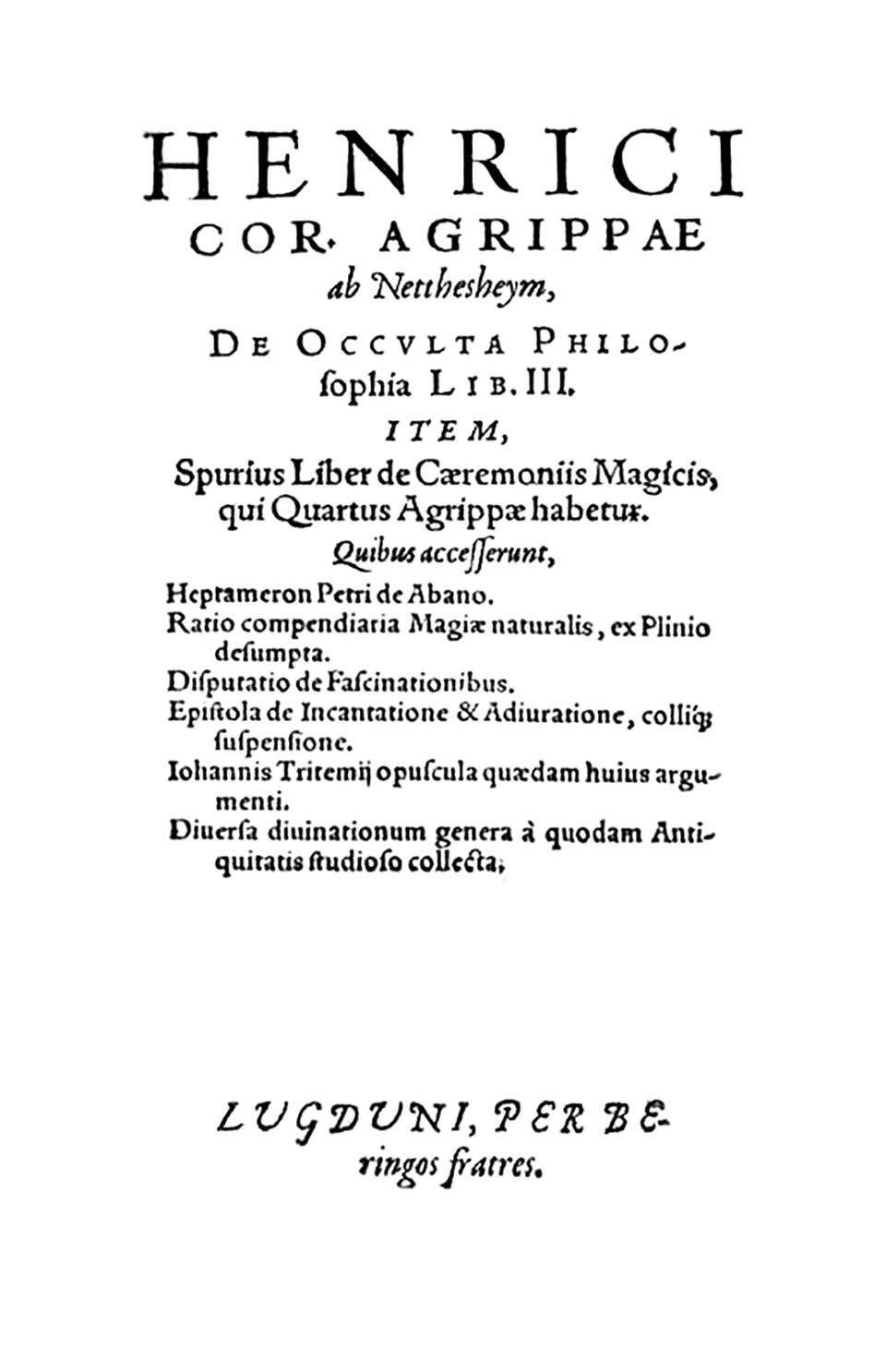
Heinrich Cornelius Agrippa of Nettesheim (1486–1535) wrote across theology, law, philosophy, and subjects that later readers group as occult. His De occulta philosophia, usually known in English as Three Books of Occult Philosophy, became one of the best-known Renaissance attempts to gather varied theories of magic into a large framework. Cambridge’s historical overview dates its composition to the early sixteenth century and publication across 1531–1533. Correspondences, astrology, numbers, letters, divine names, and intermediary beings enter the work’s argument together. It should not be described as a simple spell manual: much of its significance lies in its attempt to explain how these ideas related to natural and religious philosophy. Agrippa cited earlier sources and moved among scholarly debates of his time. A page attributing every symbol later connected with him directly to his own invention would overstate his role.
The three-book argument in motion
The title’s “three books” describes an ascent through three connected worlds. Book One begins with elemental and natural qualities: stones, plants, animals, sympathies, antipathies, and the hidden virtues attributed to material things. Book Two moves upward to celestial mediation through number, proportion, music, geometric figures, planetary images, and astrological correspondences. Book Three treats the intellectual or divine world through religion, names, angels, intelligences, prayer, and ceremonial authority. Agrippa argues through the sequence. Natural objects receive celestial qualities; celestial patterns participate in higher intellectual order; the learned operator studies correspondences that join the levels. A planetary table copied from Book Two is therefore not an isolated spell chart. It occupies the middle of a theory that links material preparation below it with theological authorization above it. This also explains why later compilations could transform Agrippa by excerpting lists. A borrowed table preserves the correspondences while discarding the ascent that gave them philosophical meaning.
A contested author, even in his own time
Agrippa’s record resists the tidy label of a man who always held one position. He also wrote De incertitudine et vanitate scientiarum et artium, a critique of human learning that included critical discussion of magic. Cambridge scholarship notes that the enlarged 1533 Occult Philosophy included a retraction or censorial passage drawing on that critique. Conflicting interpretations have followed the books ever since. Extracting a single approving sentence from the earlier work and ignoring the later criticism makes Agrippa appear more doctrinally consistent than the evidence allows. The tension also exists inside the architecture of the Three Books: the highest forms of knowledge depend on piety and divine order, while fallen or superstitious practices are repeatedly distinguished from legitimate wisdom. He was a Christian scholar working amid Renaissance arguments about lawful and forbidden knowledge. Those boundaries are part of the text’s analysis, not an external warning pasted onto a neutral catalogue of techniques.
Influence through selection and reinterpretation
Later ceremonial writers treated Agrippa as a major authority, and print made his extensive compilation available to readers far beyond his immediate circle. Selection and reinterpretation often carried that influence. A later grimoire could borrow a table or name without carrying over Agrippa’s explanation, while a modern diagram might derive from an appendix, translation, or later attributed work. The published three-book work, its surrounding chapters, and later attributions preserve different stages of the material. Agrippa’s research value lies in how a Renaissance intellectual assembled inherited materials into a theory of the cosmos and how that theory remained open to criticism, revision, and reuse.
Questions to explore
- How do the three books organize natural, celestial, and religious magic?
- Which ideas entered later attributed works?
- How does his critical writing complicate the earlier project?