
Sigil of Bathin
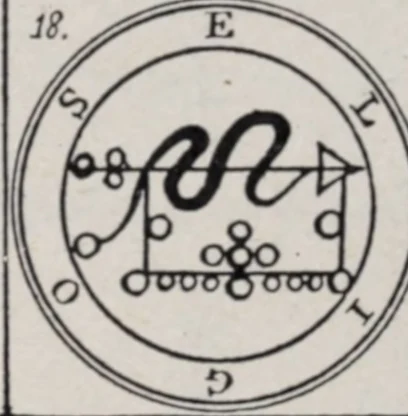
At a glance
- Entry
- 18 of 72
- Rank
- Duke
- Legions
- 30 in the text
Description in the text
Bathin is credited with knowledge of herbs and precious stones. The text also says he can carry people suddenly from one country to another.
Read entry 18 on page 27 of the 1916 edition
Appearance
A strong man with a serpent tail seated on a pale horse.
Topics attributed to this entry
- Herbs
- Gemstones
- Travel
Reading this entry
Bathin is a strong duke pictured as a muscular man with a serpent’s tail on a pale horse. The account credits him with knowledge of herbs and precious stones, two categories often paired in this catalogue. It also assigns sudden transport between countries. The passage does not name a destination, method, or particular plant or gem, so those details should not be supplied by a modern summary as if they came from this entry.
The contrast between knowledge of natural materials and extraordinary travel is the entry’s distinctive combination. Other spirits teach herbs or disclose treasure, but Bathin’s office moves the human subject across political space. He commands 30 legions according to the text, which finishes with the familiar seal reference. The horse is pale in the source; color and serpent tail are both useful identifiers when comparing historical descriptions.
Read entry 18 on page 27 of the 1916 edition or compare the 1904 transcription.
A closer reading of entry 18
What the numbered text says
Bathin’s horse-mounted, serpent-tailed human portrait is paired with two quite different offices. One concerns knowledge of herbs and precious stones; the other claims sudden transport between countries. The text gives no list of plants, stones, routes, or destinations. Its use of “virtues” belongs to an early modern account of attributed properties, not to a tested pharmacological or mineralogical reference.
The numbered 1916 Gutenberg heading used here prints Bathin. Its alternative spellings in other demonological catalogues are outside this entry’s cited text.
About the printed seal
Seal 18 is placed on the third 1916 plate. The passage describes wearing the sign by reference to earlier formulae, but supplies no interpretive legend for the lines. Its pale horse and serpent tail are source details in prose, not shapes to be read from the seal.
Compare another entry
Compare entry 31: Foras. Foras likewise claims knowledge of herbs and precious stones, but surrounds it with logic, ethics, eloquence, hidden treasure, and recovered lost things. Bathin instead adds rapid travel across countries. The shared material vocabulary does not make their offices identical.