
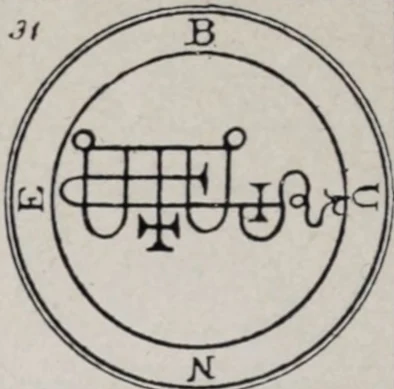
Sigil of Foras
At a glance
- Entry
- 31 of 72
- Rank
- President
- Legions
- 29 in the text
Description in the text
Foras is credited with teaching the properties of herbs and precious stones, as well as logic and ethics. His entry also associates him with eloquence, longevity, invisibility, hidden treasure, and the recovery of lost things.
Read entry 31 on page 31 of the 1916 edition
Appearance
A strong human figure.
Topics attributed to this entry
- Herbs and stones
- Logic and ethics
- Lost things
Reading this entry
Foras has a relatively plain appearance: a strong man, without the animal features or theatrical arrival common elsewhere. His attributed curriculum is broad. He teaches the properties of herbs and precious stones and the arts of logic and ethics. The entry then adds invisibility, long life, eloquence, discovery of treasure, and recovery of lost things. It does not specify a plant, stone, or ethical doctrine.
A translator's note says one or two codices read “invincible” where the majority read “invisible.” This is a genuine textual uncertainty, not two separate powers securely assigned by every witness. The 29 legions and seal close the account. Foras illustrates how a visually simple figure can carry one of the catalogue’s more crowded lists of attributed powers, with a disputed word that changes an important claim.
Read entry 31 on page 31 of the 1916 edition or compare the 1904 transcription.
A closer reading of entry 31
What the numbered text says
Foras is drawn as a strong human, a spare form for an unusually long list of attributed skills. Herb and gemstone properties lead into logic and ethics, then invisibility, long life, eloquence, treasure, and recovery of lost objects. The footnote marker beside invisibility flags editorial apparatus, but the numbered text itself gives no example of such an effect. A reference profile should preserve the list’s variety without presenting it as tested instruction.
About the printed seal
The fifth 1916 frontispiece labels the associated sign 31. Its lines do not diagram the curriculum or the hidden objects in the prose. The manuscript-style imperative around wearing it is a textual convention of this witness, not a function the image can demonstrate.
Compare another entry
Compare entry 18: Bathin. Bathin also receives knowledge of herbs and precious stones, but adds sudden transport across countries. Foras has no travel claim; he instead teaches named disciplines and is credited with treasure and lost-object recovery. Their shared material study leads to different surrounding offices.