
Sigil of Zepar
At a glance
- Entry
- 16 of 72
- Rank
- Duke
- Legions
- 26 in the text
Description in the text
Zepar is assigned a narrowly focused office concerning attraction between women and men. The same passage also attributes infertility to him, an unsettling second aspect of that office.
Read entry 16 on page 27 of the 1916 edition
Appearance
A soldier in red clothing and armor.
Topics attributed to this entry
- Attraction
- Infertility
Reading this entry
Zepar appears as a soldier dressed and armored in red. Although the visual description is martial, the entry does not assign him warfare. Instead it attributes the bringing together of women and men in love and, in the same breath, infertility. The two offices should be kept together: reducing the passage to romance strips away the darker reproductive claim. The duke’s red uniform is stated, but its color is not explicitly interpreted by the source.
This is a short entry with 26 legions and a seal said to secure his obedience. It gives no alternate form, animal mount, or genealogy. The historical wording frames women as objects of an operator’s desire, reflecting the unequal and coercive assumptions of the text. A reference page can document that claim without presenting it as advice for influencing another person.
Read entry 16 on page 27 of the 1916 edition or compare the 1904 transcription.
A closer reading of entry 16
What the numbered text says
The red soldier is followed by an unusually narrow and troubling pair of attributed offices: joining women and men in love and causing barrenness. Neither claim is accompanied by a general healing, prophecy, or learning role. The text treats women as objects of another person’s desire, a feature of the historical source that should be visible rather than softened into modern relationship advice. Its 26 legions are specifically called inferior spirits.
About the printed seal
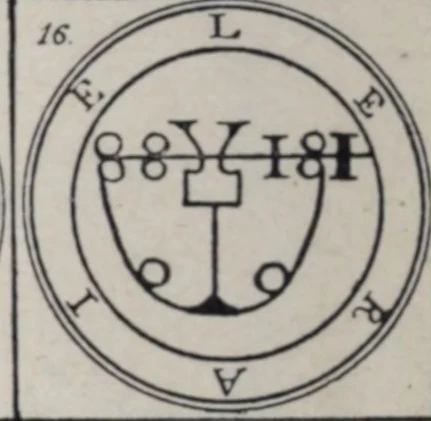
The statement that Zepar responds on seeing his seal belongs to the grimoire’s internal claims. The third 1916 plate gives the numbered drawing as 16; it does not portray the soldier in red or provide a basis for interpreting the shape as fertility imagery.
Compare another entry
Compare entry 19: Sallos. Sallos also receives a claim about affection between women and men. His passage, however, calls his arrival peaceable and does not add Zepar’s barrenness claim. Collapsing both to a generic love function would erase the sharper qualification in entry 16.