
Le Breton’s 1863 Paymon keeps the crowned dromedary rider but omits Bébal and Abalam; Ars Goetia 9 spells the king Paimon and supplies a larger procession.
- 1863 headword
- Paymon
- Ars Goetia
- No. 9 · King
- Legions
- Dictionnaire 200 · Goetia 200
What Collin de Plancy’s Paymon entry says
Paymon is one of the infernal kings. The dictionary says he appears as a human riding a dromedary, wears a diadem sparkling with jewels, and has a woman’s face. Two hundred legions drawn from the orders of Angels and Powers obey him. If called through sacrifice or libation, he appears with two great princes, Bébal and Abalam. The short entry concentrates on rank, entrance, face, mount, retinue, and former celestial affiliation rather than listing a broad set of teachings.
Hierarchy is the organizing subject. Crown, two named princes, two celestial orders, and two hundred legions make the arrival a display of structured power. The condition involving offering belongs to the historical account and can be studied as part of that structure without being reproduced as guidance.
Reading Louis Le Breton’s 1863 portrait
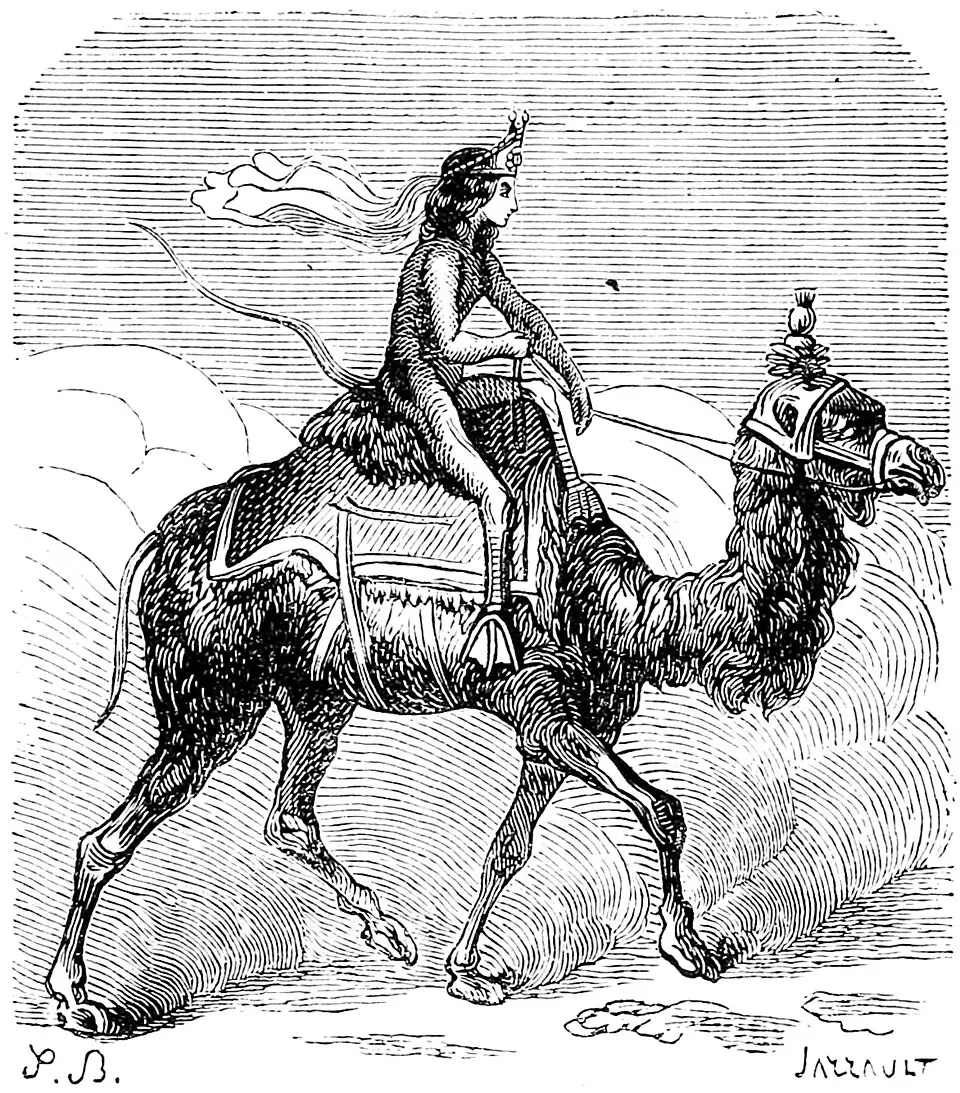
Le Breton shows a slender crowned rider side-saddle on a shaggy dromedary. The jeweled diadem and composed face contrast with the animal’s heavy neck and rolling gait. No musicians or massed retinue appear, so the mount and crown carry the kingly identification in a compact column illustration.
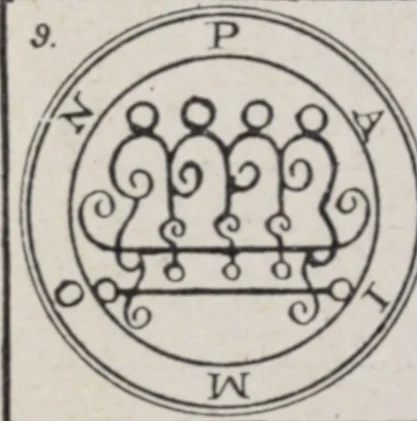
The portrait gives a body to Paymon but cannot display two hundred legions. Paimon’s Goetia seal solves a different page-design problem by assigning an abstract sign to number 9. The seal, the rider, and the printed names should therefore remain separately labeled even when placed in one profile.
Paymon and Ars Goetia spirit 9
Both traditions present a crowned king on a dromedary, describe a feminine or womanlike face, name a vast following of two hundred legions, and bring the kings Bebal and Abalam into the entourage. The basic royal procession is shared.
The Goetia adds a band of musicians, a powerful voice that must be clarified, a western orientation, and wide offices in arts, sciences, secrets, dignity, and understanding. The Dictionnaire entry is narrower and makes the jeweled crown, sacrifice or libation, and mixed angelic ancestry central. Paymon and Paimon also preserve a spelling shift.
Worked comparison: a procession reduced to one rider
Count the participants named by each text. The Dictionnaire gives Paymon, Bébal, Abalam, and two hundred legions. The Goetia adds musicians before the rider and expands the king’s learned offices. Le Breton depicts only the king and mount. The empty ground is therefore compression, not evidence that the attendants disappeared from the tradition.
The comparison shows how illustration produces an emblem by stripping away a crowded entrance. Crown, face, and dromedary are sufficient for recognition. The Goetia seal offers another compressed identifier, but neither compact image should be mistaken for the whole textual procession.