
Four miniature kings crowd the head of Le Breton’s horned 1863 Tap, the endpoint of the Gaap cross-reference; Gaap is the Ars Goetia spelling.
- 1863 headword
- Tap
- Ars Goetia
- No. 33 · President and Prince
- Legions
- Dictionnaire 60 · Goetia 66
What Collin de Plancy’s Tap entry says
The dictionary’s Gaap headword redirects to Tap. Under Tap, Collin de Plancy describes a great president and prince who appears at noon, commands four principal kings, and is associated with Byleth. His offices include love and hatred, making people insensitive or ignorant, teaching philosophy and liberal sciences, giving answers across time, and carrying people rapidly between kingdoms. The French account closes with sixty legions.
The redirect is a useful part of the evidence because the familiar modern spelling is not the form chosen for the full French article. The office itself is structured by control over relation and location: attraction versus hostility, understanding versus insensibility, and sudden transport across political space.
Reading Louis Le Breton’s 1863 portrait
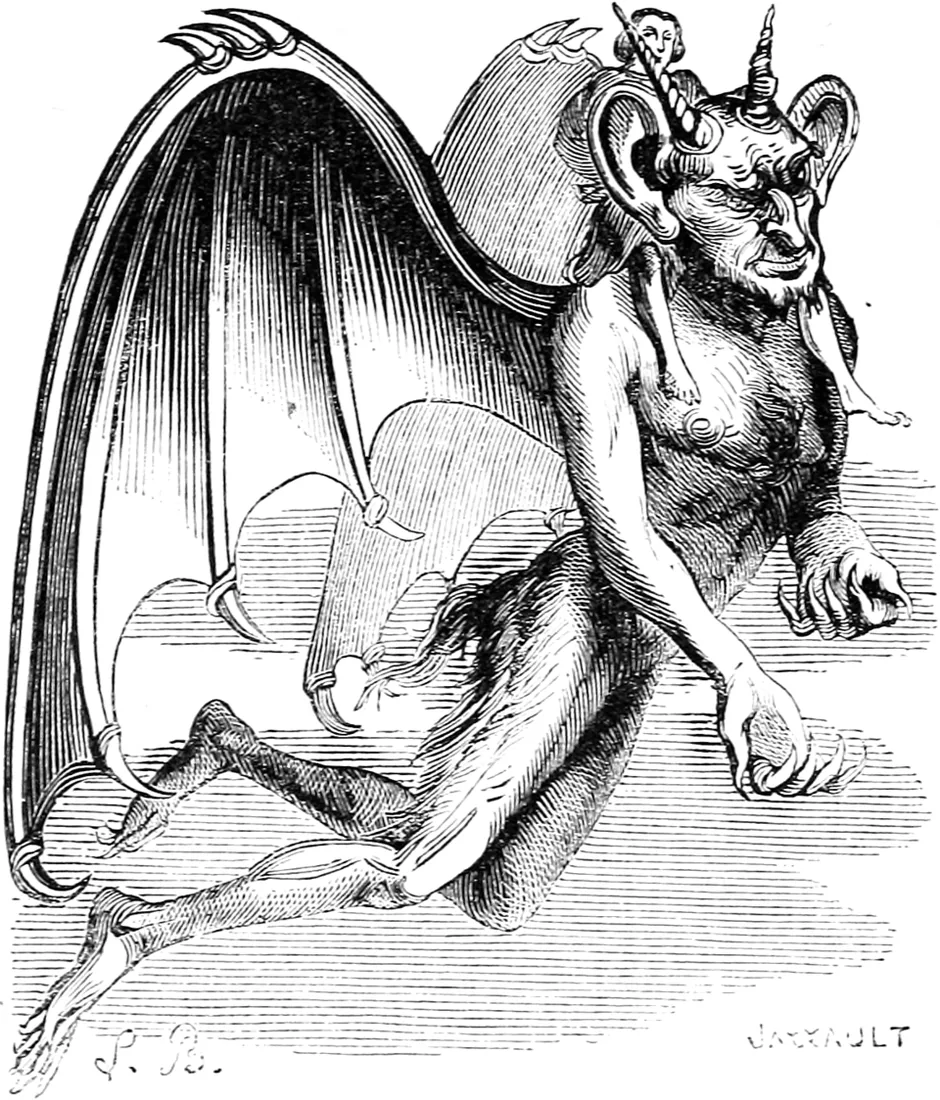
Le Breton builds Tap as a seated horned hybrid with huge batlike wings, pointed ears, a hairy torso, human arms, and hoofed legs. Four tiny human figures perch around the head and ears, converting the four subordinate kings into a miniature court carried by the larger body. The composition is dense rather than processional, while transport between kingdoms and changes of mind remain outside the frame.
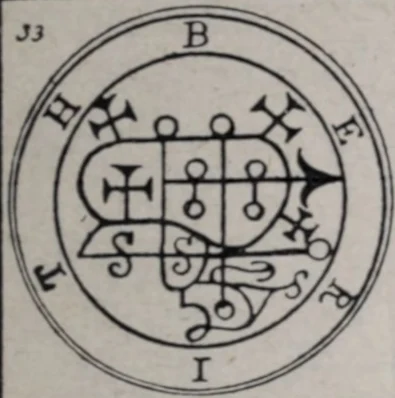
The engraving makes hierarchy anatomical: the four small kings are countable, but their placement turns them almost into attributes of the much larger prince. It is labeled Tap in the dictionary tradition, while modern Goetia pages file the corresponding spirit under Gaap. The separate Goetia seal attaches to number 33 and supplies a catalogue marker across that spelling shift rather than a source for the winged body or miniature court.
Tap and Ars Goetia spirit 33
Both sources combine the ranks of president and prince, place four kings around the figure, connect the appearance with a southern solar condition, and list philosophy, liberal sciences, love or hatred, time knowledge, and rapid transport among the offices.
The Dictionnaire specifies noon, uses Tap as the full headword, connects the spirit with Byleth, and gives sixty legions. The Goetia says the sun is in a southern sign, elaborates effects on understanding and consecration, and gives sixty-six legions. The six-legion difference should remain visible.
Worked comparison: Gaap, Tap, sixty, and sixty-six
Use four fields rather than one normalized label: French headword Tap, redirect Gaap, Dictionnaire following sixty, and Goetia following sixty-six. Now count the miniature people in the engraving: four, matching the subordinate kings rather than either legion total. The image therefore visualizes one count precisely while leaving the sixty-versus-sixty-six disagreement and the page redirect to the texts.
The example shows three numerical functions at once. Spirit number 33 locates the Goetia entry, four identifies the perched royal court, and sixty or sixty-six counts the larger following in different witnesses. Le Breton’s miniature kings confirm that the stable four was visually salient, but the engraving cannot settle the changing legion total. Tap and Gaap likewise remain parallel labels for one closely aligned record.