
Le Breton’s 1863 Furfur has antlers, batlike wings, human arms, and hoofed legs; Ars Goetia 34 retains the fiery tail absent from the engraving.
- 1863 headword
- Furfur
- Ars Goetia
- No. 34 · Earl
- Legions
- Dictionnaire 26 · Goetia 26
What Collin de Plancy’s Furfur entry says
Furfur is an infernal count who appears as a stag with a flaming tail. The dictionary says he lies unless enclosed in a triangle, can take angelic form, speaks with a rough voice, preserves union between spouses, produces lightning, thunder, and storms, and answers about abstract matters. Twenty-six legions follow him. The short entry is organized around transformation and conditions: animal becomes angel, lies become answers, and weather becomes commanded spectacle.
The triangle does more than decorate the scene. Within the source’s ritual logic it marks the condition under which speech changes from deceptive to reliable. Collin de Plancy reports that claim as part of the catalogue. A historical profile can analyze the condition without turning it into practical instruction or evidence that such answers occur.
Reading Louis Le Breton’s 1863 portrait
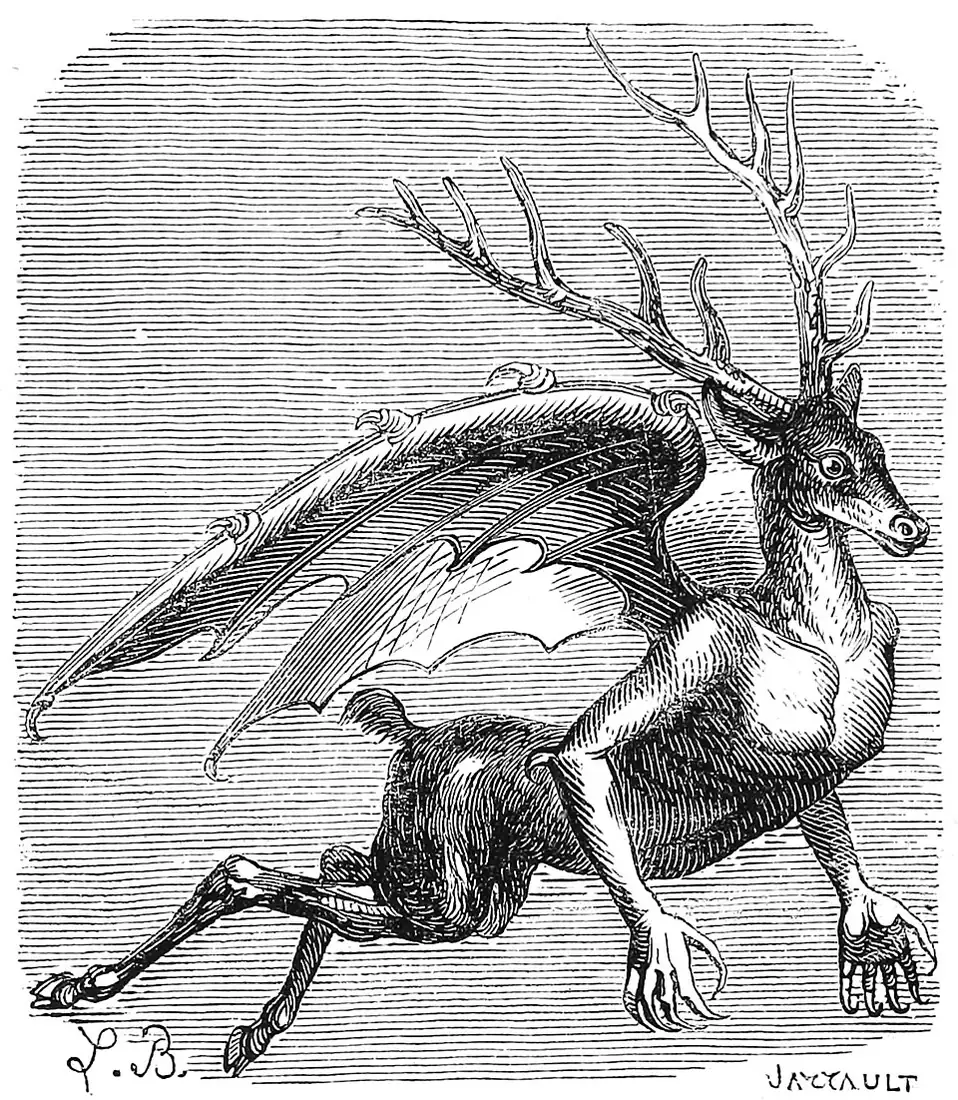
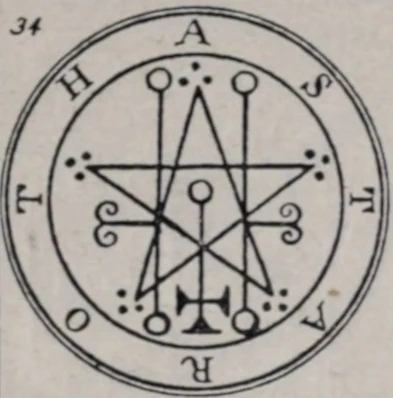
Le Breton draws an antlered stag head on a hybrid body with enormous batlike wings, humanlike arms and hands, a furred torso, and hoofed hind legs. The creature turns toward the viewer rather than standing as an ordinary deer. No visible flame, triangle, spouse, or storm appears, so the engraving combines animal and humanoid or winged traits while leaving the fiery-tail clause to the text.
The portrait compresses the entry’s change of form instead of illustrating only its opening stag. Antlers and hooves retain the animal, while wings and arms move toward the later angelic body without presenting a conventional angel. Furfur’s Goetia seal remains an unrelated line sign for number 34. The hybrid portrait and the abstract character can both appear as black shapes on white, but only the former invents anatomy from the transformation.
Furfur and Ars Goetia spirit 34
Ars Goetia 34 also gives a stag with a fiery tail, angelic form under a triangle condition, rough speech, love between women and men, weather phenomena, secret or divine answers, twenty-six legions, and the rank of earl.
The Dictionnaire phrases the relationship office as marital union and the intellectual office as abstract matters. The Goetia describes love between the sexes and speaks of secret and divine things. The French summary says Furfur lies unless constrained; the English passage makes truthfulness conditional in closely related but not identical language.
Worked comparison: what the portrait cannot show about truth
List the portrait’s visible evidence first: antlers, stag head, batlike wings, humanlike hands, fur, and hooves. Now list the entry’s other evidence: fiery tail, triangle, angelic change, rough voice, deception, and truthful answers. The image appears to blend two bodily phases but shows no visible flame or ritual boundary. Adding the Goetia seal supplies no test of the speech condition; it only links a sign to the catalogue entry.
The worked reading keeps three claims apart: the hybrid body Le Breton actually drew, the transformation and truth condition asserted by the historical texts, and the conclusions available to a modern viewer. The unexpected wings and arms make the engraving more interpretive than a simple stag portrait, while the absent flame prevents the prose description from being projected onto the pixels. The seal remains a third representation with no anatomy at all.