
Le Breton’s 1863 Caym welds blackbird and sword into one body, although the dictionary assigns the blade to a later human form; Ars Goetia 53 spells Caim.
- 1863 headword
- Caym
- Ars Goetia
- No. 53 · President
- Legions
- Dictionnaire 30 · Goetia 30
What Collin de Plancy’s Caym entry says
Under the spelling Caym, the dictionary describes a superior president who normally appears as a blackbird. In human form he answers from the middle of a blazing fire and carries a sharp sword. Collin de Plancy calls him the most accomplished sophist in hell, associates him with a famous dispute attributed to Luther, and lists the sounds of birds, cattle, dogs, and water among the voices he can interpret. A peacock-tailed human variant and thirty legions complete the entry.
Argument and interpretation are the organizing ideas. The article moves from a debating skill to the problem of hearing meaning in nonhuman sound, then multiplies the possible bodies in which that intelligence appears. The Luther anecdote enlarges a catalogue office into cultural history, while the fire and sword give the illustrator concrete material.
Reading Louis Le Breton’s 1863 portrait
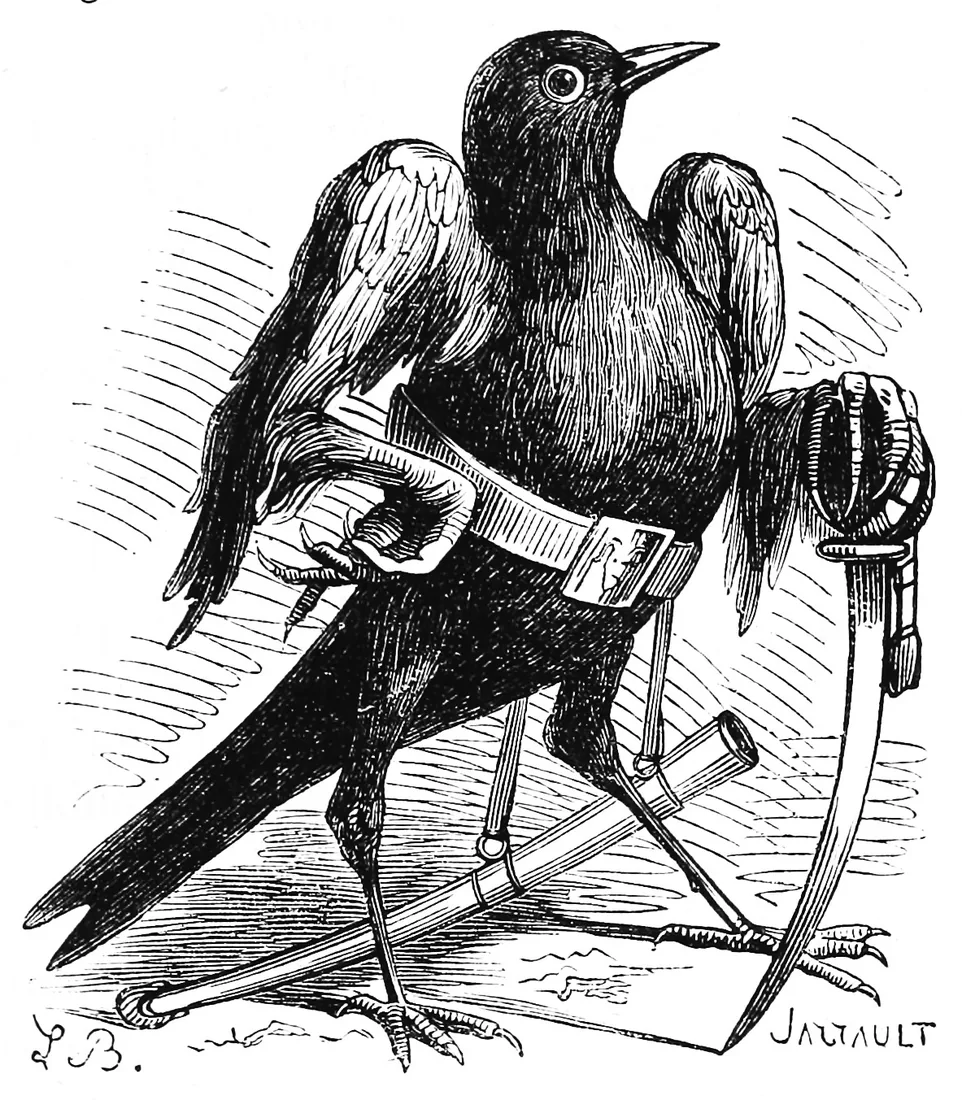
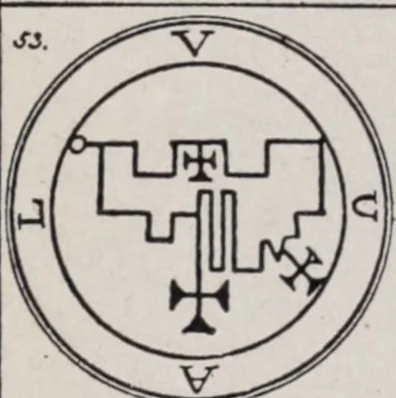
The engraving chooses the ordinary avian stage and gives it the long sword mentioned for the later human form. A compact dark bird stands in profile while the blade cuts a bright diagonal across the pale ground. That combination compresses a transformation into one emblem: bird and weapon appear simultaneously even though the entry introduces them in separate phases.
Le Breton’s composite choice is analytical rather than mechanically literal. The sword lets the small bird carry the adversarial force of the sophist, and its oversized blade makes the figure legible at column width. The Goetia seal beside number 53 offers no bird or sword; it identifies the catalogue position through an independent line design.
Caym and Ars Goetia spirit 53
The Goetia likewise begins with a thrush or bird, changes to a sword-bearing human, places the voice among burning ashes, credits disputation and future answers, interprets animals and waters, and gives thirty legions. Camio, Caim, and Caym are spelling layers around the same inherited record.
The Dictionnaire turns the disputant into an infernal superlative, attaches the Luther story, names a blackbird, and adds a peacock crest and tail. The Goetia expands the heard voices to other creatures and burning coals but does not include the Lutheran reception story. Neither source requires the portrait to merge bird and sword; that is the illustrator’s decision.
Worked comparison: how two phases become one emblem
Make a two-column list headed “bird stage” and “human stage.” The blackbird belongs in the first column; the sword and fiery speaking scene belong in the second. Le Breton places the bird and sword in the same frame but omits the human body and brazier. The familiar online image is therefore a visual synthesis, not a direct snapshot of one complete sentence.
That small mismatch is useful evidence. It shows an illustrator selecting attributes for recognition and page design while the prose retains transformation and sequence. Reading portrait and entry together recovers the sequence that a standalone image erases.