
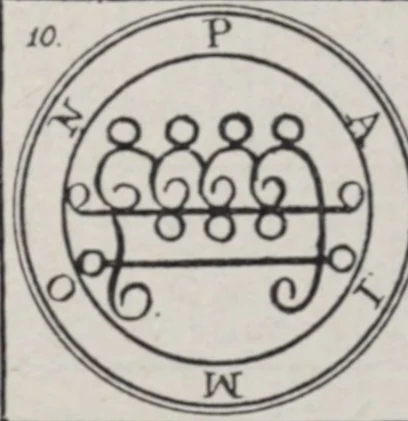
Five goatlike legs radiate from the leonine hub of Buer’s 1863 portrait; Le Breton gives the rolling description anatomy, while Ars Goetia 10 records the offices beside an abstract seal.
- 1863 headword
- Buer
- Ars Goetia
- No. 10 · President
- Legions
- Dictionnaire 50 · Goetia 50
What Collin de Plancy’s Buer entry says
The 1863 dictionary gives Buer one of its shortest but most concentrated notices. He is a second-class infernal president in the form of a five-branched star or wheel that rolls on itself. His offices join philosophy and logic to medicinal herbs, healing, and the provision of good servants. The article closes with fifty legions. Nearly every clause supplies either a visual feature, a field of knowledge, or a practical benefit, leaving little narrative material around the catalogue core.
The wheel image and the list of teachings do different jobs. Shape makes Buer easy to recognize, while philosophy, logic, herbs, health, and service classify what the spirit is said to do. Collin de Plancy preserves that compact catalogue logic instead of surrounding it with the long anecdotes found under Astaroth, Berith, or Asmodeus.
Reading Louis Le Breton’s 1863 portrait
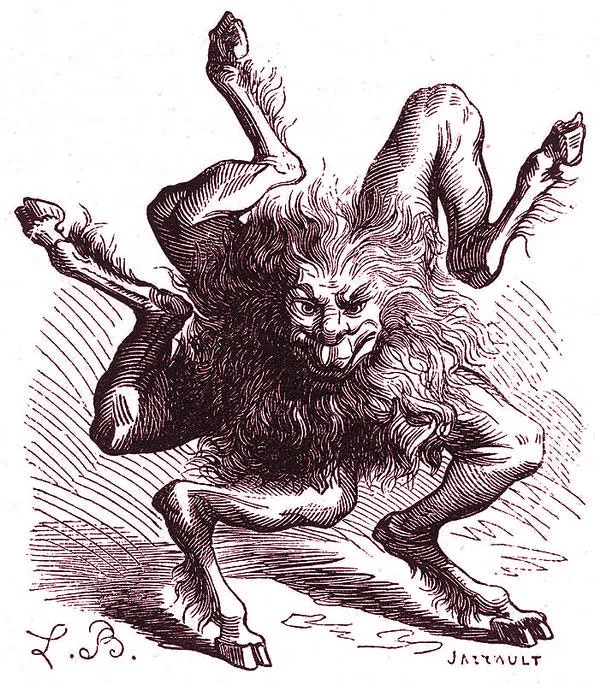
Le Breton makes the verbal wheel literal. Five goatlike legs radiate from a leonine head, each bent so that the creature seems able to tumble around its center. There is no stable top or bottom. The repeated limbs generate motion without a landscape, accessory, or human pose, producing a silhouette that remains recognizable even when the engraving is reduced.
The image is often mislabeled as Buer’s sigil because its radial body resembles a diagram. It is still a creature portrait: the legs have joints and hooves, the center has eyes and a mane, and the whole form illustrates the sentence about rolling. The Goetia seal uses abstract strokes and belongs to a different visual record.
Buer and Ars Goetia spirit 10
Both sources call Buer a president, give fifty legions, and connect him with philosophy, logic, plants, healing, and helpful spirits or servants. The agreement is strong even though the Goetia’s printed passage associates his appearance with Sagittarius without spelling out the five-legged wheel.
The Dictionnaire states the star-or-wheel body directly and calls the attendants good servants; the Goetia edition says good familiars and expands philosophy into moral and natural branches. The difference shows how an image can make a later summary seem more specific than the corresponding English printed description.
Worked comparison: portrait, diagram, or moving body?
Begin with the five repeated legs. If the image were a seal, those marks would function as lines in a sign. In Le Breton’s engraving they carry anatomy: hooves touch an implied ground, joints bend, hair catches the light, and a face occupies the hub. Now compare the prose phrase about a wheel that advances by rolling. Every visual choice develops that physical action.
The exercise separates resemblance from function. Buer’s portrait is diagram-like because the described body is radial, while the Goetia seal is diagrammatic because the book assigns a sign to spirit 10. Their shared black ink and circular balance do not give them the same historical purpose.