Grimoires
The Heptameron’s weekday operations survive in a 1559 print and a Vatican relative, while its Peter of Abano attribution remains doubtful.

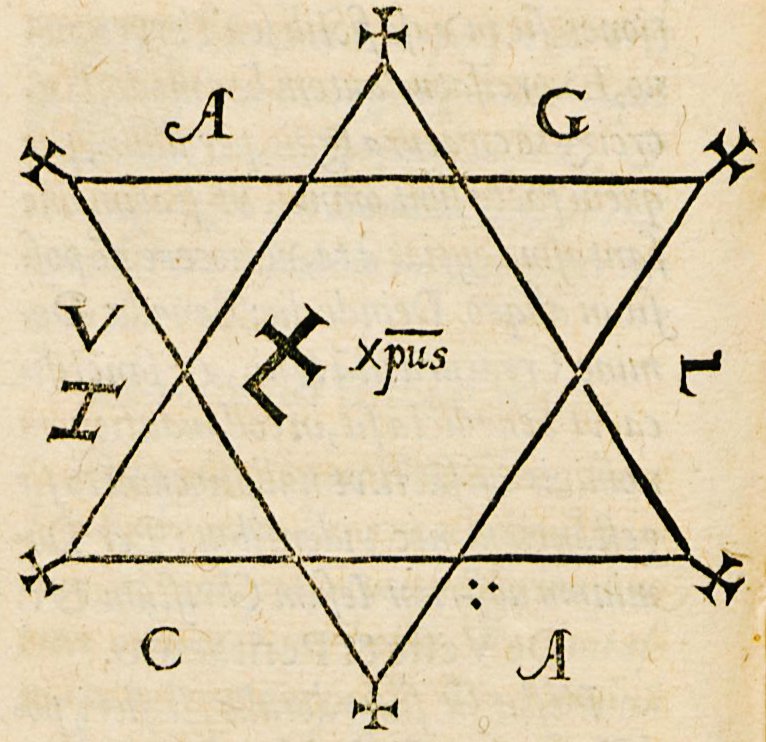
A printed seven-day arrangement
Heptameron describes an arrangement of angelic and celestial names by day, season, and hour, accompanied by formulae and circle diagrams. Its seven-day title is a useful description of the printed organization but should not be mistaken for evidence that every element originated together. Peterson identifies a 1559 printed Elementa Magica attributed to Pietro d’Abano and compares it with later editions. The publisher joined it to a pseudonymous Fourth Book of Occult Philosophy attributed to Agrippa, a publishing context that could make several separate works appear to be one authorized curriculum. Pietro d’Abano was a real medieval physician and astrologer, but this printed ritual text’s attribution to him is not accepted as straightforward authorship. Scholarly reading separates the historical man from the authority his name lent a later compilation.
Manuscript and older sources
A related manuscript titled Elucidarius Magiae, Vatican Reg. lat. 1115, folios 97–114, is dated 1569. Its arrangement differs from the convenient day-by-day form of the print, suggesting that the printed editor did more than reproduce an unchanged manuscript. Peterson traces elements to other Solomonic and astrological works, including the Key of Solomon and the Sworn Book of Honorius. Those parallels demonstrate textual borrowing; they do not give a single precise date for every sentence in the compiled text. Some older bibliographic claims of very early Heptameron printings have not been verified with surviving copies. The known 1559 edition and 1569 Vatican manuscript show the tradition at two different stages.
Worked example: why the circle changes
The text explicitly treats its circle as variable. For a selected operation, the bands are meant to identify the hour and its angel, the angel ruling the weekday and its ministers, the current season and its rulers, the head of the seasonal zodiac sign, and seasonal names for the earth, sun, and moon. A printed example for the first hour of Sunday in spring is therefore an instance of a rule, not a universal circle ready for every day. Shift the example to a Friday hour in autumn and several inscriptions must change even when the concentric geometry remains. The daily chapters add another layer by supplying the angels, winds, perfumes, and appearances associated with each weekday. This is how the compact text works: preliminary blessings and preparation establish the frame, the calendar generates the circle’s labels, and the day section supplies the addressed hierarchy. An image reposted without its day and season preserves the outline while discarding the information the outline organizes.
Reading its celestial language
The work’s planetary and angelic labels can look like an astronomical data set, yet they are part of a historical ritual taxonomy, not modern measurements or a validated forecast. Names may change across a manuscript, a Latin print, Turner’s English version, and later occult reuse. Circle illustrations can change as well. One day’s names, surrounding rubric, and diagram can differ between versions. Such differences reveal editorial choices and translation history more reliably than a claim that a single arrangement is timelessly correct. The printed daily sequence links timing, names, spatial diagrams, suffumigation, and conjuration within one ceremonial narrative, even where a manuscript orders the material differently. Its compact tables made the material easy to excerpt. Later compilers could retain a weekday angel while dropping the variable circle, or reproduce the circle while changing the formula around it. The Heptameron’s influence therefore often travels in modules rather than as an unchanged whole.
Questions to explore
- How does the manuscript arrangement differ from the 1559 print?
- Why did the printed weekday sequence become easier to excerpt?
- What does the Pietro d’Abano attribution add to the book’s claimed authority?